
Test of economical summer tires from Motor — 2025
During preparations for a new tire test, the Polish magazine Motor slightly changed the selection of participants, and this time it was decided to take tires with low rolling resistance, which help reduce fuel consumption. Experts looked for tires with an "A" rating for economy on the Euro label and the maximum possible rating for traction on wet pavement, and as a result, six models with "A/A" ratings were found. Some of them, such as Continental UltraContact NXT, are novelties, while others, for example, Bridgestone Turanza T005, are already leaving the market. Bridgestone has already released the Turanza 6 tire, but it is not offered in the "A" class for fuel efficiency.
Also tested were Falken Ziex ZE310 Ecorun, Goodyear EfficientGrip Performance 2, Michelin e.Primacy, and Nexen N'Blue S, and the seventh participant was the Chinese Prinx XLAB Comfort EV, which was the only tire in the test with a "B" rating for traction on wet roads.
The tests on dry and wet asphalt were conducted last autumn at a polygon in Germany, and the efficiency tests were carried out in a laboratory there. The tests took five days, and the weather was stable and optimal for summer tire testing: the temperature was around 24°C with a light wind and no precipitation.
Since eco-tires were chosen, it was decided to use an electric vehicle as a test bed, and the Nissan Leaf was used in most tests. Only in the tests for braking efficiency on wet pavement and resistance to longitudinal aquaplaning were the tires installed on a specially prepared Skoda Octavia. The chosen tire size was 205/55 R16.
Wet asphalt
The braking distance on wet pavement was measured from 100 km/h, and Prinx needed 18 meters more to stop than the leader (Continental), which is an unacceptable result. The other tires did not have any problems.
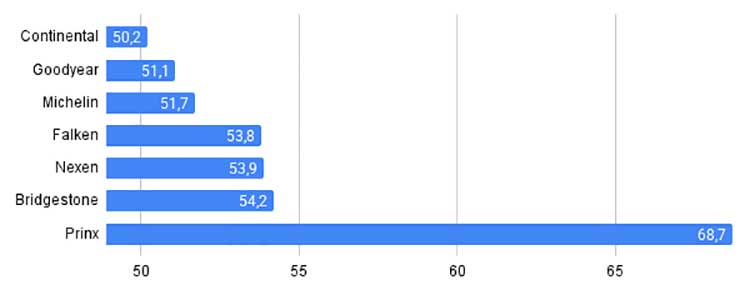
On the circular track, where the resistance to lateral skidding was evaluated, Continental was again the best, followed by Goodyear with a minimal gap. The Prinx tires lagged behind the other participants, but not as significantly as in the previous discipline.
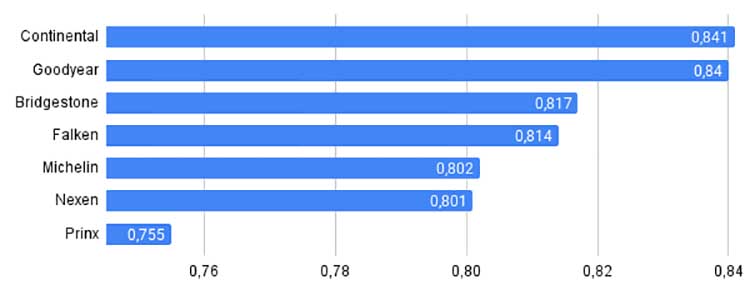
In the handling tests, Continental allowed the best lap time, and Prinx worked noticeably worse than the other tires.
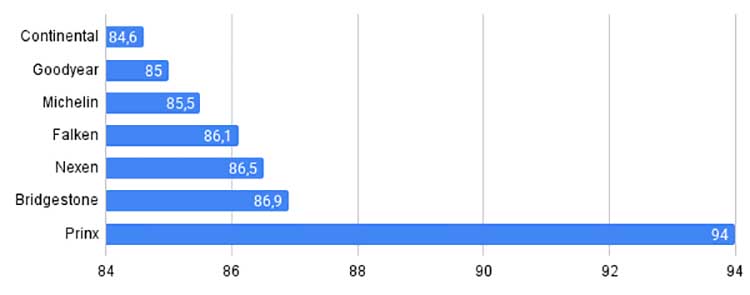
In the test for resistance to longitudinal aquaplaning, the first place went to Nexen tires, and the last places were taken by Michelin and Prinx, which, however, do not pose a safety hazard.

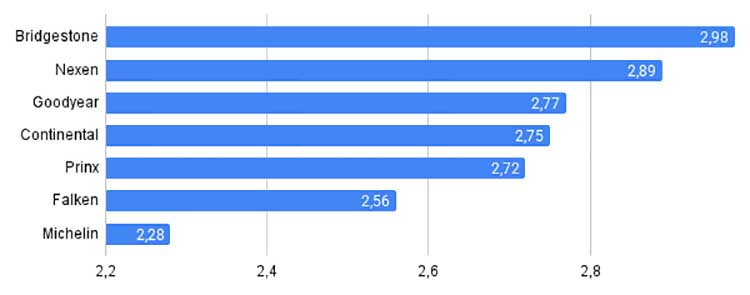
In the test for resistance to transverse aquaplaning, Bridgestone and Nexen were the most effective, and the result of Michelin was called disappointing.
Dry asphalt
On dry pavement, the differences between the tires decreased, and all of them were able to quickly stop the car, with Michelin and Falken being the best in this discipline.
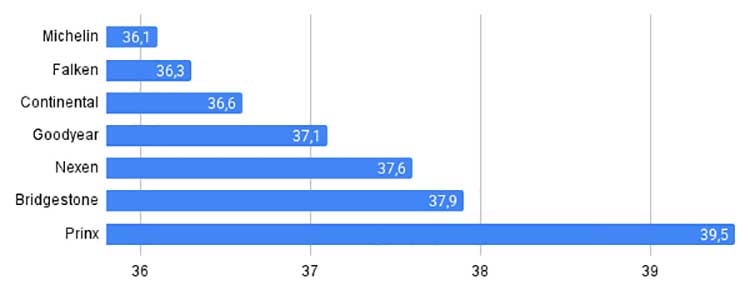
The pilot passed the winding track the fastest on Continental, and Goodyear, Falken, and Bridgestone also showed very good results, but the other tires only slightly lagged behind the competitors.
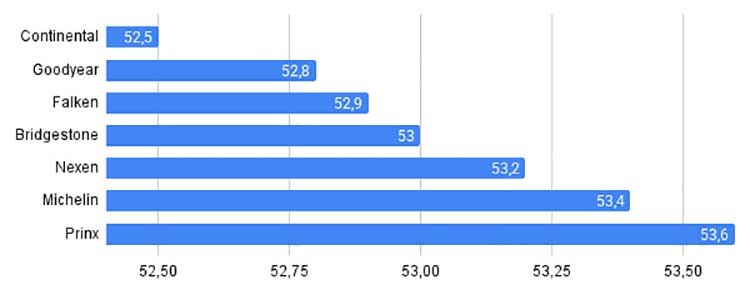
The tires were also given subjective evaluations for their behavior on dry asphalt, and the pilot noted that the most accurate reactions to steering wheel actions were provided by Continental, but the properties of Nexen on the last line were also at an acceptable level.
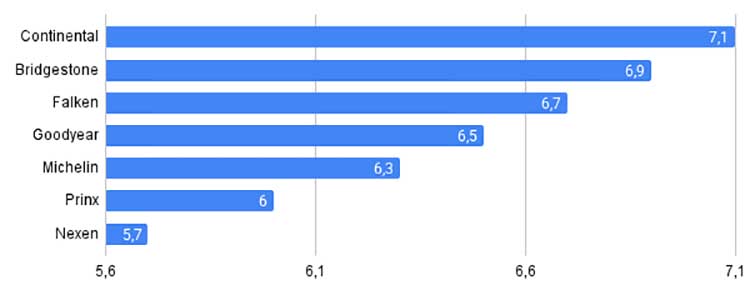
The best ratings for comfort were received by Continental, Goodyear, and Michelin, and the worst in this parameter were Prinx.
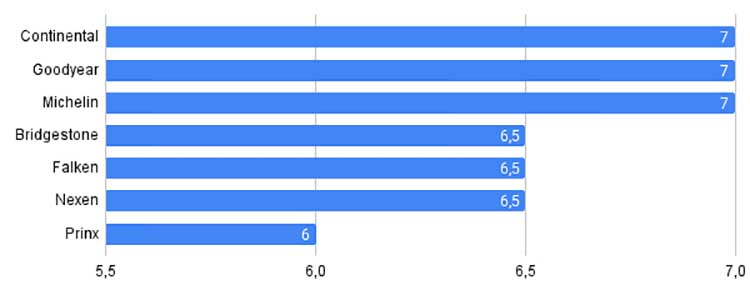
The rolling noise was measured outside the car at 50 km/h, and Goodyear was the quietest. Bridgestone took the last place, but they "do not create excessive noise in the cabin."
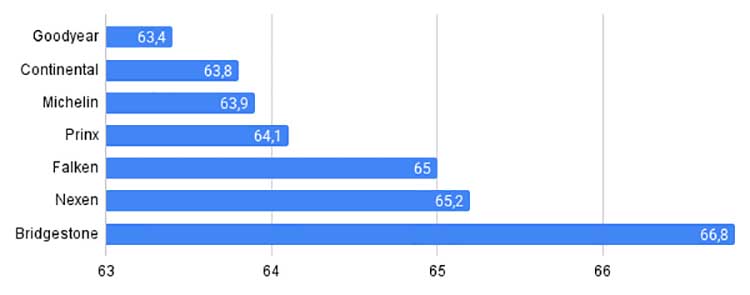
The rolling resistance was measured using a drum stand. According to the experts, Michelin and Continental have simply sensational indicators, while Nexen and Bridgestone performed very well, and the results of Falken, Continental, and Prinx were also quite good.

Test results
The winner of the test was the Continental UltraContact NXT tire, which was the best on both dry and wet surfaces, including due to very accurate reactions to steering wheel turns, and only in the rolling resistance tests did it show an average result. The second place went to Goodyear EfficientGrip Performance 2 tires, which lagged behind the leader by less than one point. On dry and wet asphalt, Goodyear slightly yielded to Continental, but they have very low rolling resistance, which means they are economical tires that provide a high level of safety. In turn, Michelin e.Primacy tires performed well on the dry track, and they also have excellent energy efficiency, but they lost points in the wet pavement tests.
Although Bridgestone Turanza T005 tires are already being replaced by new-generation tires in most sizes, they still perform very well in tests due to the lack of obvious drawbacks and predictable behavior in any conditions. At the same time, Falken Ziex ZE310 Ecorun tires (which are also being phased out, as the Ziex ZE320 model has been released) received the same number of points, and this, according to the testers, confirms that modern mid-range tires are increasingly able to compete with premium products. In the test, Falken performed well in all disciplines, which indicates balanced characteristics.
Nexen N'Blue S tires did not cause any complaints, as they work well on wet pavement and effectively counteract aquaplaning. On dry asphalt, Nexen also provides the necessary level of safety, and in addition, they have low rolling resistance, and in the test, they were also the cheapest.
Claims arose only with Prinx XLAB Comfort EV tires, which performed very poorly on wet pavement, where they had unacceptable handling and braking distance. On dry asphalt, the results are average, the rolling resistance is the highest among the tested tires, and in addition, Prinx was more expensive than Nexen, so the price is definitely unjustified.

Source: magazynauto.pl. Photo: Robert Magdziak / Motor