
Signs of the best snow tires
Winter tires are traditionally subject to the highest requirements for passability on ice and snowy roads. Since these are opposite road conditions in terms of characteristics, the technologies that solve them should also be different. Studded tires are rightly considered the most passable in snow, as they don't have to be quiet and comfortable. Studded tires have one task - to be the most effective in winter conditions. However, as practice shows, this is not always the case. That's why when choosing tires, you should pay attention to both the tire as a whole and to each technology separately.
The negative profile of the tire is responsible for passability in snow. This is the combination of all the channels and lamellas that, in turn, grip the snow. In this case, a lot depends on what kind of snow we are dealing with, but nevertheless, the deeper and "angrier" the tread pattern, the more passable the tire. A distinctive feature of high passability in deep snow is the shoulder area of the tire. If the tread blocks are arranged with different projections, forming something like "saw teeth", then this will provide not only better passability in snow but also significantly improve the car's passability when rebuilding on a winter road, where snow grooves often form between traffic lanes. This design solution allows for more effective overcoming of snow.
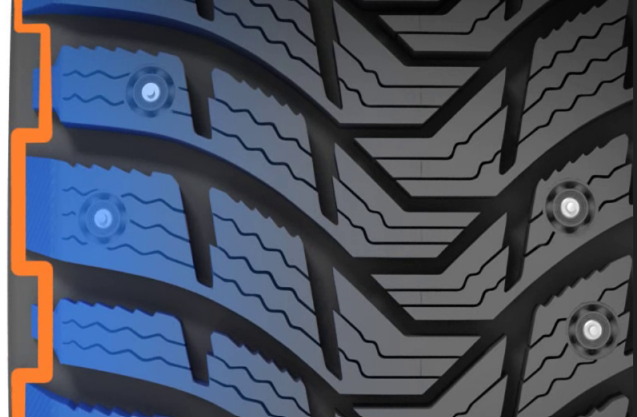
Of course, this does not mean that tires without such a feature are weaker. A tire is a compromise of characteristics, and when one characteristic is improved, others may suffer. In this case, it's not very obvious what characteristics may suffer, but there are also less obvious characteristics, such as rolling resistance, noise, or resource.