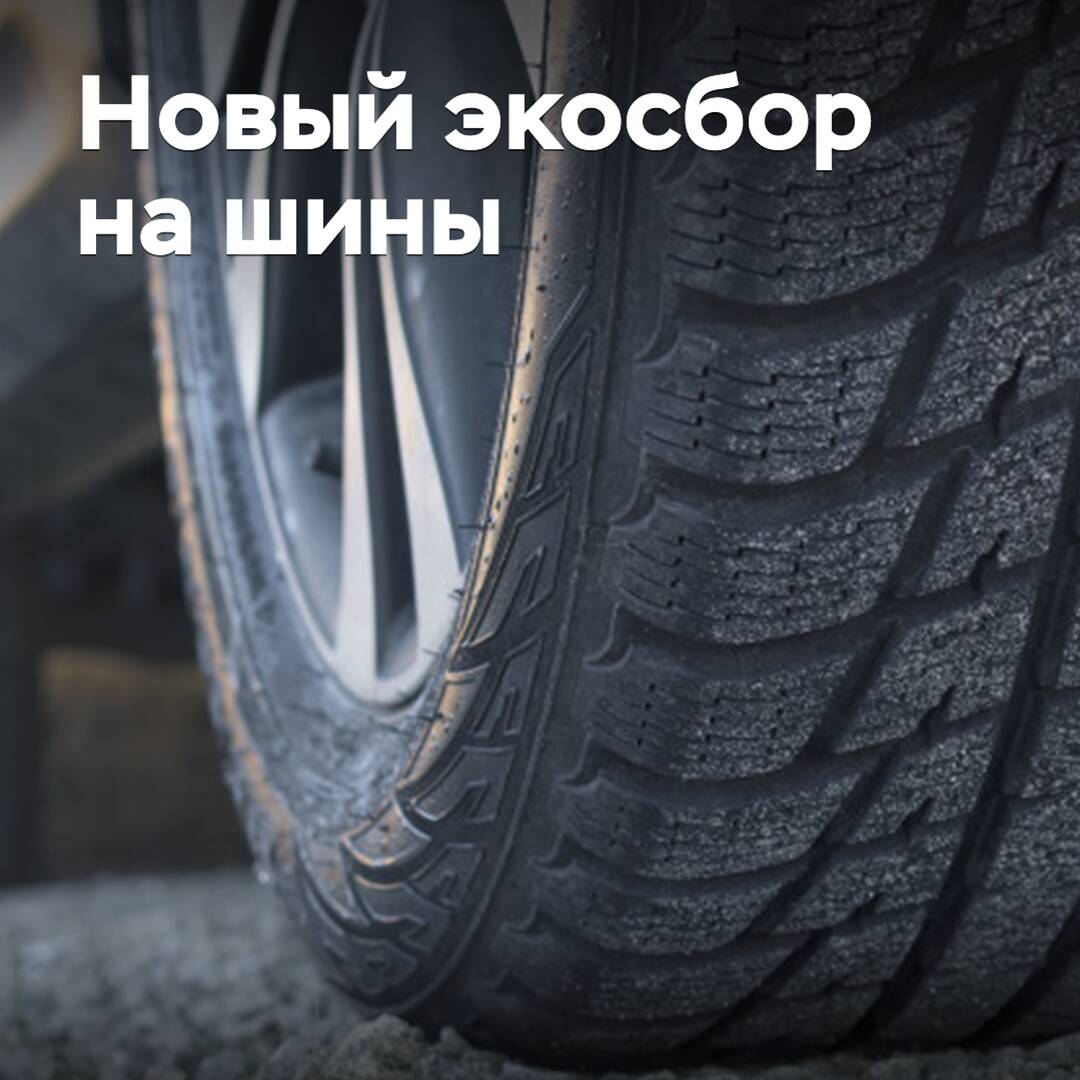
New Eco-Fee on Tires: What is it for and How will it Work
As early as January 1, 2026, Russia plans to introduce a new eco-fee on tires, which, according to the Ministry of Industry and Trade, should remove carcinogen-unsafe tires from the market.
"The eco-fee rate will increase for market participants who only sell carcinogen-hazardous tires that exceed PAH (polycyclic aromatic hydrocarbons) and require special, more complex technological processing," said Deputy Minister Mikhail Yurin, according to TASS.
At the same time, experts are convinced that, in fact, the reason for the emergence of the new fee is to limit the rapidly growing volume of cheap Chinese imports in support of domestic manufacturers. "This measure has no relation to the quality of tires, real carcinogenicity, or the presence of these substances in Russian or Chinese products. This is a measure of customs and tariff regulation," said Anton Shaparin, Vice President of the National Automobile Association.
"Our domestic producers find it difficult to compete with players from the PRC, who have gained access to our market. Accordingly, the government has come up with a way to combat this Chinese dumping: they need to make it more expensive. How? The utilization fee for tires exists, but it is minimal. So, an eco-fee will be introduced," Shaparin is quoted as saying by the publication "Kommersant".
The fact that the expert's opinion is true is also indicated by the fact that Roskachestvo recently published the results of tests for carcinogens in tires, and, essentially, a comparison was made of tires produced in China and Russia. As a result, all tested Chinese tires were found to have increased content, unlike all the Russian-made tires studied, which, as emphasized in the department, "demonstrates a systemic problem in the budget segment", while "leading domestic manufacturers, focusing on export requirements, have already switched to safe recipes that meet strict standards".
The Ministry of Industry and Trade says that earlier they agreed on a government project to revise the calculation of the base rate of the eco-fee, which applies to tires and tires for passenger cars, trucks, buses, trolleybuses, motorcycles, quadricycles, and mopeds. The definition of the carcinogenicity of tires is fixed in the new GOST R 51893-2024, which came into force on September 1, 2025.
In the supporting documents for the draft government decree, it is stated that currently, only 11% of Russian tires do not meet the requirements of the new GOST, while among imported tires, this level reaches 40%, according to Izvestia.
"The measure will mainly affect the budget segment of Chinese tires. This is done to increase the load on domestic productions within Russia," says auto expert Oleg Moseev. "We see that all the measures that the government is taking are aimed at giving maximum opportunity to produce and sell products localized within the country".
Earlier, the General Director of Ikon Tyres, Andrey Pantiukhov, said that currently, the most serious problem for the Russian tire industry is the growth of Chinese imports in the absence of protective measures by the state. "We are working on this now, and we will come up with new proposals to the government and the EEC, so that protective measures can be taken," he noted.
"Izvestia" writes that currently, the eco-fee per ton of tires is around 185,000 rubles (the base rate of 10.3 thousand multiplied by the complexity coefficient of disposal of 18). Next year, the base rate will increase to 11.1 thousand, and for tires without a safety certificate, an additional increasing coefficient will be introduced.
The publication cites the words of the owner of the network of commercial vehicle dealer centers "Alliance Traks" Aleksey Ivanov, who says that "as a result, the eco-fee per ton of uncertified tires may reach 389,000 rubles - this is more than a twofold increase. For the importer, the difference will be around 200,000 rubles per ton of tires".
According to his calculations, for a standard set of passenger tires weighing about 35 kg with a safety certificate, the eco-fee will be approximately 3.3 thousand rubles, and without it - 6.6 thousand rubles. In the segment of tires for crossovers and SUVs, which are heavier, the difference will be 5-5.5 thousand rubles.
"Producers and importers who currently produce safe products will be able to quickly obtain GOST R 51893-2024 certificates and will not face increased costs," Ivanov says. "And those who work with cheap Asian tires of questionable quality will either leave the market or be forced to raise prices".
Vyacheslav Fetisov, First Deputy Chairman of the State Duma Committee on Ecology, Natural Resources, and Environmental Protection, Chairman of the All-Russian Society for Nature Conservation, earlier emphasized that "for the overwhelming majority of car owners and honest businesses, the possible introduction of an environmental fee will pass almost unnoticed".
"The Russian tire industry is fully ready for new requirements. Our plants are already producing tires that meet the strict GOST, fully covering the market demand. Consumers will still have a wide choice of safe tires in all price segments," he said.
Photo: imperial.ac.uk