How Bobruisk tires are tested
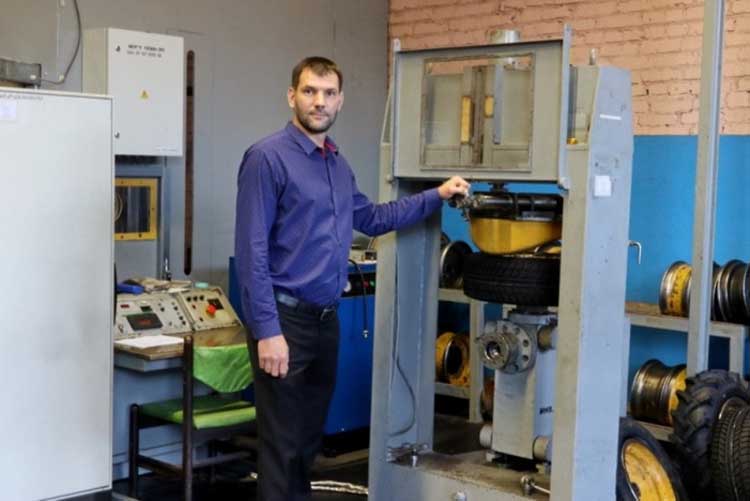
Tires must be designed, manufactured, and ultimately sold, but there is another important stage in the production and sales chain, namely testing, and how tires are tested at the Belarusian JSC "Belshina" was told by the head of the laboratory of certification and stand tests of the engineering and technical center of the company, engineer Maxim Manko.
Tire testing is divided into two types: static and dynamic, and in the latter case, a running drum is used. Some tests last only an hour, while others last continuously for up to two weeks, as a result of which the laboratory employs about 50 people, and the process does not stop for a minute.
"The parameters for which tires are tested are a whole list," says Manko. "This is compliance with GOST for basic dimensions, wear indicators, maximum speed, and others. And it is also known that tires affect fuel consumption, and in this regard, our specialists check them for fuel efficiency. For this, tests are carried out to determine the rolling resistance coefficient (in accordance with UN Regulation No. 117). As a result, a letter designation - A, B, C, D - is assigned to the tire with a certain class. In simpler terms, the lower the resistance, the less fuel is consumed."
Passenger tires must "travel" from 20 to 24 thousand km at 90 km/h, i.e., tests take almost two weeks under loads that are one and a half times higher than "economical". In addition, tests are carried out on the performance of the shoulder area and sidewalls, and here the load is even greater - 160-200%, which the tire must withstand for 90 hours. There are also less lengthy tests, for example, for 60 minutes, during which the speed is gradually increased to the maximum declared, and if no defects are found, the test is passed.
"Belshina" is also known for its large and super-large tires, which are tested according to separate methodologies. KGS, depending on the application, must pass from 2 to 5 thousand km at 10-40 km/h, and in the tests of the largest tires, one of the main indicators is TKVCH (tonne-kilometers per hour). According to it, you can understand what volume of work the tire can perform without overheating, and the tests are carried out within three days with temperature measurement in the sub-shoulder layer.
According to Manko, tires are also tested using water, which assesses their strength under the influence of internal pressure. The tire is filled with water until it breaks, and, as they say at "Belshina", in the case of their tires, the pressure for this should be at least seven times higher than the maximum allowed.
"Now, new models of passenger tires - PS-101, PS-102, PS-103 - are being prepared for serial production. And also their winter version of the PW-101, PW-102 series," Manko said. "These are premium-class products. Even the slightest mistake is unacceptable. However, as always in our work. And I am confident in my employees."
It was previously reported that "Belshina" is preparing to enter the premium segment, and the new tires, as the company's general director Alexander Kovalenko said, will be named Belshina Artmotion Premium and Artmotion Premium Snow.
Source: "Shinnik". Photo: "Shinnik" and "Vestnik Belneftekhim".