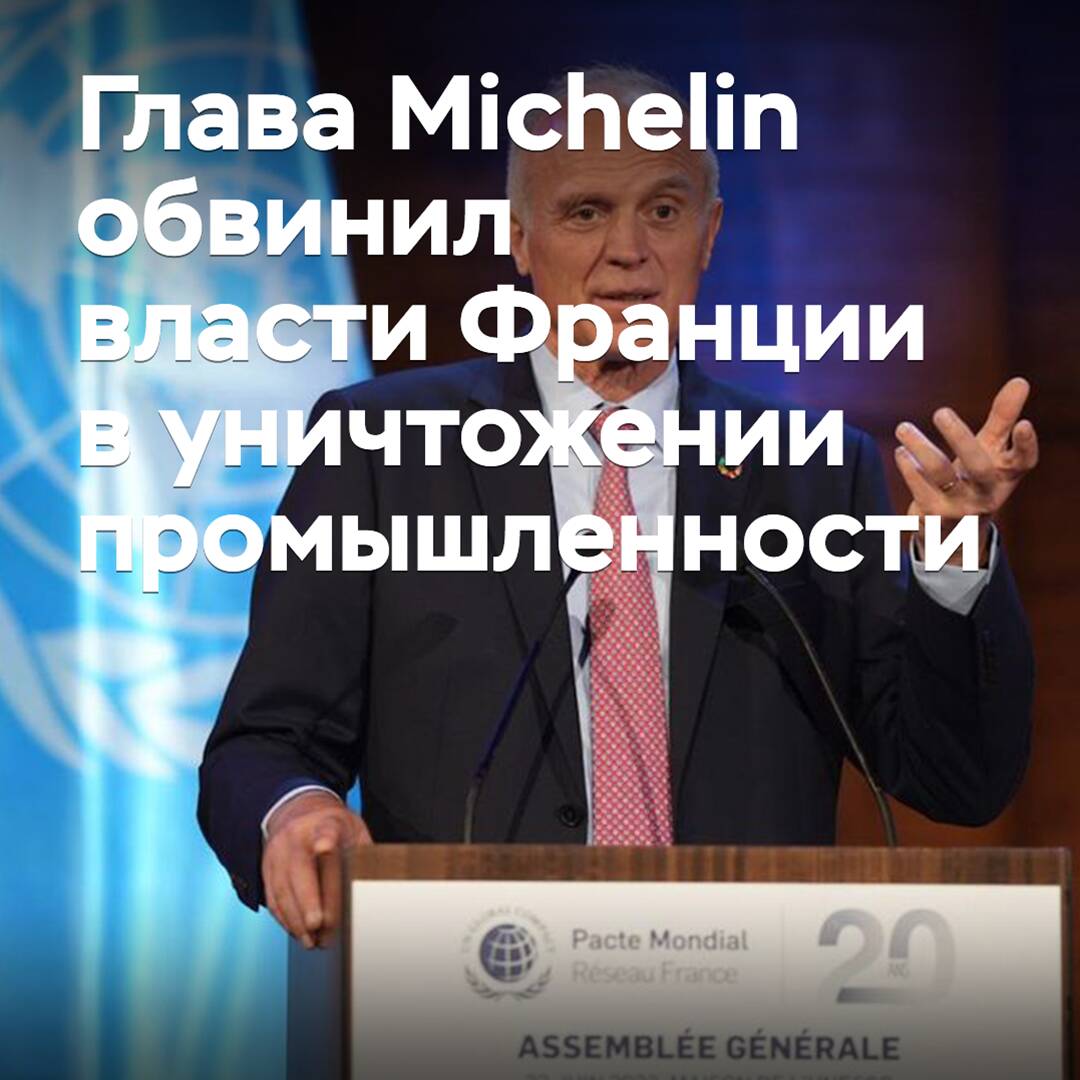
Michelin Head Accuses French Authorities of Destroying Industry
The managing chairman of Michelin, Florent Menegaux, stated in an interview with Bloomberg that France is destroying its industry with excessive taxes and clearly hinted that the company may move its investments to other countries.
"You're killing the country's economy when you set taxes that are much higher than in other countries," he pointed out. "Currently, direct and indirect taxes in France are the highest in Europe. It's not worth waiting for businesses to swallow all this."
According to Bloomberg, the French budget for 2025 provides for additional revenue of 8 billion euros through a temporary increase in corporate taxes and an increase in the rate for buying back shares as part of a package of measures to reduce spending. In addition to Menegaux, other leaders of major companies are also warning that the prolonged political crisis is slowing down investments and job creation.
High taxes, combined with a decline in demand in the automotive sector, have already forced Michelin to decide to restructure its production facilities in France, Germany, and Poland.
According to Menegaux, production costs in Europe are twice as high as in Asia, and the gap has grown significantly since 2019. In the region, industrial holdings face such problems as high electricity and labor costs, as well as bureaucratic delays, and the situation is exacerbated by the growing likelihood of a trade war related to the threats of US President Donald Trump to impose new tariffs.
"We need to wait and see what happens next, but the mechanisms operating in a globalized world are very complex," Menegaux noted. "If new tariffs appear, it will be very, very difficult to understand what the consequences will be. Perhaps the prices of tires for American consumers will rise."
Under these conditions, Michelin has focused on developing outside of France, as well as investing in high-margin sectors, including the production of tires for the mining, aviation, and agricultural industries. The company is also continuing to diversify its business, for example, by entering the markets for inflatable tents for the army and textile products for the space industry, and is also working on a new adhesive material that does not contain harmful substances. Another direction is medicine, and the purchase of a number of assets has already allowed Michelin to create a biocompatible material for implants and regenerative medicine.
Since the situation on the key markets for Michelin remains uncertain, the company is looking for opportunities to acquire new assets in Italy, where there are many family-owned niche enterprises, and particular attention is being paid to medium-sized businesses that have difficulties with management succession.
"Most often, these are very well-managed companies that already export outside of Italy," Menegaux noted. "In Italy [where the company already has two plants], we have a lot of interest, since their economy has been less affected than in Germany, France, and Spain."
Michelin does not exclude large-scale acquisitions, and Menegaux emphasizes that the company has significant own funds with a low level of debt, which gives it such an opportunity. "Without turning to the market for help, we can attract up to 10 billion euros to do what we want," he said.
According to the head of Michelin, the competition laws in Europe "need to be revised to allow cross-border deals that can strengthen market players in the face of tough competition from Asia". "The tire industry remains a fragmented industry, and it needs consolidation," he added.
Regarding the likelihood of multi-billion dollar mergers with such European competitors as the German Continental, Menegaux noted that "there are no such projects at the moment, but we are open to all options".