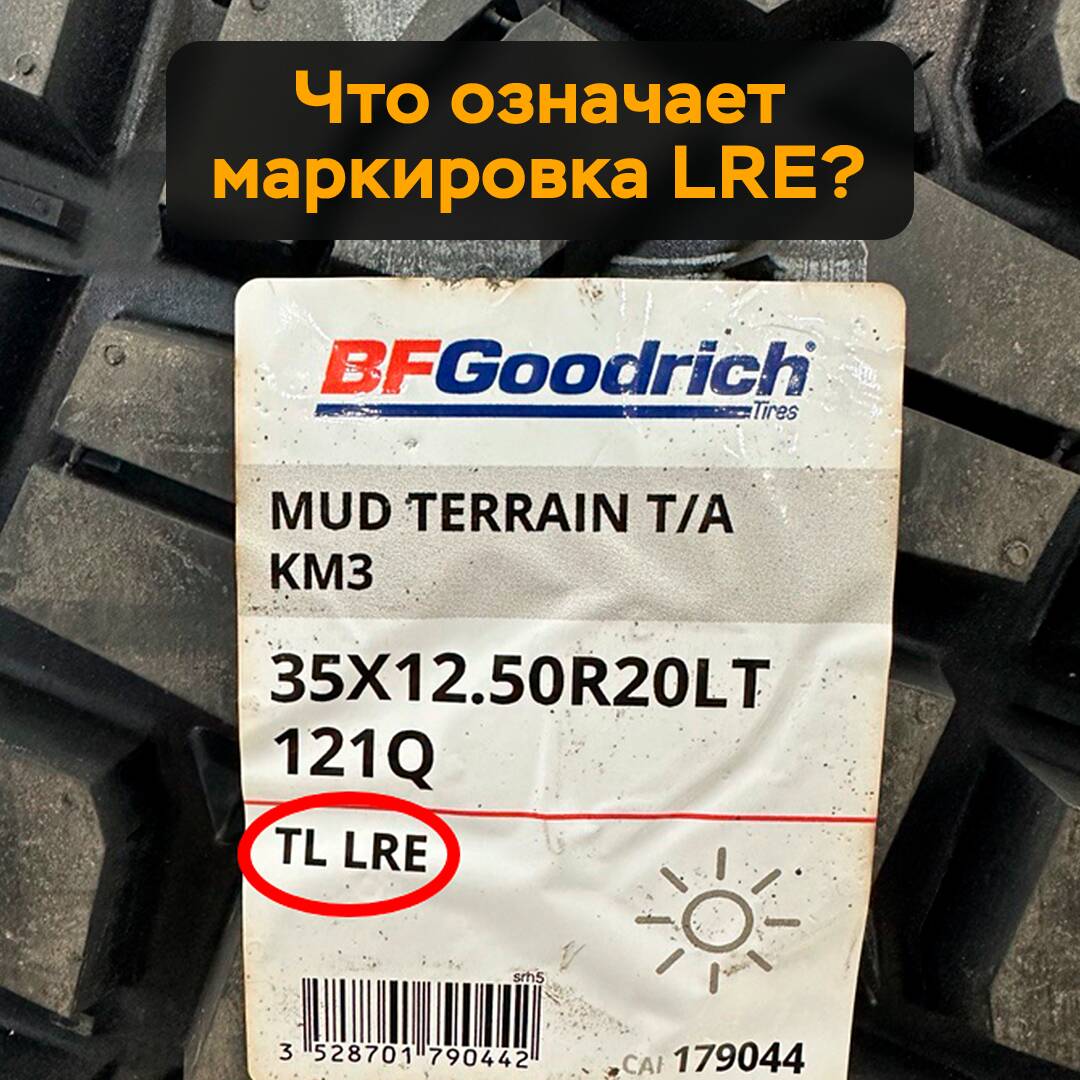
What does the LRE marking mean?
In the USA, everything is a bit different. Tires, of course, are no exception to this rule. Since tires produced for the US market often appear on our shelves, it's essential to understand, or rather, be aware of their peculiarities. This is especially true for markings. If you see the letter designation DOT on a tire, it means there is a standard set of markings, such as the composition and expected lifespan of the tire. However, you may also come across a marking like the layering norm. Today, we'll tell you about it.
A pneumatic tire must withstand the weight of the vehicle and internal air pressure. In the early days of the tire industry, the reliability of a tire was invariably associated with its thickness. The thicker it was, the more reliable it was. Logically and understandably. So, how to denote the ability to carry a load in a way that's understandable to others? The number of layers was simply indicated on the sidewall under the "PR" marking. For example, the designation "PR4" implied 4 layers of cord, and "PR8" corresponded to 8 layers.
The materials used today are much stronger, so they require fewer layers to withstand the same air pressure and load. This reduces friction, reduces the weight of the tire, and improves rolling resistance.
Most tires currently produced have only 1-3 actual layers of cord, which corresponds to 10, 12, or 14 layers according to the old standard. The tire is identical, but it has fewer layers, so it cannot be marked with the expected number of layers, only the actual one. That's why the Load Range (LR) marking was introduced. This letter expression indicates not the number of layers, but the load that the tire can withstand according to the old standard. For example, a tire with a load range of B (LRB) is designed for 4 layers, not 4; LRC is designed for 6 layers, and so on.
Load Range rating based on layering
LRB - 4
LRC - 6
LRD - 8
LRE - 10
LRF - 12
The conclusion is simple. Don't bother yourself with this) The layering norm is an old American marking, understandable for an American buyer. For our consumer, it's essential to understand the load index and speed index and ensure they match the vehicle.