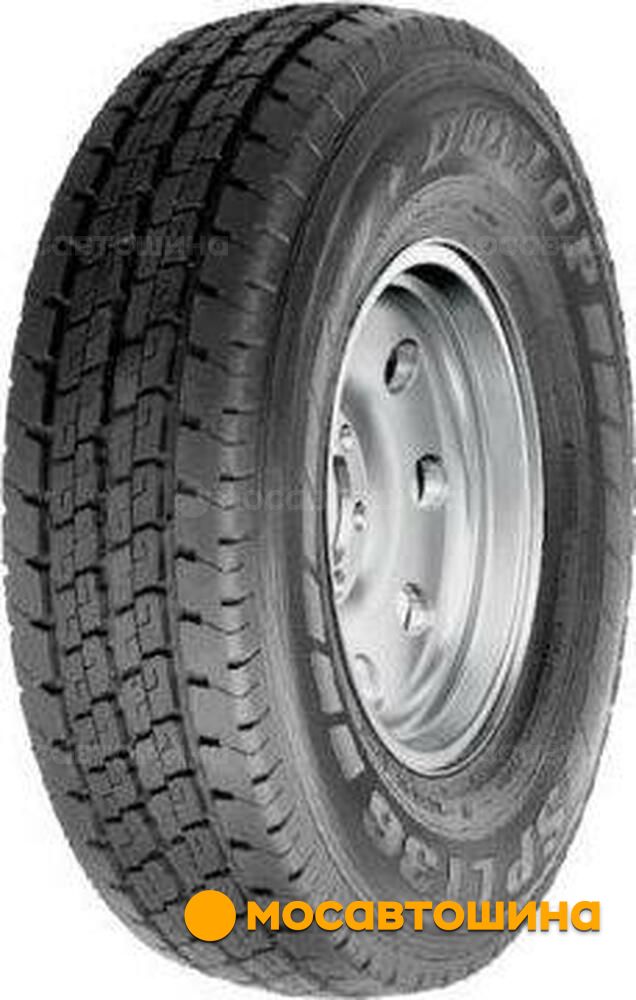
The Dunlop LT 36 passenger tire stands out for its somewhat specific application area. It is designed to be installed on any axle of light trucks and buses. At the same time, the universal tread pattern and elastic rubber compound provide the possibility of operation not only in the summer but also in the winter.
4-ribbed tread design
The tread pattern of this model features four longitudinal ribs separated by wide drainage grooves. The central ribs consist of two rows of double tread blocks of a polygonal shape. Since they are stretched along the direction of movement, this has significantly improved the directional stability and reduced rolling resistance.
The large number of tread blocks has allowed the contact patch to be saturated to the limit with a multitude of edges of adhesion. As a result, the tire demonstrates excellent traction properties. Moreover, they remain at a high level even on winter coatings, thanks to the large distance between the blocks, which has given the tread good self-cleaning abilities.
Long service life
In contrast to the central part of the tread, each shoulder zone is a solid structure. The absence of any breaks throughout their entire length has allowed these tread elements to be given high rigidity. This has optimized the distribution of external pressure over the contact patch, thanks to which the tread has acquired increased resistance to uneven wear, thus extending the life of the tire. Additionally, the reinforced construction of the shoulder zones has had a beneficial effect on handling, especially when performing sharp maneuvers. The rigid shoulder zones of the Dunlop SP LT 36 are noticeably less prone to deformation changes, which has allowed the contact patch to be given a practically rectangular shape, as well as ensuring its stability regardless of the characteristics of the road surface and driving mode.
The second component of the long service life was the rubber compound. Thanks to the inclusion of special components in its composition, the tread has become much more resistant to abrasive wear. Moreover, the rubber compound remains elastic even at negative temperatures, which has provided the tire with the possibility of operation in cold weather.
Excellent resistance to aquaplaning and slushplaning
Thanks to the block structure of the tread pattern, the tire has a very developed drainage system, consisting of three longitudinal and numerous transverse channels. At the same time, their dimensions allow them to drain not only water but also more heavy masses of meltwater from the contact patch. Thanks to this ability, the tire stands out for its increased resistance not only to aquaplaning but also to slushplaning.
Low noise level
The presence of a large number of separate tread elements required the use of a whole range of solutions aimed at reducing the level of noise generated by them. One of them was the multi-stage arrangement of the blocks of the central part of the tread and its shoulder zones. Thanks to this, the specialists of the English company were able to significantly reduce the level of resonant noise, which significantly increased the level of driving comfort.
Main features of the Dunlop SP LT 36 tire
- the original S-shaped symmetrical non-directional tread pattern provides good traction properties, both on highways and on dirt roads;
- increased load capacity and resistance to uneven wear, thanks to the optimized distribution of external pressure over the contact patch;
- the 4-ribbed structure of the tread pattern provides good directional stability;
- excellent stability when maneuvering, thanks to the reinforced construction of the shoulder zones, which has made this part of the tread very rigid.
 Enlarge