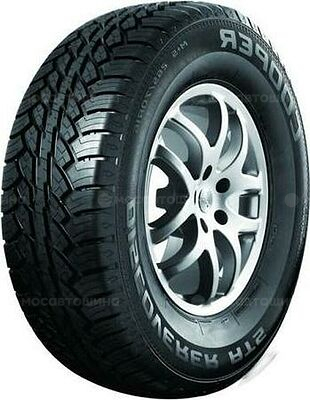
Cooper Discoverer ATS — not just an "all-season" tire, but a balanced solution for those who drive their vehicle both in the city and off-road. The tire provides confident overcoming of light off-road conditions without compromising comfort on asphalt. The main advantages: reliable contact with the surface and excellent traction in any conditions.
Asymmetric Tread Structure
The manufacturer applied an asymmetric non-directional pattern here — a key technical solution. The outer side is responsible for grip on dry pavement and handling, the inner side (with more aggressive lugs) — for evacuating mud and snow. The tread consists of several rib structures, the central one of which is made monolithic. Due to the numerous active gripping edges, the contact patch remains dense and continuous even on uneven surfaces.
Reinforced Shoulder Area and Rubber Compound
For heavy off-road vehicles, the strength of the sidewall and "shoulders" is critical. Here, the shoulder area is specially reinforced — the thickness of the rubber layer is increased and an additional cord layer is used. This eliminates cuts when driving onto stones, curbs, and roots. As for the compound, a modernized composition of the rubber mixture with a package of additives and thermostabilizers is applied. This provides high rigidity of the lugs at any temperature and resistance to abrasive wear.
Key Features of Cooper Discoverer ATS:
- audience — four-wheel drive off-road vehicles and pickups used in the city, on highways, and light off-road;
- non-directional design with asymmetry — continuous contact with the road, high traction and passability without compromising handling at speed;
- improved handling on wet pavement — deep grooves and channels quickly evacuate water, minimizing aquaplaning;
- special compound — increased resistance to uneven and abrasive wear, protection against mechanical damage.
 Enlarge
 Enlarge
Approximate calculation.
Credit amount from 2 000 to 300 000 rubles.
Initial payment from 0% to 90%.
Loan term from 3 to 36 months.
The interest rate is calculated individually.
Read more