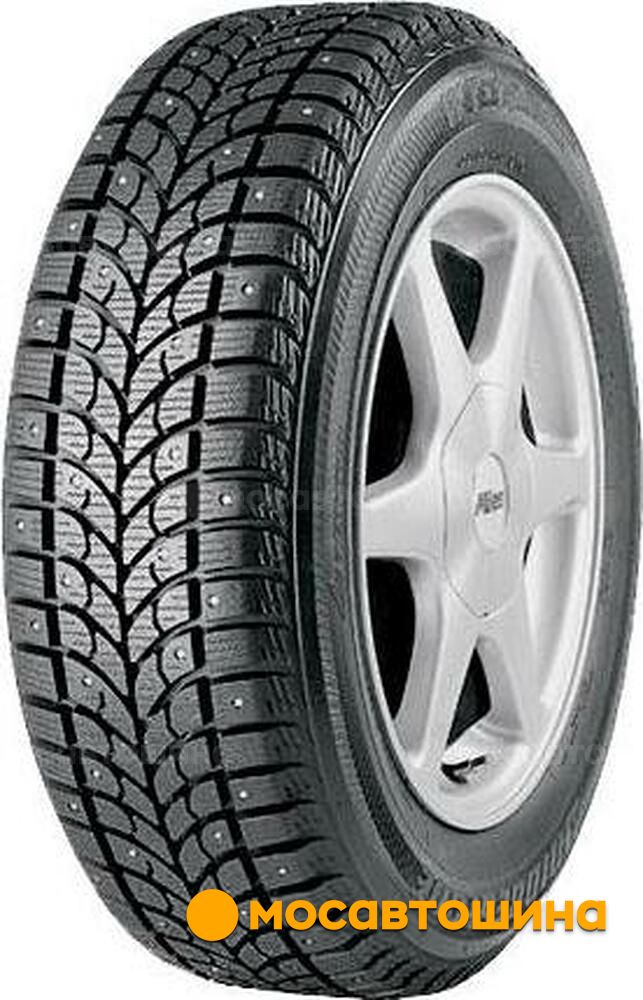
Having appeared on the domestic market, the Bridgestone WT17 winter tire for passenger cars has become popular. This is due not only to its price, which is more attractive than that of most European analogues, but also to its balanced operational properties. This model has no obvious "weak points", which is a "trademark" feature of all Bridgestone tires and is achieved through the use of three-dimensional modeling technologies in development. These technologies were also applied in this tire.
Numerous tread blocks
One of the key features of the tread design of this tire is the increased number of blocks, which are also small in size. With this solution, Japanese tire makers were able to significantly increase the number of contact edges, and thus improve snow traction. The trapezoidal shape and arrangement at an acute angle also reduce rolling resistance and noise levels.
Several thousand contact edges and spikes
Most of the contact edges of this tread are formed not by small blocks, but by lamellas cut into them. The total number of these lamellas is several thousand. In combination with spikes that form 8 rows during movement, this provides the model with very reliable and stable traction on rolled snow and ice.
Main features of the Bridgestone WT17 tire
- a large number of small blocks improves snow traction;
- low rolling resistance and high acoustic comfort are achieved due to the multi-stage and longitudinal arrangement of most tread blocks;
- reliable and stable traction on rolled snow and ice is ensured by several thousand lamellas and spikes, arranged in such a way that they form 8 continuous "anti-skid chains" during movement;
- the open design of the shoulder areas with numerous transverse blocks improves snow passing ability, prevents skidding in turns, and reduces the braking distance on slippery surfaces.
 Enlarge