
-
 Enlarge
 Satoya Heavy Duty D
Description Satoya Heavy Duty D
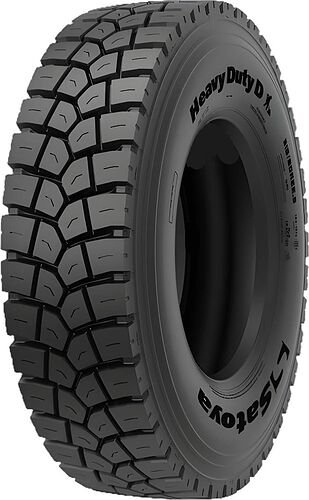
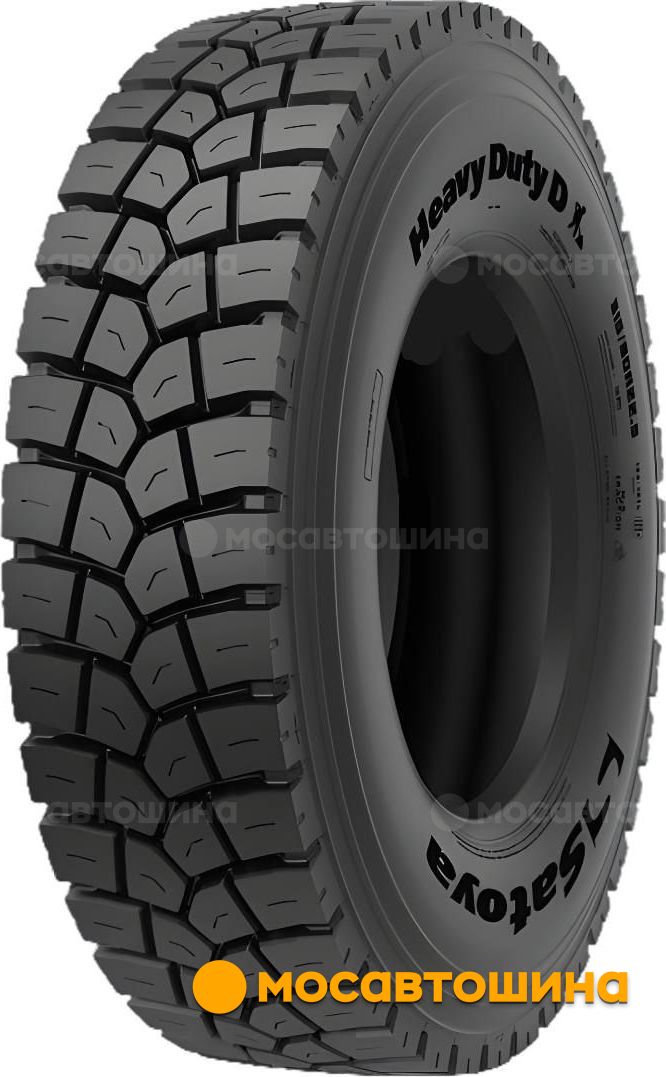
Satoya Heavy Duty D — a commercial truck tyre designed for drive axle applications. Since drive wheels transmit engine torque to the road, buyers prioritize tread patterns with pronounced transverse working edges. The tread follows a large-block design, clearly distinct from the longitudinal-rib pattern typical of steering axle tyres.
The central part of the tread consists of several rows of large polygonal blocks. Elements in adjacent rows are staggered, with their edges oriented across and at an angle to the direction of rotation. This provides the buyer with a tread featuring a high number of biting edges for transmitting longitudinal force, instead of just a few smooth, continuous ribs.
Blocks are separated by wide transverse and diagonal grooves, interconnected across the entire tread width. These grooves extend openly toward the shoulder areas, maintaining noticeable spacing between adjacent elements. This layout preserves the large blocks as independent tread components and creates edges oriented at various angles.
Most block surfaces feature short, narrow sipes. Each sipe adds extra biting edges within the large block without breaking it into a collection of small segments. For the buyer, this means a combination of two tread scales: robust main blocks with finer edge details on their surfaces.
Wide shoulder blocks extend to the edges of the tread and are separated by open transverse channels. As a result, the large-block geometry covers the entire working width of the tread, not just the central area. At the edges, pronounced transverse edges and open gaps between elements are maintained.
Overall, the Heavy Duty D offers buyers a clearly defined drive-axle tread pattern: multiple staggered block rows, abundant transverse edges, open interconnected grooves, and additional sipes. It's the right choice for those seeking a block-based tread design engineered to deliver longitudinal traction through drive wheels.
Key features of Satoya Heavy Duty D
- Designed for drive axles, optimized for torque transmission;
- Large-block tread pattern creates numerous transverse working edges;
- Staggered rows distribute blocks across the full tread width;
- Interconnected grooves maintain open spaces between adjacent elements;
- Short sipes increase the number of biting edges on block surfaces;
- Shoulder blocks extend the block geometry to the tread edges;
- Large tread elements remain solid and are not fragmented into many small sections.