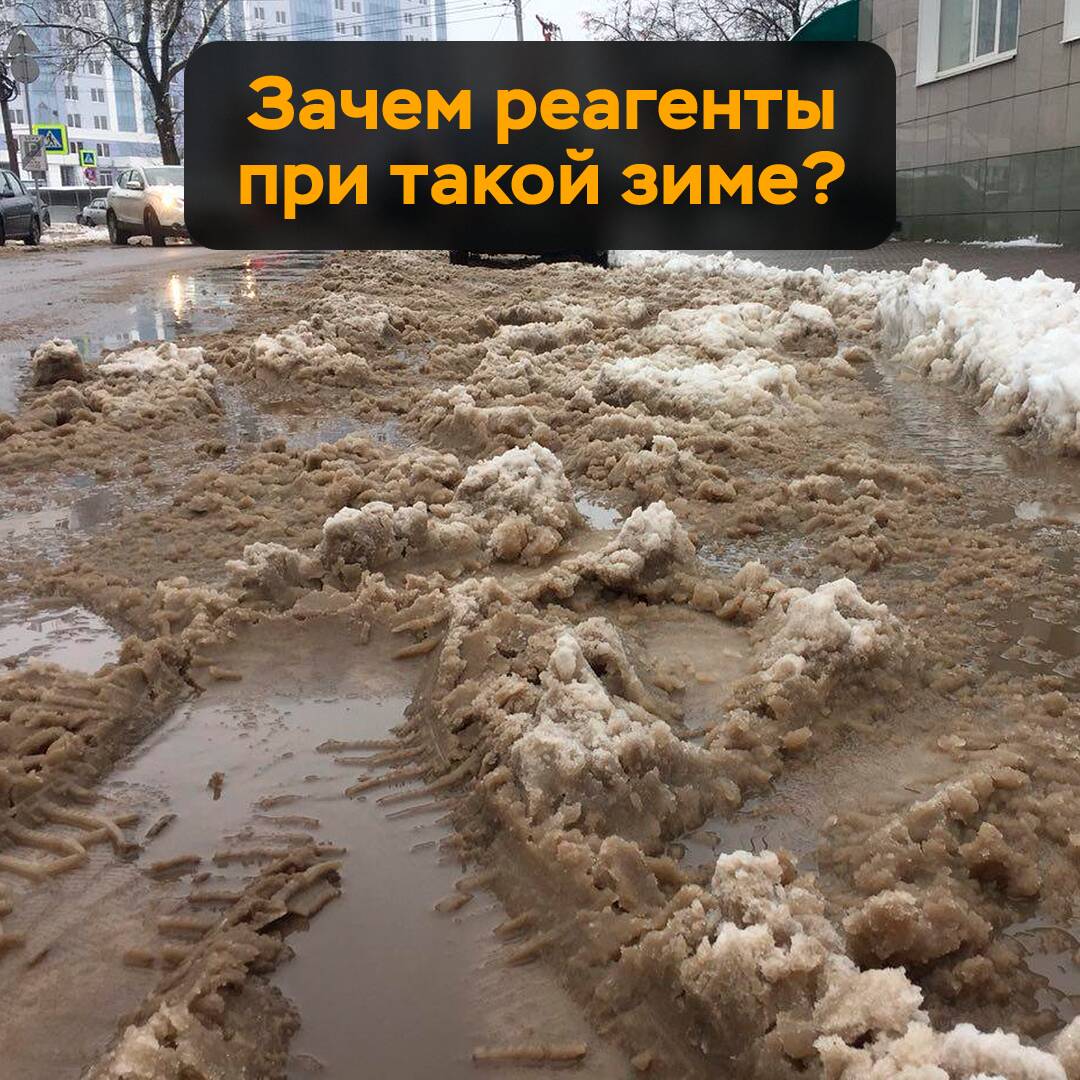
What are reagents for in such winter?
Often, it seems that road services intentionally complicate the situation on the roads by scattering reagents into puddles. At first glance, there is no logic in this. "Corruption", many drivers may think, standing in traffic jams due to the slow movement of road service equipment. "It needs to be disposed of somewhere, so they scatter it into puddles". But the thing is quite different. It is precisely in such work to combat ice that there is sense.
The fact is that road services cannot be in all points of a large city with high traffic intensity at the same time. That's why there is a regulation "GUIDE TO COMBATING WINTER SLIPPERINESS ON ROADS". It is according to this set of rules that the reagent should be spread, warning of ice. This depends on a certain temperature threshold and forecast for the near future. In other words, the task of road workers is not to allow the formation of ice, but not to fight it after it has appeared.
As we know from practice, this is not always possible, but nevertheless, the work of road workers is effective, albeit not ideal. It is enough to look at neighboring republics. For example, in Kazakhstan, in case of a sharp drop in temperature and the formation of ice, intercity roads and highways are closed. They are simply closed until the weather conditions stabilize. Thus, the capital of Kazakhstan, Astana, has already been several times in 2023 with completely closed approaches to the city.
We should treat road services in our cities with understanding. And, of course, we should not forget that reagents, although they make the road situation easier, are not beneficial to tires and wheels. In addition, if the snow that has thawed after the action of the reagent is not removed in time, you should be especially careful, as the braking distance on the resulting "mass" can also be significant.