
Why does Goodyear need airships?
Do you know the most popular symbol in the tire industry? Yes, undoubtedly, it's Bibendum, the tire man from Michelin. But in the world of tires, there's another popular and iconic symbol - the Goodyear blimp.
Interestingly, this is not just a PR move by the company. The blimps were developed and built as a separate and promising branch of the company's development. But time has shown that progress will go in a different direction, and now it's more of an image component that is not focused on progress and innovation. Why is the history of blimp building so closely intertwined with Goodyear?
Goodyear has indeed made a huge contribution to the development of airship aviation. Perhaps we know airships exactly as they are today thanks to this company.
The main initiator of the rapid start of development in this direction in 1924 was the head of the already successful company "Goodyear Tire & Rubber Company" Paul Litchfield. He saw huge potential in airships and bought the rights to patents from the monopolist of the time, Zeppelin. Litchfield's plans included competition on land with major tire manufacturers, but at the same time, complete dominance in the air.
The silently floating giants in the air attracted people's attention, and the company decided to use this to promote the Goodyear name. The death-defying stunts of acrobats and landing on the roofs of skyscrapers of the time demonstrated the amazing maneuverability and simplicity of movement in a big city.
Of course, this invention simply could not fail to attract the attention of the military. Thus, Goodyear's airships received a parallel branch of development - military.
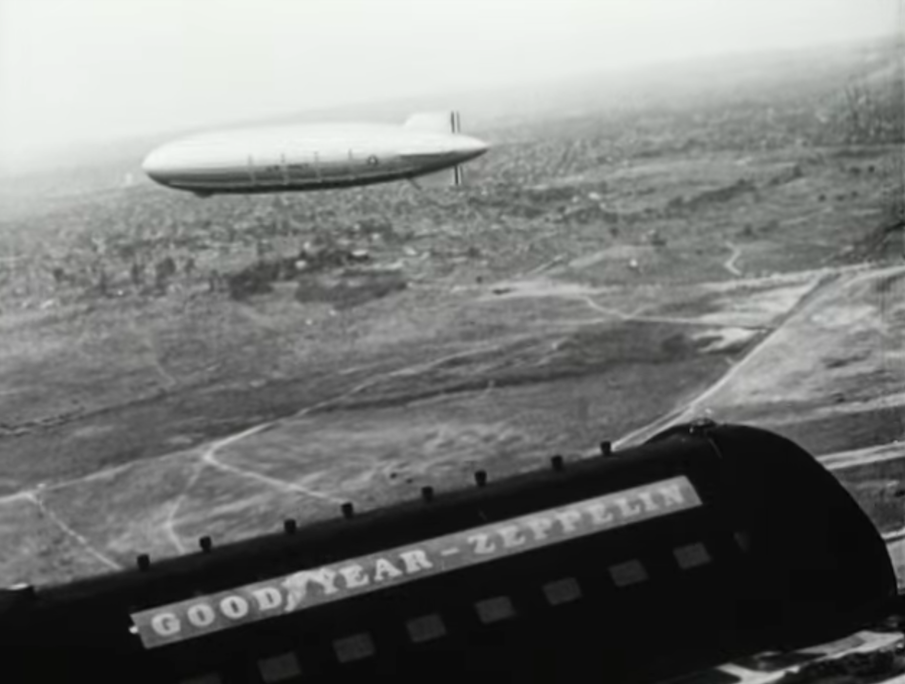
The successfully developing company "Goodyear-Zeppelin" at that time received an order from the military to build two aircraft carriers and successfully completed it. For that time, airships had unique characteristics. The 239-meter-long air giants could reach speeds of 128 km/h at a range of 17,000 km. The main function was reconnaissance, which they successfully performed. The safety of movement was ensured by a crew of 89 people, 5 aircraft, and 8 large-caliber machine guns. Despite their revolutionary nature, airships could not withstand weather storms, and at different times, both airships - "Akron" and "Macon" - sank during a storm at sea. Military airships continued to be produced, but even then, developers and customers saw limited prospects for this direction.
One way or another, the history of airships has always been associated with crashes of varying severity. One of the reasons for the failures was the use of explosive hydrogen. Modern airships use less hazardous helium and have higher and safer characteristics than past models. Probably, this will serve as a new impetus for the development of the industry. Nevertheless, it's worth being confident that Goodyear will be at the forefront of developments.