
Wanli started producing aircraft tires
The company Wanli Tire, founded in 1988 in Guangzhou (China) and known for its automotive tires under the brands Wanli, Sunny, Aptany and Milever, has entered a new segment of the market, presenting its first self-developed tires for aviation.
The release of new products is directly related to the policy of the Chinese government, which has been named the "low-altitude economy" and is aimed at developing small aviation. According to local media, the new program has been developed in the strategy of more than 30 provinces, which has become a "signal for a quiet industrial revolution, facing the sky".
According to the Civil Aviation Administration of China (CAAC), by 2025, the turnover in this segment will reach 1.5 trillion yuan (210 billion dollars), and by 2035, it is planned to increase to 3.5 trillion yuan (490 billion dollars). As a result, the demand for aircraft components, including tires, has sharply increased, which Wanli has taken advantage of, having extensive resources of its parent holding Guangzhou Industrial Investment Holdings Group (GIIHG), which already has experience in developing aircraft components, such as engine parts.
As noted in Wanli, the company "has made a technological leap from the ground to the air", and aviation tires are the only component of an aircraft that comes into contact with the ground and is directly related to flight safety. They must withstand intense friction and high temperatures that occur when rolling at high speeds, as well as extreme temperature fluctuations of hundreds of degrees Celsius, which occur when descending from 10,000 meters. For this reason, aircraft tires are considered the "pearl" of the tire industry, as they have the highest requirements.
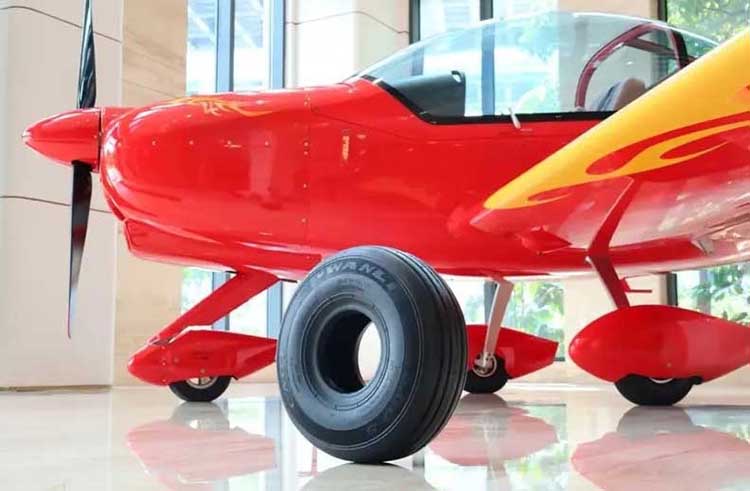
The company adds that the situation in the market for small aviation tires allows for the production of products with relatively low technological barriers, but with broad prospects for future development, and the developers faced three key tasks. Thus, it was necessary to develop new composite materials with super-high durability, thermal stability, and fatigue strength, which would provide the necessary structural integrity of the tires and rapid heat dissipation. In addition, the design, pattern, and profile of the tires were optimized to improve traction and wear resistance, and the company also modernized the equipment to meet the high-quality standards used in the aviation industry.
"The successful release of tires for small aviation is the culmination of decades of technological development of Wanli Tire, testifying to the fact that the company has mastered new opportunities in the field of research, development, and production of new products, and is an important milestone in our history," - say in Wanli, adding that "entering the aviation tire market is just the starting point", and the company has even higher ambitions for the future. In particular, it is planned to "carry out a deep transformation" and become not just a tire manufacturer, but a supplier of diversified solutions in the segment of rubber products - now Wanli already produces, in addition to tires, seismic isolation bearings, pneumatic springs, rubber gaskets, etc.
The company emphasizes that it "does not intend to limit itself to the production of one product, but instead use the powerful industrial base of GIIHG to create a diversified product line that covers various areas of application". In the future, Wanli intends to start producing new products, for example, for high-speed rail transport, specialized equipment, deep-water exploration, and the aerospace industry.