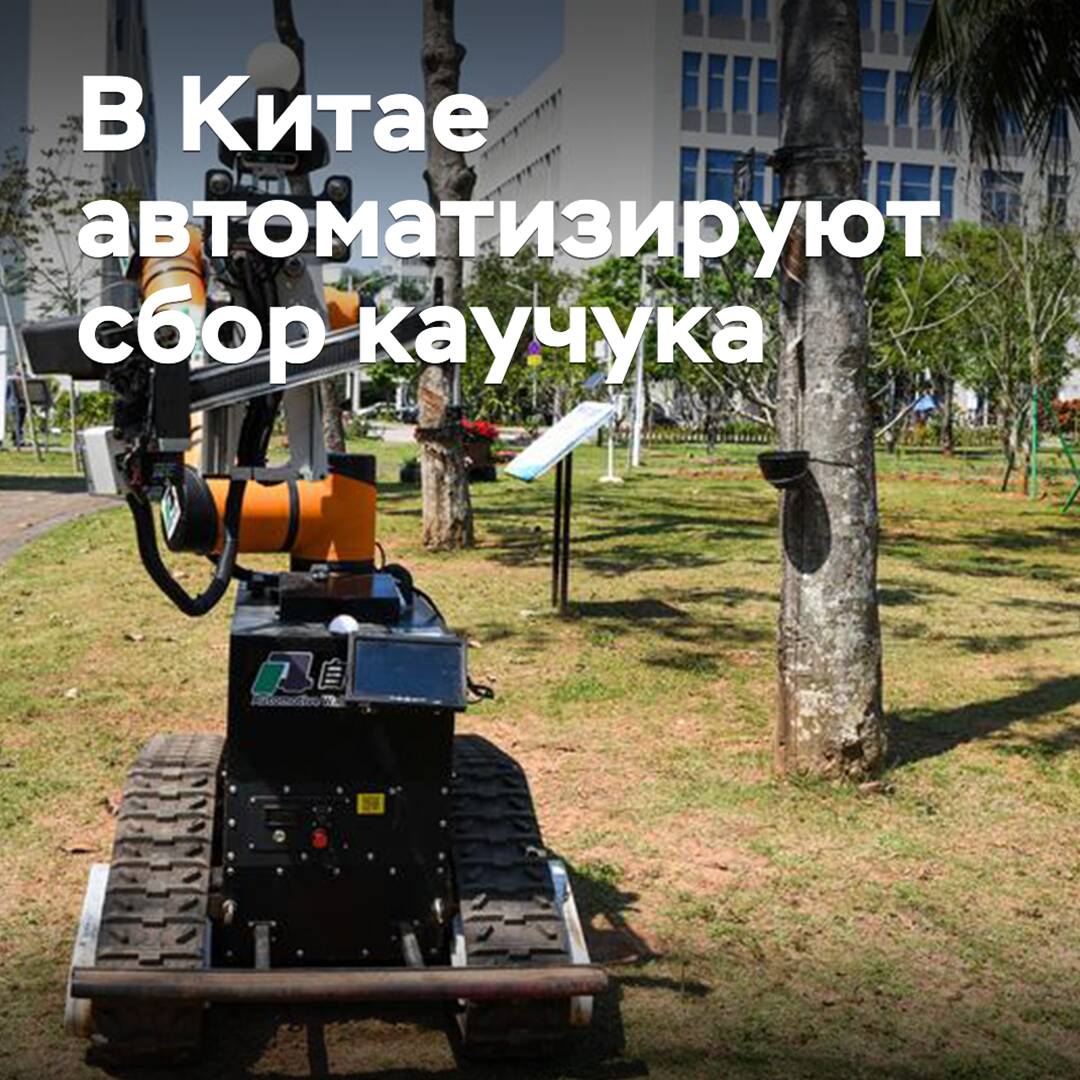
In China, they are automating the collection of natural rubber
The Chinese Academy of Tropical Agricultural Sciences (CATAS) has jointly developed an autonomous rubber-tapping robot with Beijing-based technology firm Automotive Walking Technology, which is set to undergo testing on plantations in the southern province of Hainan in April during the upcoming harvesting season, Xinhua reports.
The new tracked robot is capable of autonomously approaching rubber trees, including on complex terrain, and making high-precision incisions in their trunks to collect latex, while the introduction of new technologies is expected to help not only increase agricultural automation but also address the problem of chronic labor shortages due to harsh working conditions, night shifts, and high levels of occupational diseases.
"Rubber-tapping robots were developed to address the problem of labor outflow, which is becoming critical in this industry," said Cai Jianhua, deputy director of the CATAS Rubber Research Institute.
The navigation system of the new robot includes a laser radar and a combination of multiple sensors, allowing it to navigate on plantations. Additionally, the robot can visually determine the depth of the bark and the required angles of incision, achieving 80% of the efficiency of manual labor, and can process 100-120 trees per hour. The power source is lithium batteries, which provide more than eight hours of operation, and the ability to replace the battery in 20 seconds allows for continuous operation on large plantations.
According to Automotive Walking Technology co-founder Sun Yao, once the cost of the robot drops to less than 100,000 yuan ($13,800), the investment in the robot will pay for itself in about 18 months on a plantation of 3.3 hectares.
"We have discussed the new development with a number of multinational tire manufacturers and rubber producers across Southeast Asia, including in Indonesia and Thailand, and they have shown great interest," Cao noted.
In the future, developers will continue to improve their technologies, and it is reported that soon operators will be able to control robots using a smartphone, receive complete data on the plantation, and use AI for automated equipment management.
Photo: Xinhua / Yang Guanyu