
At Bridgestone, a methodology has been developed for collecting particles from worn-out tires
Bridgestone announced that it has developed a methodology for collecting particles generated during tire and road wear, with the aim of understanding the impact of TRWP (Tire & Road Wear Particles) on the environment.
TRWP particles are formed as a result of friction between the tire and road surface, which is necessary for safe driving, and consist of materials from which the tire tread and road surface are made. In recent years, these particles have attracted significant public attention, and Bridgestone, like other tire manufacturers, has been working to better understand their size distribution, behavior when spreading in the air, and so on, as well as to develop an effective method for their collection.
In the initial stage, the company's specialists focused on improving the understanding of how particles are formed, and then, using the B-Mobility test track at the Bridgestone Innovation Park in Kodaira (Japan), developed a method that allows for the effective collection of TRWP. With the help of a high-speed camera and laser light scattering, the spread of particles in the air was visualized, after which a device was developed that covers the entire tire and effectively captures TRWP. Additionally, the use of an unmanned electric vehicle with a regenerative braking system allows for the collection of particles without the impact of exhaust gas and dust emissions.
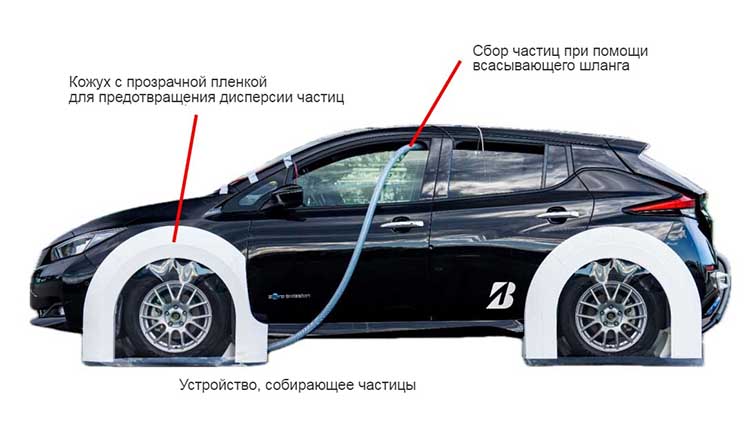
The study of the mechanical and physical properties of particles is being carried out within the framework of the Tire Industry Project (TIP), launched by the World Business Council for Sustainable Development (WBCSD), and Bridgestone notes that the collection of TRWP using the new method will allow for a faster assessment of their impact on the environment. In parallel with this, the company is also continuing to work on reducing the formation of TRWP through the use of more durable tires with increased wear resistance.