Winter Tyre Test from Tyre Reviews — 2025
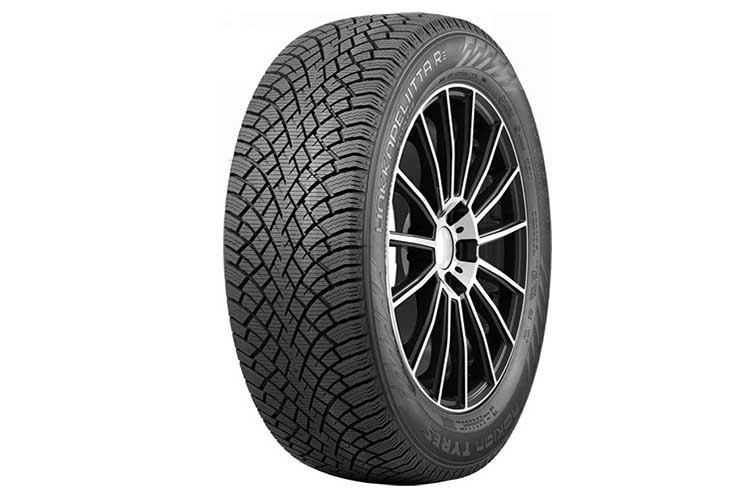
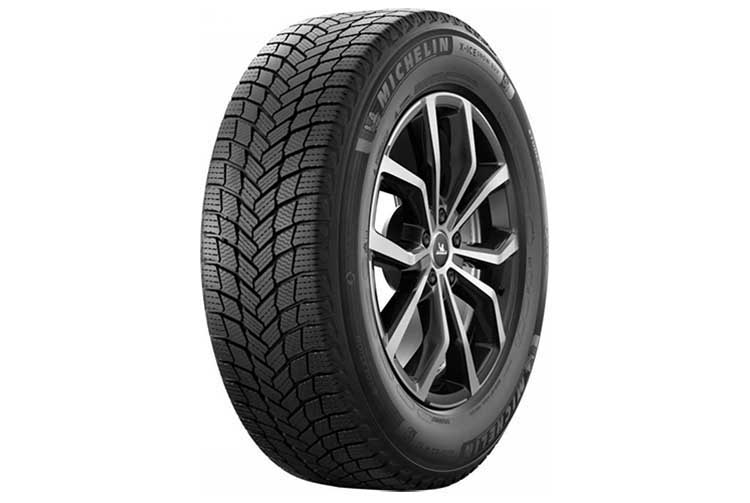
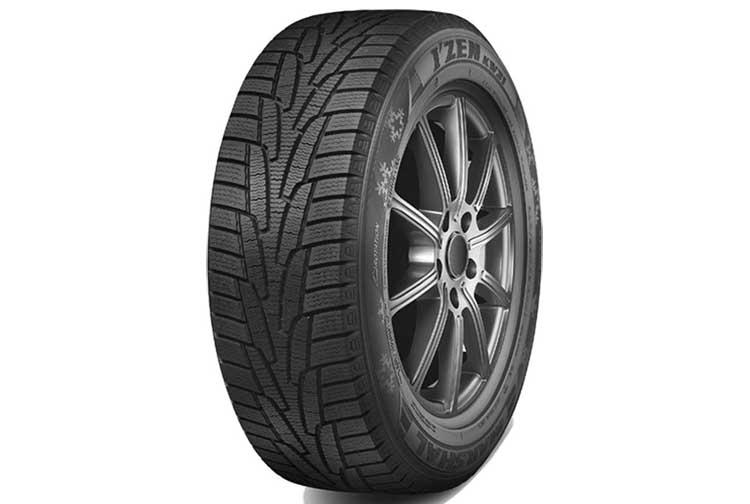
Jonathan Benson, creator of the Tyre Reviews portal, tests tires of various categories, and this time it's the turn of friction models of the Scandinavian type, designed for harsh winters, and the list of participants included mainly premium products from top manufacturers: Continental VikingContact 8, Goodyear UltraGrip Ice 3, Michelin X-Ice Snow and Nokian Hakkapeliitta R5 (all of which are supplied to Russia only through parallel imports). In addition, the Marshal I'Zen KW31 tire from the Korean company Kumho was also tested, and for comparison, one studded tire (Nokian Hakkapeliitta 10) and one friction tire of the European type (Continental WinterContact TS 870) were also taken. The size 205/55 R16 was chosen, and the tires were tested in 21 disciplines.
On snow, all the "Scandinavians" showed good results, and in the handling test, Marshal took the last place, but their lag in lap time from the leader was only 4.1%. The Kumho tires react slowly to the driver's actions and take longer to restore traction after a skid, but the level of grip can be considered quite acceptable.
Michelin has excellent traction, but it is lost too abruptly, which made it difficult to pass the circle, while Nokian's handling was better, which increased the pleasure of driving, and Continental reacts so quickly to turns that it can lead to skidding, however, there is enough traction to pass turns at high speeds. Goodyear performed a bit better, providing excellent handling on snowy surfaces.
The "studded" tires showed average results, and the "European" tires surprised by being able to surpass Marshal, even despite the fact that more emphasis was placed on increasing traction on wet and dry asphalt during their creation. However, it is possible that the relatively weak traction of the I'Zen KW31 is to blame.
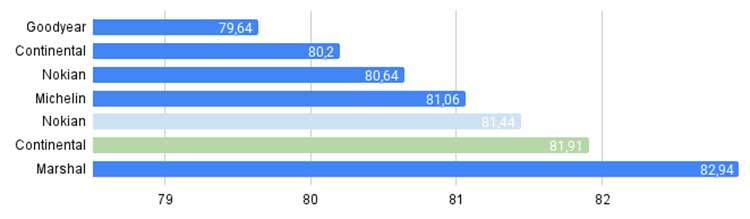
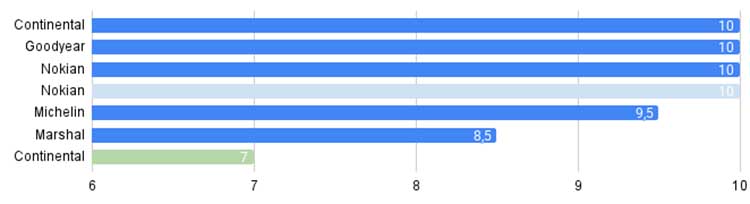
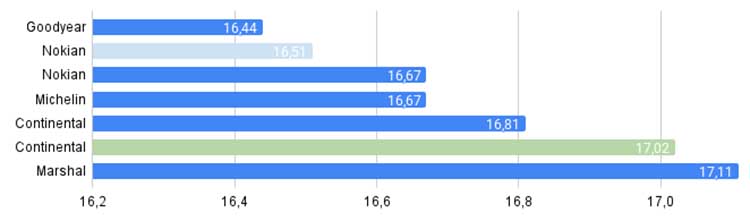
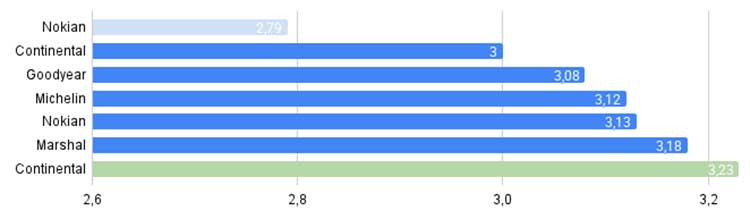
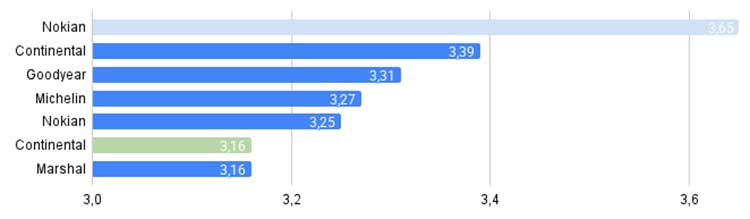
While on snow, the balance of power in various disciplines was almost the same, on ice the situation changed. The reason is that ice can differ significantly in its characteristics, and handling was evaluated on rough ice, and the traction and braking properties of the tires were evaluated on smooth ice, and in the first case, the level of traction was initially slightly higher. At the same time, smooth ice, which can be found, for example, at intersections, creates the greatest difficulties for drivers in the winter period.
In the handling tests, Marshal again lagged behind their "classmates", as their behavior was a bit nervous, while Michelin's traction was also good, but the reactions were not the fastest, which made it necessary to adjust the driving style. In addition, the grip took a relatively long time to recover.
The first three places were taken by Continental, Nokian, and Goodyear, which are all very effective, providing excellent ease of handling. Although it could be expected that studded tires would be the leaders in this discipline, this did not happen, and the Hakkapeliitta 10 lost to all "friction" tires of the Scandinavian type. The reason, as Benson points out, lies in the characteristics of the ice, since softer non-studded tires found it easier to "grip" the surface irregularities. At the same time, the studded Nokian tires have no handling problems, and "even if skidding began, there was still a huge reserve of traction to keep the car on the desired trajectory, and driving on these tires is a real pleasure". As for the "Europeans", they predictably took the last place, but at the same time, they again showed surprisingly good results, only slightly behind the studded tires.
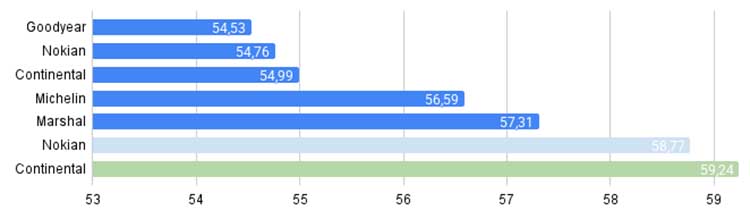
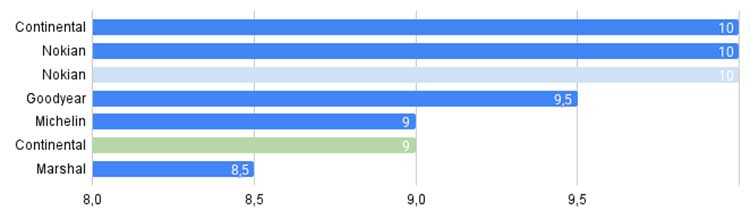
On smooth ice, the Hakkapeliitta 10 tires showed their full potential and significantly outpaced the friction tires of the Scandinavian type, not to mention the "Europeans".
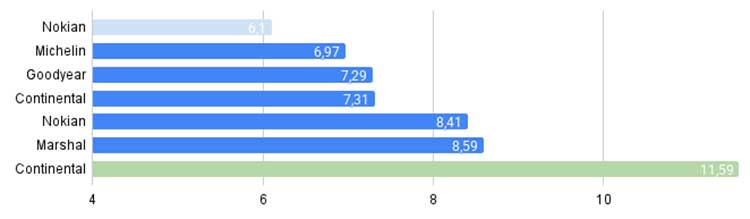
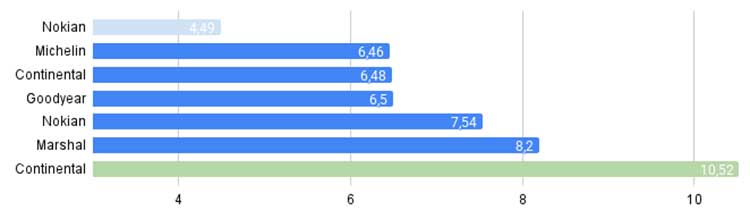
On wet pavement, the scatter of tire results for the northern winter turned out to be very significant, and the worst lap time was shown by Michelin, which clearly lacked traction on the front axle. "This surprised me so much that I reviewed all recent tests of the X-Ice Snow, and, yes, it seems that Michelin is indeed inferior to its competitors in similar conditions, that is, the manufacturer apparently sacrificed traction on wet pavement for improved performance on ice," Benson noted.
The next place was taken by Marshal, which are more prone not to insufficient, but to excessive steerability, that is, they create a risk of skidding, which is extremely undesirable on a wet road. However, the informativeness was good, so the subjective assessment was high.
Goodyear tires on a wet track, although they do not have outstanding traction, behave balancedly, improving handling, while on Continental, the distance is passed without problems, which is helped by a slight lack of steerability. Finally, Nokian takes the first place, which was "simply incredible". "And again, I was surprised when I found out that historically, the R5 was more focused on increasing traction on ice," Benson noted, adding that this time Nokian on wet pavement did not leave any chance for competitors.
The studded tires, unfortunately, could not be tested on a wet track (since they affect the coating, and it needs to be maintained in perfect condition, which requires additional expenses), and the friction tires of the European type feel at home in such conditions, which was reflected in the results.
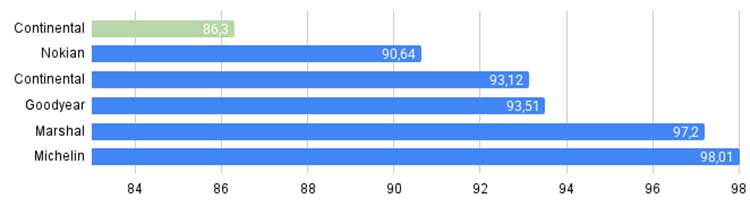
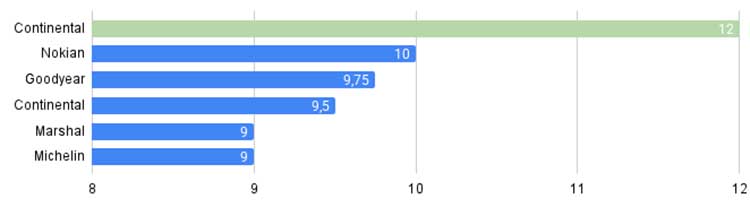
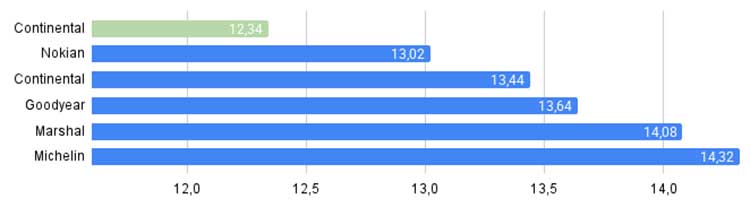
In the braking test on a wet surface, Nokian was again the best in its class, and their gap from the nearest competitor even grew to 12.5%, while Michelin again fell to the bottom of the rating.
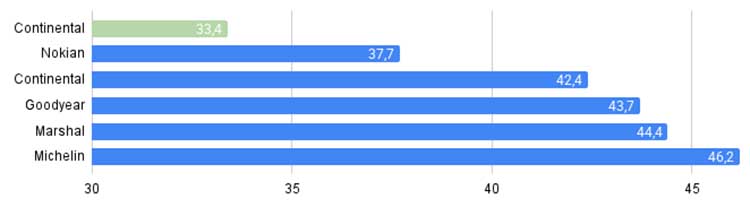
In the tests for resistance to aquaplaning, Goodyear was the leader, and Continental tires lagged behind the rest.
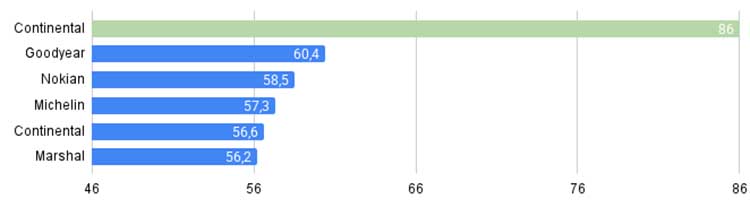
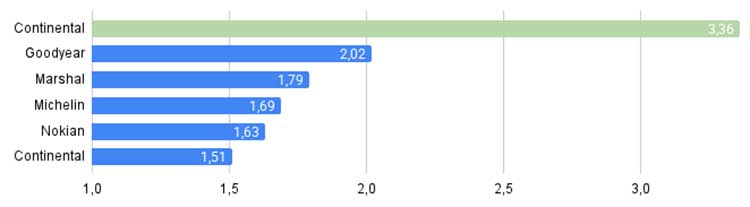
On dry pavement, Nokian was again the best in terms of handling, and the second and third places were taken by Goodyear and Continental, respectively. In general, the differences between the tires were small, and all participants had a certain tendency to skid when rebuilding sharply, but this is characteristic of all models for harsh winter.
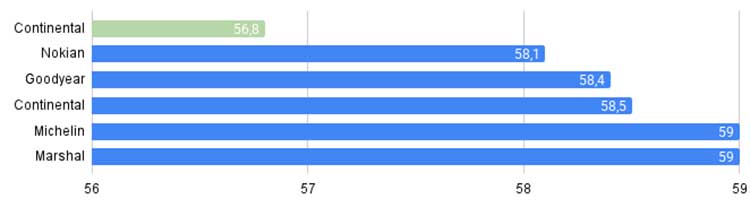
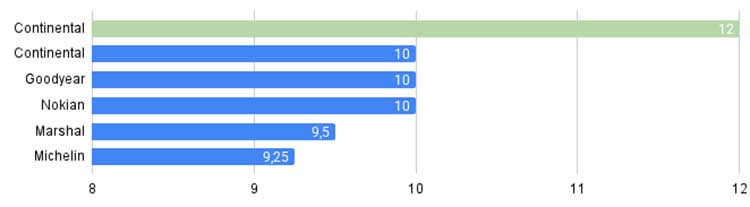
The shortest braking distance on a dry surface was also shown by Nokian, and the worst result was again shown by Michelin, which is unusual for tires of the French brand. The non-studded Continental tires of the European type predictably bypass the "Scandinavians", but not with such a significant margin as one might expect.
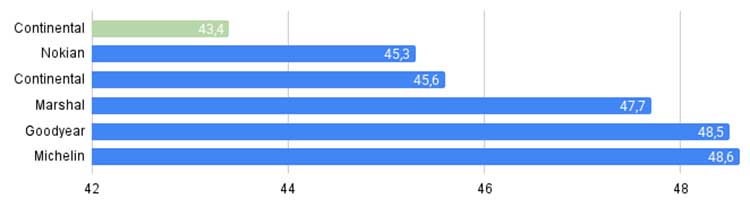
In the tests for the level of comfort, the results also differed insignificantly, and Goodyear and Nokian were recognized as the best in terms of ride smoothness, and Continental earned points due to the lowest noise level.
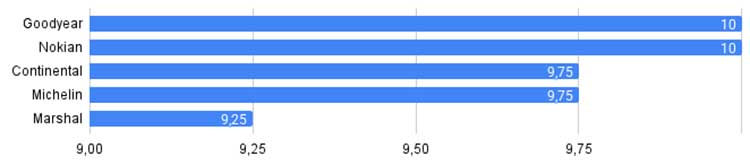
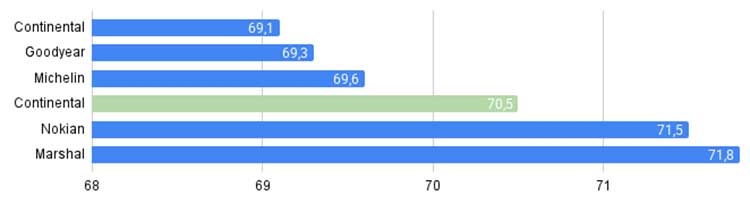
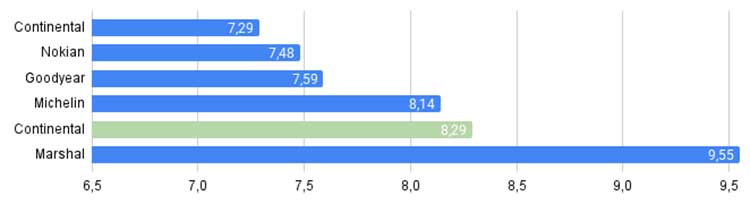
The most economical tires in the test were Continental, and Nokian and Goodyear also showed good results in this regard, while Michelin's rolling resistance was slightly higher, but only Marshal would significantly increase fuel consumption.
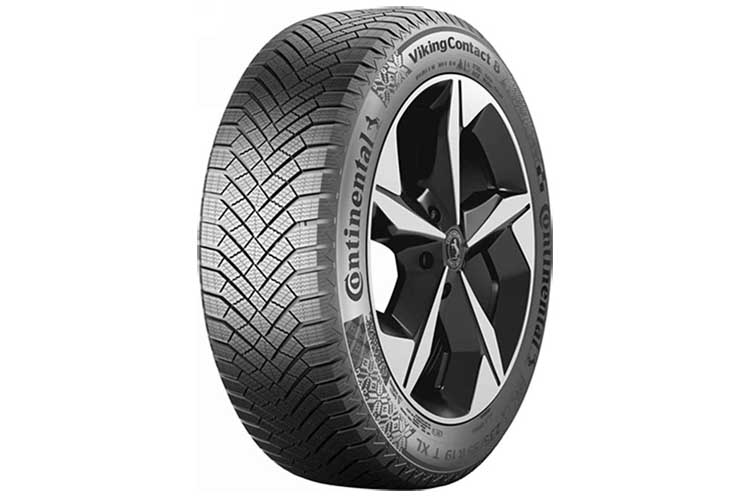
The first place in the entire test is taken by Continental VikingContact 8, which performed well in almost all disciplines and conceded to competitors only in terms of resistance to aquaplaning. In all other respects, these are excellent tires that work perfectly in difficult conditions and combine a high level of traction with low noise and very good fuel efficiency. Such a balance of characteristics is indeed impressive, so the victory is well-deserved.
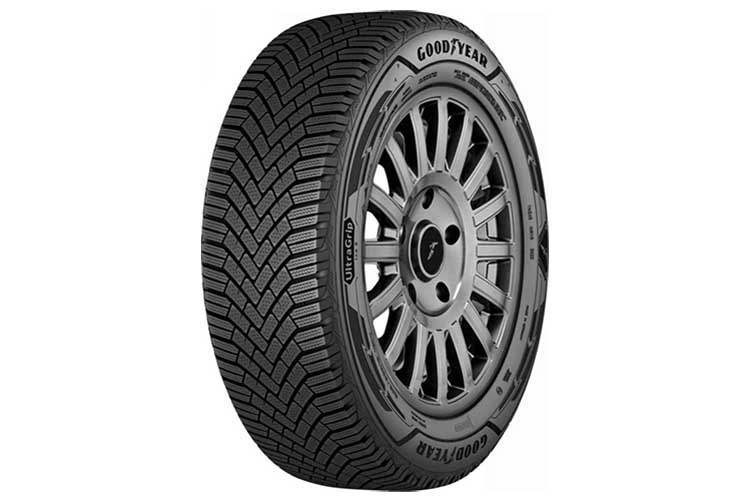
Goodyear UltraGrip Ice 3 can also be considered tires with very balanced parameters, but in their case, there was also a fly in the ointment, and the picture was spoiled by a long braking distance on wet pavement. Goodyear was the best on snow and second on ice, and in addition, they have high resistance to aquaplaning, as well as good ratings for comfort and fuel efficiency.
If the weight of the assessments in the tests on dry and wet asphalt were higher, Nokian Hakkapeliitta R5 tires could have taken silver, because in this part of the tests they were significantly better than their competitors. On snow, Nokian has good braking qualities and handling, but not the highest tractive effort, and the main problem is that the tires have relatively weak traction on smooth ice. There are no complaints about comfort and economy, and Nokian's overall rating is high, but it would be nice to improve the balance between performance on wet and icy surfaces.
Michelin X-Ice Snow showed generally good results on ice and did not particularly lag behind the trio of leaders on snow, but at the same time, they demonstrated the weakest performance on dry and wet pavement, as well as high rolling resistance, so, according to Benson, "fourth place is the maximum for a tire from the French brand". "This is now an aging model, and I hope its successor will appear soon," he added.
Marshal I'Zen KW31 closes the list, and the fact that they conceded to European-type tires on snow already says a lot, but this also includes the worst results in almost all other tests. Of course, Marshal was compared to tires of a higher segment this time, but since they are designed for extreme winter conditions, and they performed very poorly on both snow and ice, it is unlikely that they deserve a recommendation.
The ratings in the table are indicated as a percentage, depending on the best result. The weight of the ratings is determined as follows: dry asphalt - 10%, wet asphalt - 15%, snow - 35%, ice - 25%, comfort - 10%, economy - 5%.
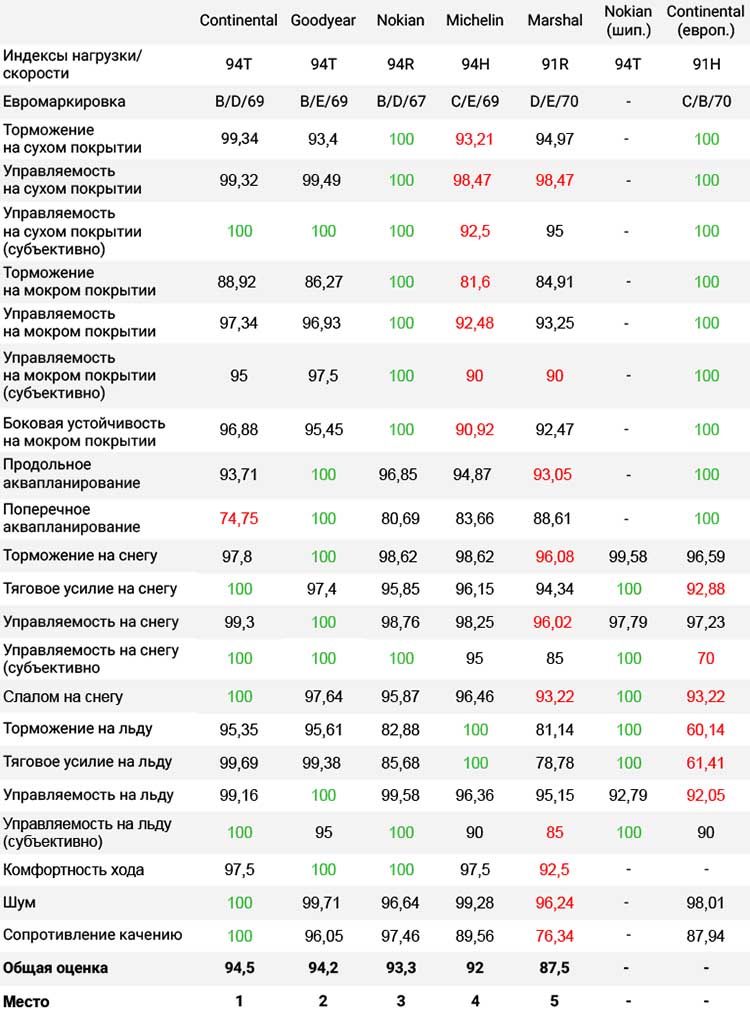
Source: Tyre Reviews