
Off-road tire test from Auto Motor und Sport — 2025
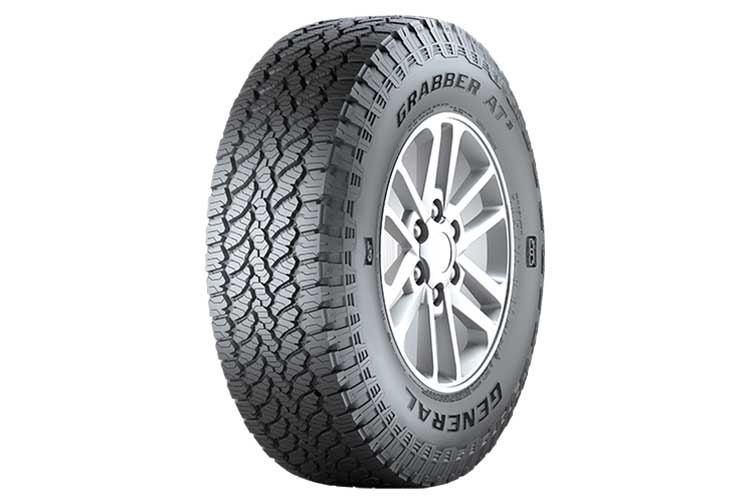
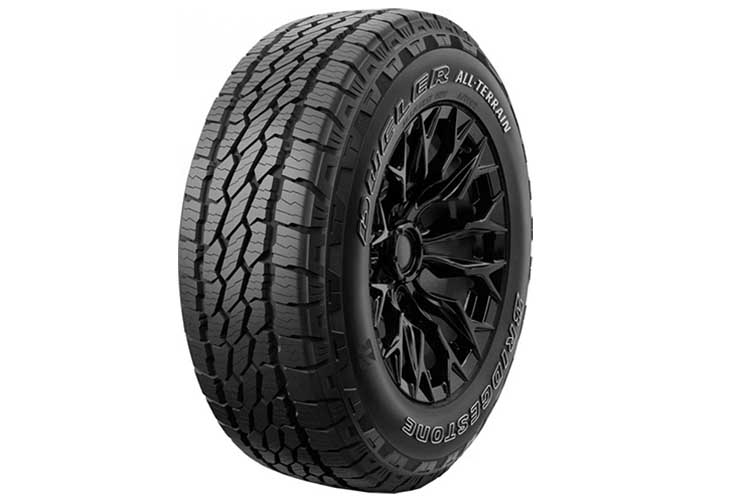
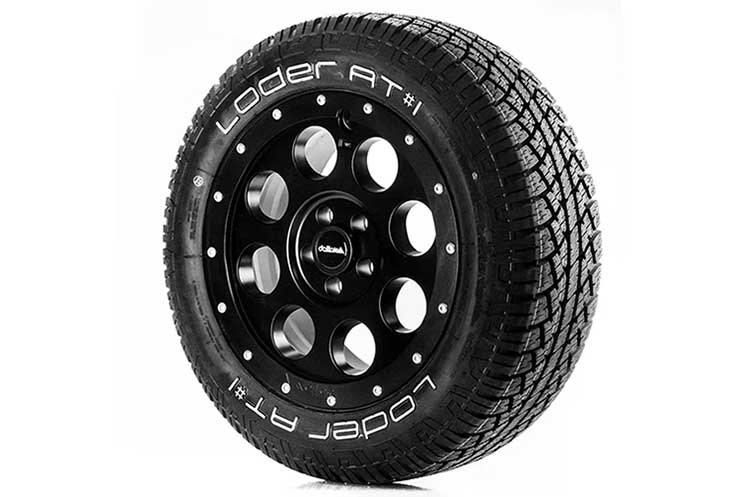
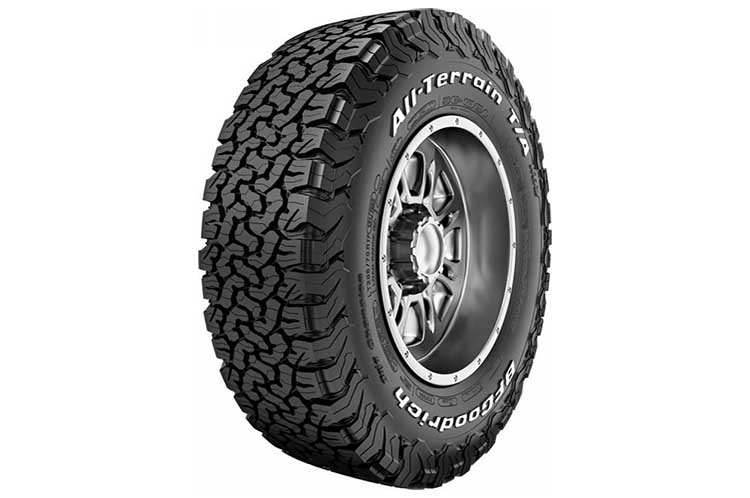
The German magazine Auto Motor und Sport conducted tests of All-Terrain class tires, which are designed to work effectively both on asphalt and on light off-road (for harsh conditions, there is a Mud-Terrain mud tire category), testing them on snow, dry and wet pavement, small gravel, dirt, and mud. The list of participants included BFGoodrich All-Terrain T/A KO2, Bridgestone Dueler All-Terrain A/T002, Falken Wildpeak A/T AT3WA, General Grabber AT3, and Loder AT#1, all of which have the 3PMSF marking, meaning they have passed certification tests on snowy surfaces. All tires are produced by well-known manufacturers, and Loder is a private brand of the German tuning studio delta4x4, with tires manufactured in China (but still cost more than all other tires in the test).
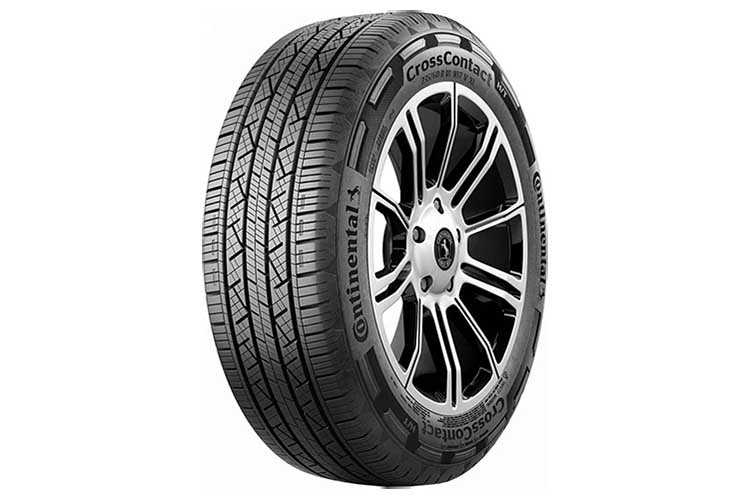
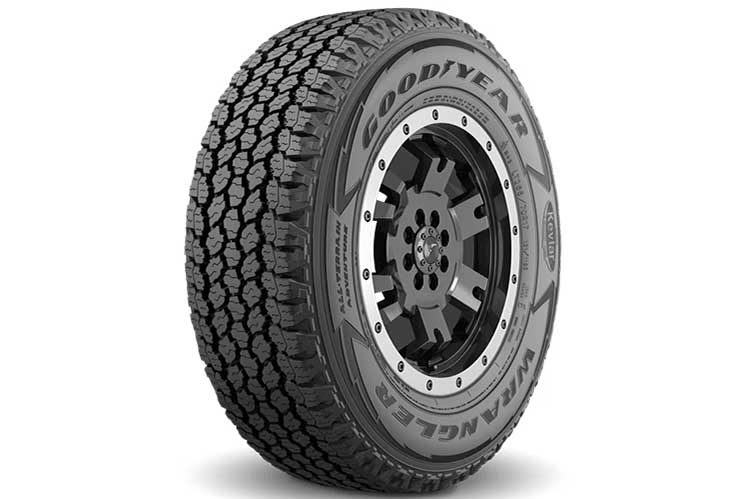
Also participating in the tests were two tires without the snowflake marking: Continental CrossContact H/T, primarily designed for use on asphalt, and Goodyear Wrangler All-Terrain Adventure (the specified Goodyear model has the 3PMSF symbol in regions such as North America, but the tires tested were without it, released in South Africa), which for this reason were not evaluated on snow. The tires were tested in the size 255/55 R18, intended for large SUVs and pickups.
Tests could also be conducted on sand and wet grass, but AMS noted that in the first case, as shown by previous tests, neither the composition of the rubber mixture nor the tread pattern has a significant impact, and for the best grip, almost smooth tires with a maximum contact patch and minimum pressure are needed. At the same time, tires with large blocks usually change the direction of the car's movement from "forward" to "down", that is, they simply get stuck. On grass, the level of grip is determined by the subsoil layer: if it is soft, the tread blocks start to work, and the results here are similar to those that can be obtained simply on soft soil, if it is relatively hard, the number of grip edges and the elasticity of the rubber mixture are important, and the indicators will be very similar to those that the tires demonstrate on wet asphalt, where the highest measurement accuracy can be ensured. In general, according to the experts, the results of the tires on sand and grass are usually very close, so it was decided to abandon these tests.
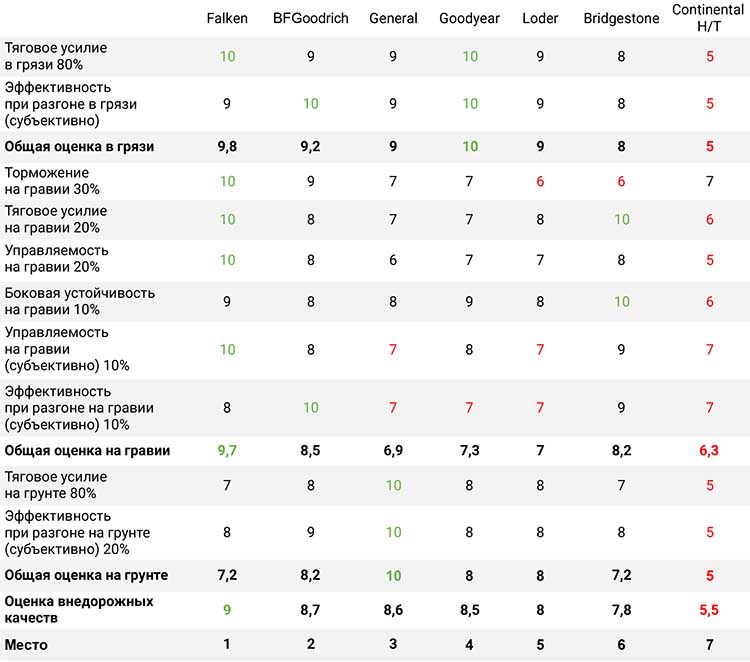
The characteristics of the surface on the gravel can change significantly from one pass to another, which was compensated by repeating the tests 10 times, and the effectiveness of braking, traction, handling, and lateral stability were evaluated. The differences between the tires were quite noticeable, and the best were recognized as Falken, which have excellent grip in both longitudinal and transverse directions in similar conditions.
Behind Falken were BFGoodrich and Bridgestone, while General, Goodyear, and Loder lagged slightly behind. In turn, the highway Continental took the last places in three of the four disciplines.
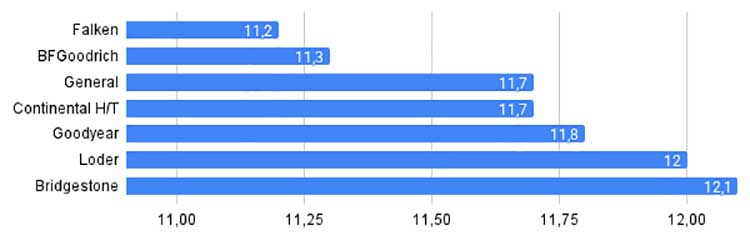
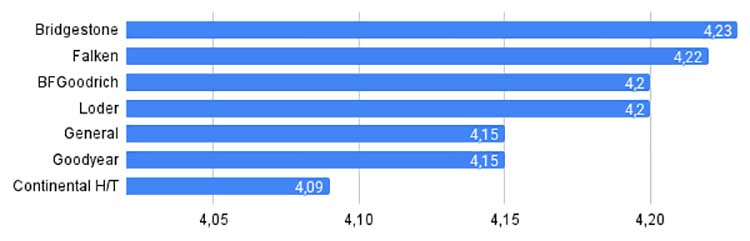
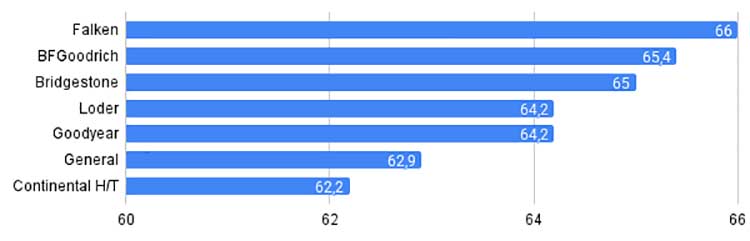
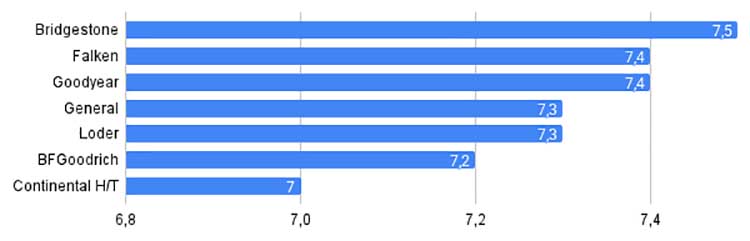
Traction when driving up a dirt slope was also measured, and in this test, after the first ten meters, the driver pressed the gas pedal harder, and the equipment measured the acceleration in m/s2. As a result, General took first place, and BFGoodrich and Loder shared second place.
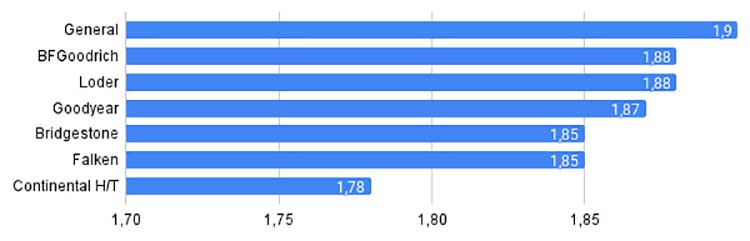
The tests in the mud were much more difficult, for which a dirt section about 150 meters long had to be repeatedly plowed and watered using agricultural equipment. The goal was to loosen and moisten the top layer of soil as evenly as possible, and it took more than two weeks to prepare the section. After that, in the mud with deep ruts, the pilot tried to accelerate on a four-wheel-drive Toyota Hilux. Naturally, the runs were repeated several times, after which the average acceleration was determined. In this test, all tires showed fairly stable results, and Goodyear had slightly higher traction, while Bridgestone had lower than average, and the highway Continental had the most difficulty.
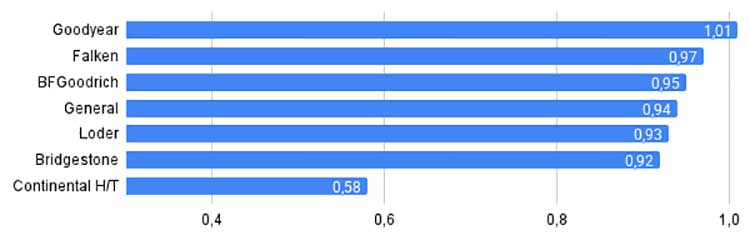
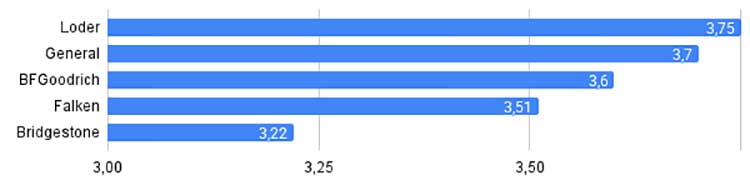
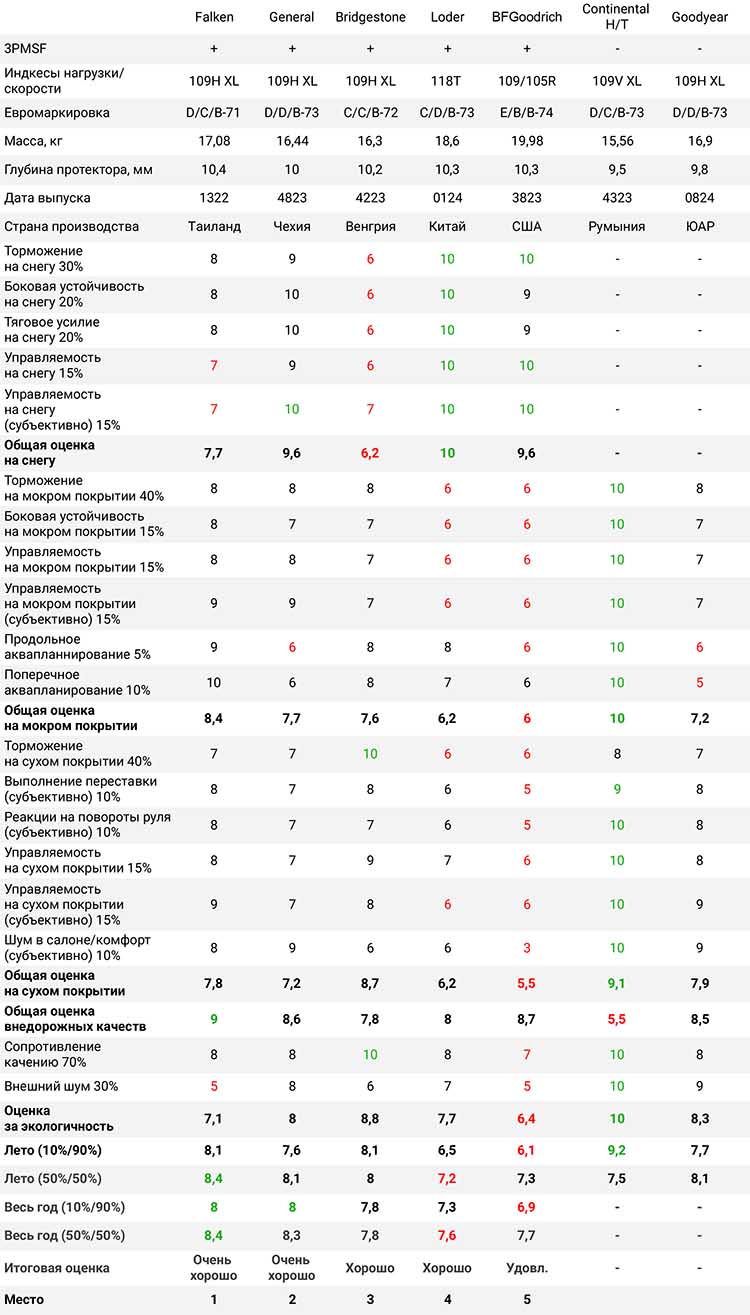
On snow, as mentioned earlier, only tires with the 3PMSF symbol were tested, and Loder and BFGoodrich performed better than the others, while Bridgestone tires struggled the most with the tasks.
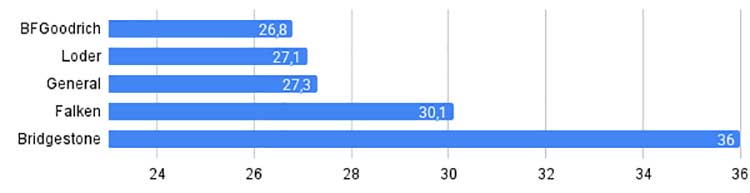
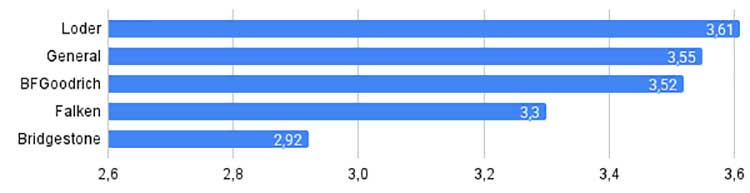
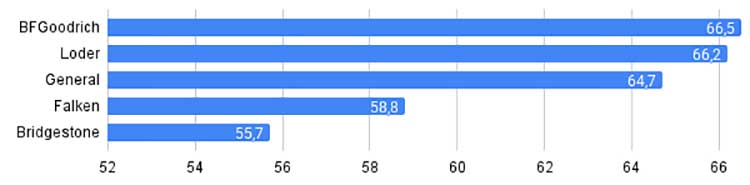
On wet pavement, Continental Highway-Terrain tires got a chance to catch up and predictably took the top spots in all disciplines, and Falken tires also showed good results, which previously proved their effectiveness in mud, i.e., they have a good balance of characteristics. The last places are occupied by BFGoodrich and Loder, whose aggressive tread patterns work well on snow but not on asphalt.
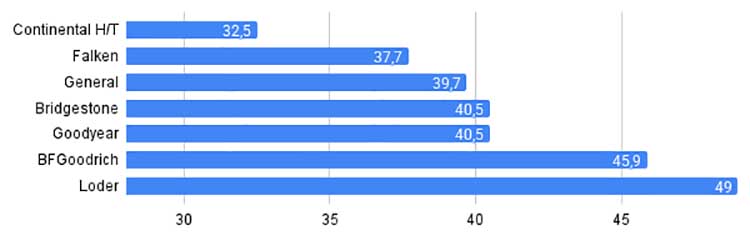
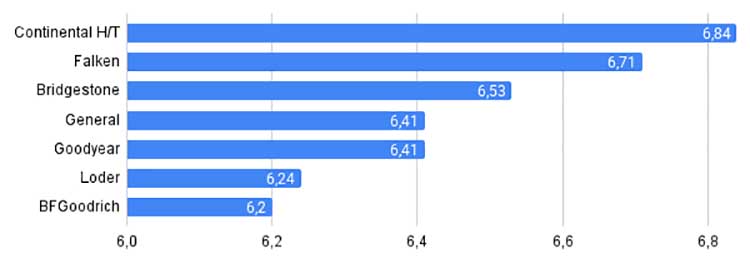
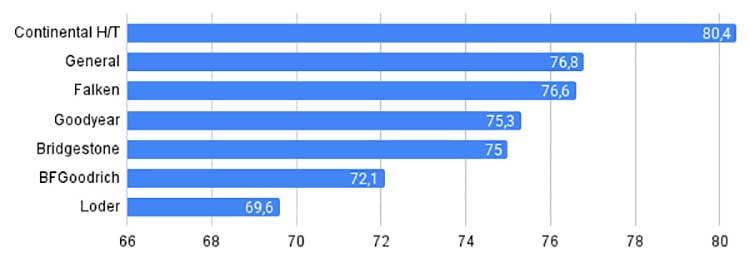
Continental also very effectively resists aquaplaning, and Goodyear and General performed the worst in this regard.
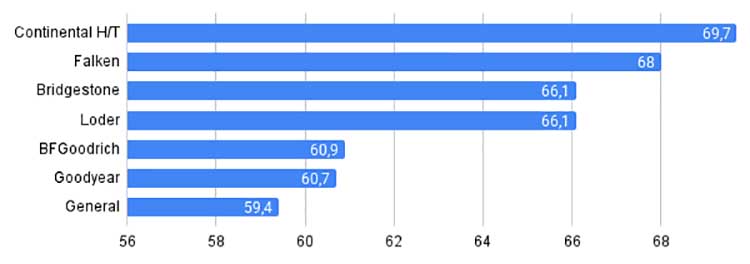
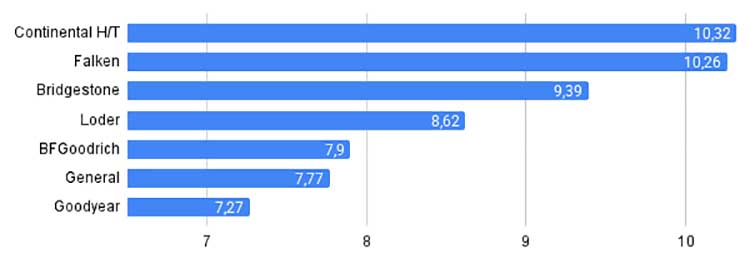
On dry asphalt, BFGoodrich and Loder again lag behind, and Continental was recognized as the best in terms of handling, although they conceded to Bridgestone in terms of braking performance.
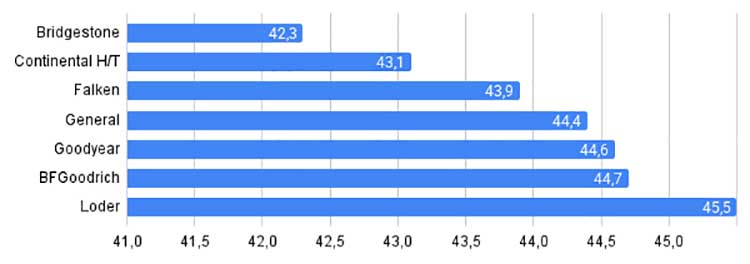
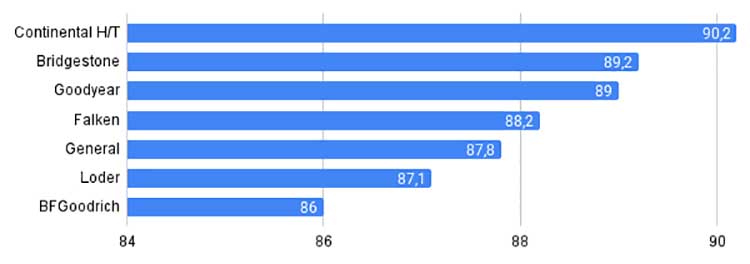
In the test for external noise level, Continental took first place, and BFGoodrich and Falken were the loudest.
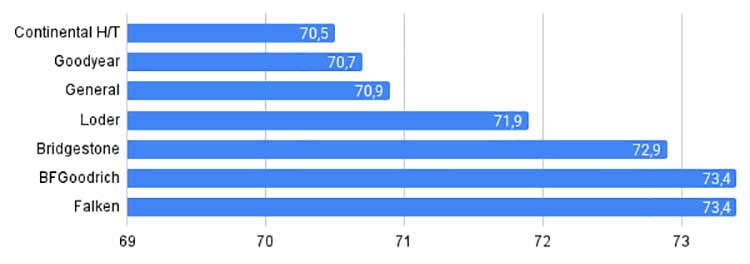
Rolling resistance was also measured, and Bridgestone turned out to be the most economical, while BFGoodrich tires significantly worsen fuel efficiency.
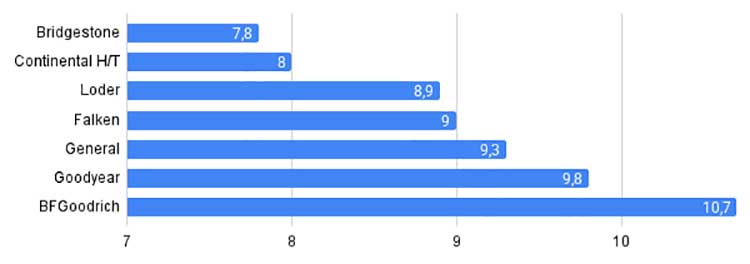
According to the results of the entire test, the "Very Good" rating was received by Falken Wildpeak A/T AT3WA and General Grabber AT3 tires, and the first of them showed results above average on almost all types of surfaces. For example, Falken has excellent traction in mud, and on gravel, they provide both a short braking distance and good stability in turns. If we talk about drawbacks, there is a certain lack of grip on dirt surfaces.
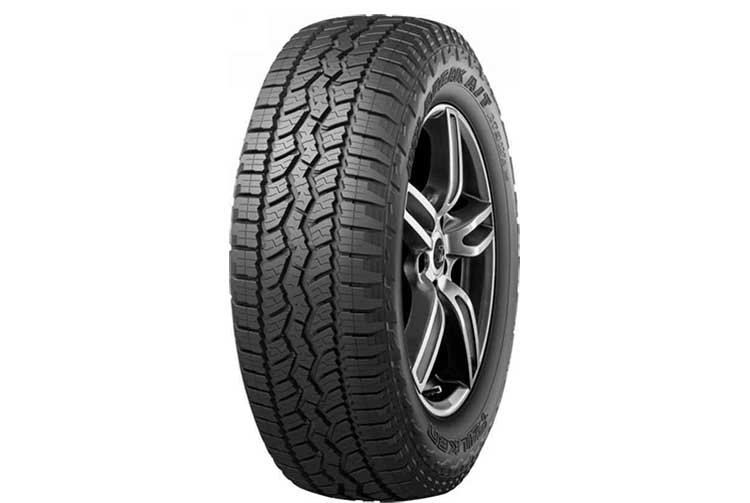
In turn, General tires are perfect for off-road and snow, and the tires each time confidently pulled the car out of the mud, and on dirt roads, they also have excellent grip. At the same time, the indicators on gravel are not so high.
Bridgestone Dueler All-Terrain A/T002 earned a "Good" rating, as although the grip on snow is not particularly impressive, they can provide a high level of safety on asphalt, including wet. It is worth considering that the tires produce a quiet but audible hum, and the ride is quite stiff.
Loder AT#1 tires also completed the test with a "Good" rating, which work perfectly on snow and, in addition, have increased load capacity in the selected size. At the same time, on asphalt, the tires take a very long time to stop the car, cannot provide good grip in turns, and tend to both understeer and oversteer, and when making a sharp maneuver, you have to constantly steer to keep the car on the desired trajectory. In addition, the smoothness of the ride and acoustic comfort leave much to be desired.
BFGoodrich All-Terrain T/A KO2 have similar characteristics, and on snow, everything is fine, but on asphalt, the tires significantly increase the braking distance, and they are also very prone to oversteer. In addition, BFGoodrich was the loudest among the test participants.
Highway Continental CrossContact H/T, as expected, performed poorly off-road and became the clear leader in asphalt tests. In addition, they do not have the 3PMSF marking, which means they are not suitable for snow, and they can only be recommended for those who spend almost all their time driving on paved and cleared roads.
Finally, Goodyear Wrangler All-Terrain Adventure stood out with very good traction in mud, which is combined with fairly high braking efficiency on wet asphalt, and in addition, the tires were quiet and comfortable. At the same time, Goodyear has relatively weak lateral grip in turns on a wet surface, as well as low resistance to aquaplaning.
Source: Auto Motor und Sport