Off-Road Tire Test by Tyre Reviews — 2024
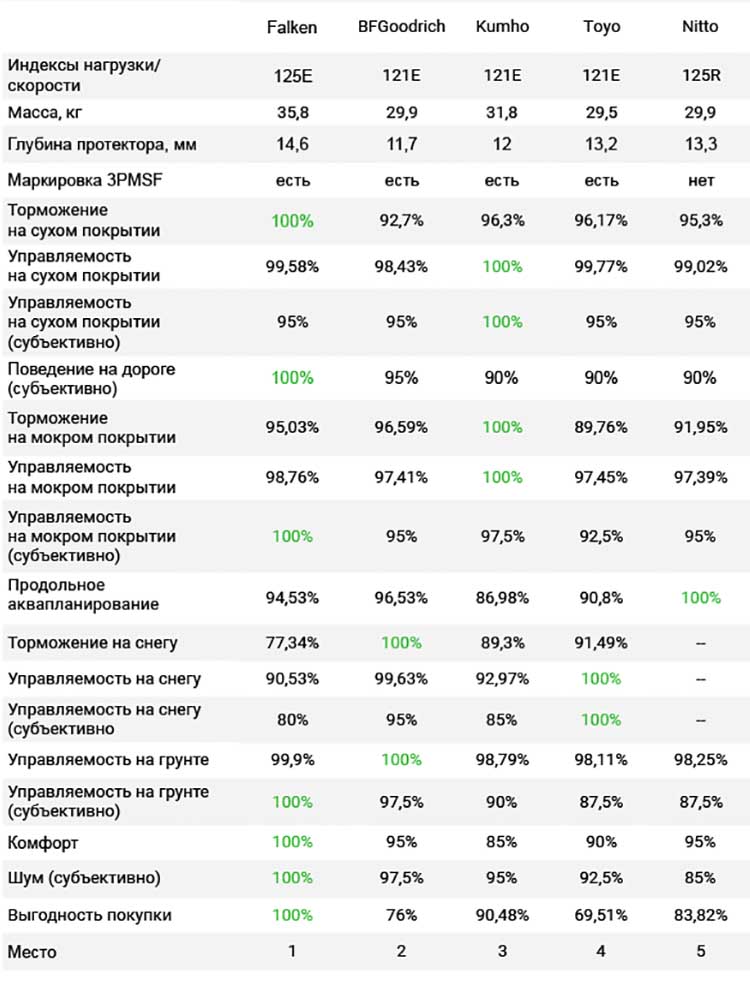
The Tyre Reviews portal continues to publish the results of its own tire tests, and this time the project's author, Jonathan Benson, compared the characteristics of five All-Terrain category tires in the 35x12.5R17 size, testing them on off-road, dry, and wet asphalt. Additionally, snow tests were conducted, and a rating of tires by cost and warranty mileage was compiled, which is designed to show how financially viable the purchase of certain tires can be.
The test included BFGoodrich All-Terrain T/A KO2 (a new model, BFGoodrich All-Terrain T/A KO3, has already been released, but it was not available in the required size), Falken Wildpeak AT4W (a 2024 novelty), Kumho Road Venture AT52, Nitto Recon Grappler A/T, and Toyo Open Country A/T III, with off-road tests conducted on a rallycross track with compacted dirt sections and muddy puddles.
On the off-road track, Toyo and Nitto from the same manufacturer took the last places. According to Benson, Nitto had slightly better traction on the front axle, while Toyo also had good grip on the same axle, but they felt very stiff even at 1.7 bar, which made the rear of the car less stable and "there was less confidence when 'giving gas', especially when restoring traction."
BFGoodrich and Falken showed the best time, with the former having excellent traction and braking qualities, but the high stiffness of the carcass made itself felt on unevenness. In terms of traction on the front axle, Falken slightly lost to BFGoodrich, but Benson notes that the Japanese brand's tires had better handling and helped to feel confident in any situation due to reliable stability.
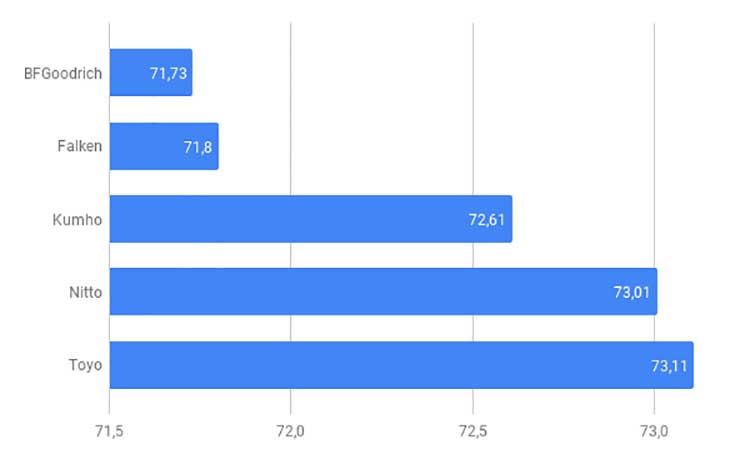
A/T class tires should also work well on asphalt, and on dry pavement, parameters such as predictability of behavior, stability, noise, and comfort were evaluated. On a dry surface, Toyo and Nitto were again similar, with roughly the same handling characteristics, response to steering wheel turns, and smoothness of the ride. At the same time, Nitto made noticeable noise in most speed ranges, both on straight and in turns, while Toyo was "almost silent" at 80 km/h but began to make noise when increasing speed.
Kumho showed themselves as sporty tires with sharp reactions to the driver's actions, which was even strange for tires of this category, and they were also quiet and provided "good, if not excellent" comfort.
BFGoodrich had the most blurred reactions to steering wheel turns and were quite quiet at low speeds, with overall good comfort, and stiffness was only felt when driving over large bumps. In turn, Falken again coped well with all tasks: noise on high speeds was minimal, and although some noise appeared in turns, in terms of acoustic comfort, the tires were among the best among those tested. The smoothness of the ride was also good.
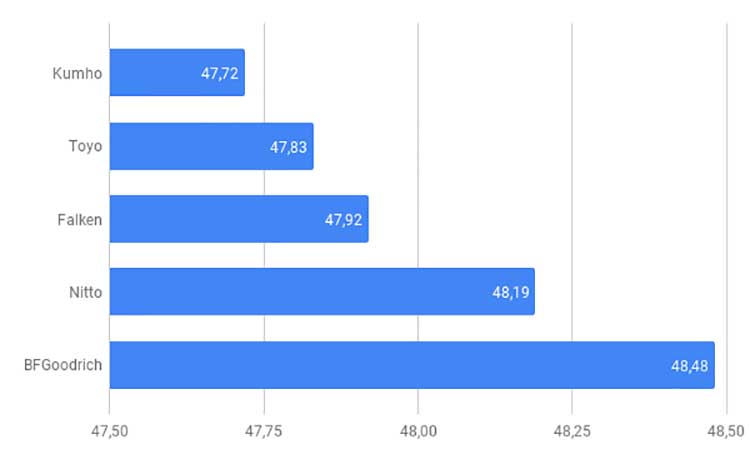
Falken also stopped the car faster than all competitors on dry pavement, with the longest braking distance recorded by BFGoodrich.
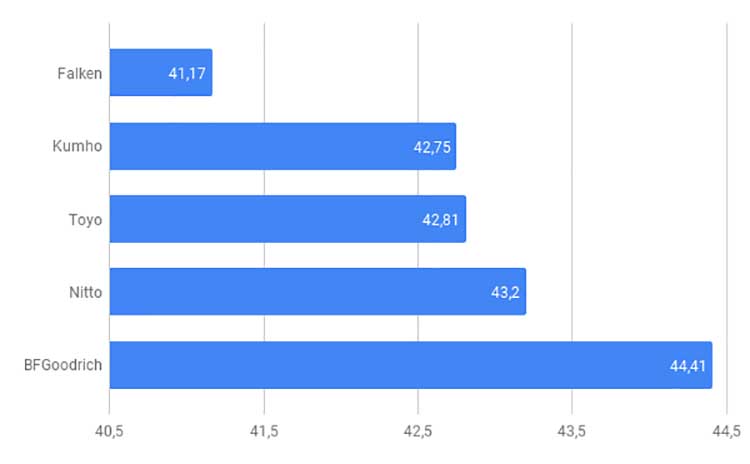
In wet asphalt tests, the tires divided into two groups, with the first including Nitto, Toyo, and BFGoodrich, which had similar lap times, a strong tendency to skid, and reduced traction when exiting turns. The second group consisted of Kumho, which provided optimal traction on the front axle but not as high on the rear (as on dirt surfaces), and Falken, which were the most balanced and guaranteed good informativity.
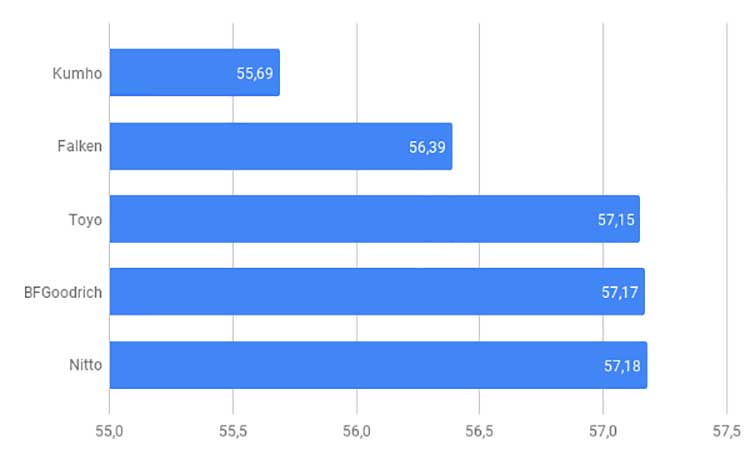
In terms of braking efficiency on wet pavement, Kumho was the best, while Toyo's result was 11% worse, which is quite significant.
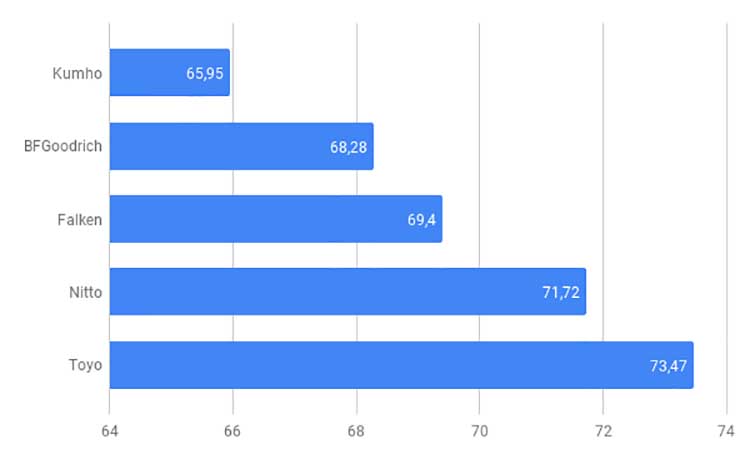
The resistance to longitudinal aquaplaning was also evaluated, with Nitto taking the first place, and BFGoodrich and Falken also showing good results.
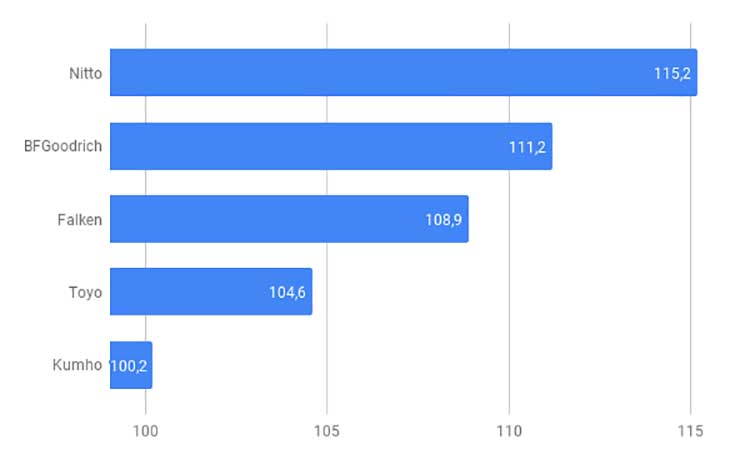
The snow tests, according to Benson, were not easy: "At the site we usually use, there is usually enough deep snow, but upon arrival, we found only a few inches. After a few days of waiting, some snow fell, but it quickly melted, and then froze again, creating terrible conditions for testing."
As a result, BFGoodrich showed the best braking performance, Toyo also had good indicators, and Kumho and Falken were slightly behind. In the handling test, Toyo was able to overtake BFGoodrich, while Kumho and Falken showed similar results. Falken noted that they slightly reduced the traction of the AT4W on snow in LT sizes to improve other characteristics, while Nitto tires did not participate in the test as they do not have the 3PMSF marking (the tires did not pass snow tests and are not intended for winter use).
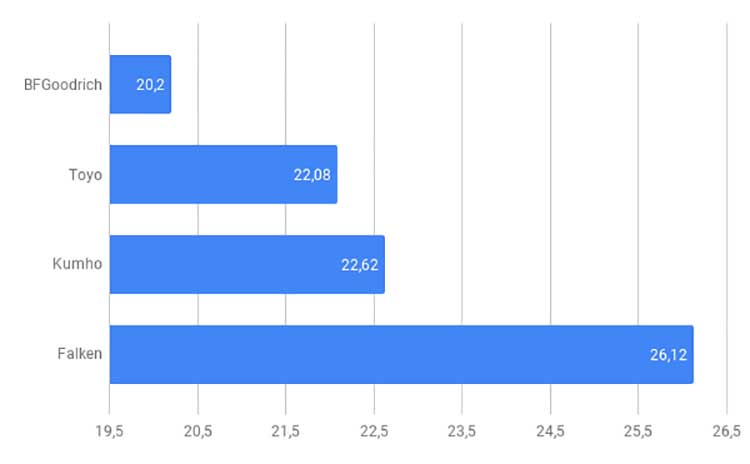
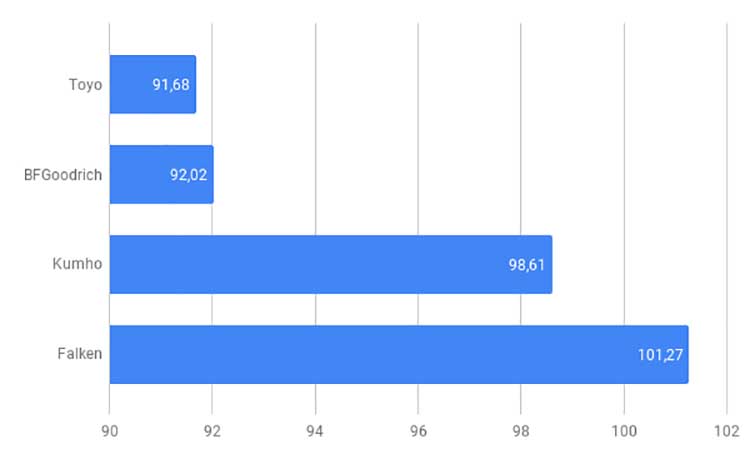
Finally, the rating by warranty mileage and price was led by Falken (although tire wear tests are still necessary to evaluate durability). Although Kumho and Nitto were cheaper, the Falken manufacturer (Japanese Sumitomo) claimed a higher mileage, making them a potentially more profitable purchase.
Falken Wildpeak AT4W also took first place in the overall standings, as they have an excellent balance of characteristics and only allowed themselves weaknesses on snow. BFGoodrich All-Terrain T/A KO2 took second place, which, although one of the oldest models in the test, still shows good results, especially on off-road and snow. On asphalt, the indicators were not the best, but quite acceptable, which means the tires also have sufficiently balanced parameters.
While BFGoodrich is clearly made with a focus on off-road qualities, Kumho Road Venture AT52 is designed with an emphasis on improving on-asphalt performance, and they can be recommended to those who use their car on paved roads most of the time. In turn, Toyo Open Country A/T III showed excellent results on snow but had reduced traction on wet pavement, which worsened their position in the rating, and Nitto Recon Grappler A/T worked well off-road and had other advantages, such as very effective water drainage from the contact patch, but loud noise and the lack of 3PMSF marking clearly limited their appeal.