
Budget Summer Tyre Test by Moottori — 2025
For a new test, the Finnish publication Moottori selected affordable summer tires in the size 205/55 R16, taking as a sample a more premium product, the tire from Nokian. The tires were tested on wet and dry asphalt, and the testers also measured the level of external noise and rolling resistance. The list of participants included the following models:
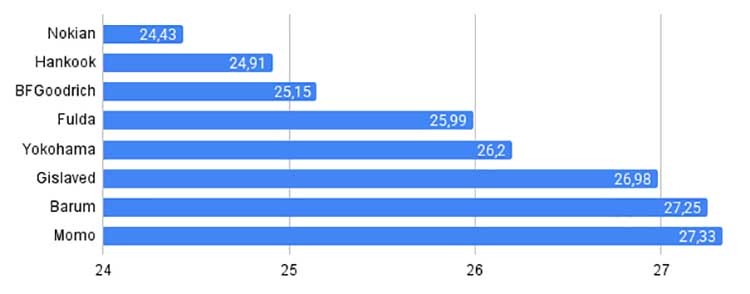
While the test participants mostly belong to the mid-price segment, Momo tires are more budget-friendly, and this is noticeable in the long braking distance on wet asphalt. At the same time, Barum has almost the same result, and this tire is manufactured by the German concern Continental. Nokian tires became the best in this discipline, followed by Hankook.
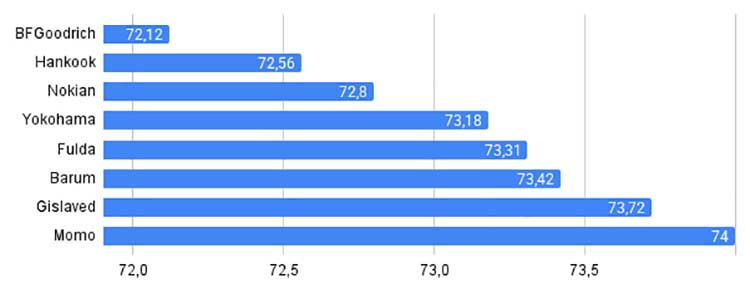
In the wet handling test, BFGoodrich stood out, clearly outpacing all competitors, while Momo was again at the bottom of the list.
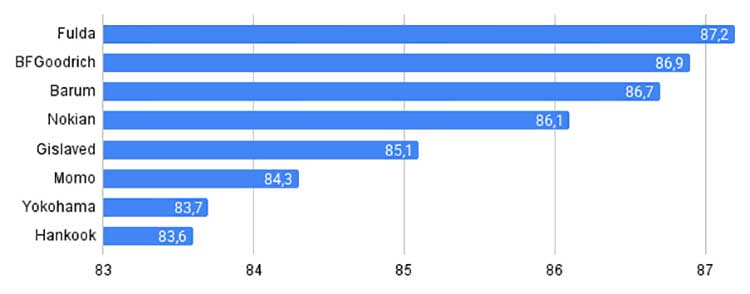
Resistance to longitudinal aquaplaning is crucial, and in this test, the Fulda tire became the leader, while Yokohama and Hankook had relatively weak results.
The most effective in terms of braking on dry asphalt were — as on wet surface — Nokian and Hankook, and the worst were the same Barum and Momo.
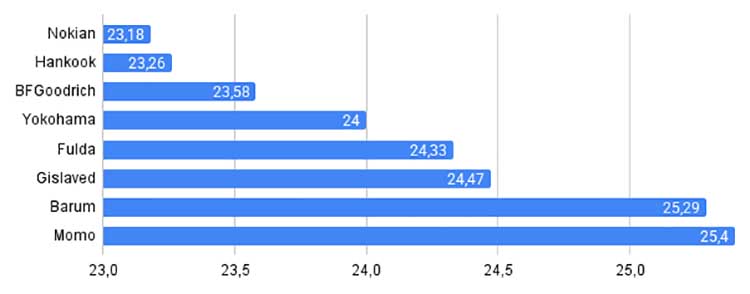
Nokian was also the quietest among the tested tires, while Momo produced the loudest noise.
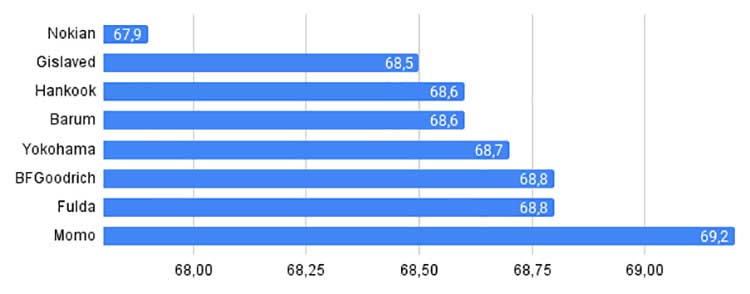
Test results
The Nokian Hakka Blue 3 took the first place in the test, thanks to the shortest braking distances on both dry and wet surfaces. The tires also resist aquaplaning well, behave stably and predictably in any conditions, and have a very low noise level, making them a balanced choice for those willing to pay extra for increased safety.
The BFGoodrich Advantage took second place, as it also boasts a good balance of characteristics, and thanks to excellent handling on wet surfaces and high resistance to aquaplaning, it can improve safety in difficult weather conditions. According to experts, on dry surfaces, BFGoodrich also has good grip and informativeness, and it effectively maintains controllability during emergency obstacle avoidance, while low rolling resistance helps save fuel.
The Hankook Ventus Prime4 was only 0.1 points behind BFGoodrich, as it quickly and accurately responds to steering wheel turns on wet surfaces, but it's worth noting that at high speeds, the grip is not as reliable as some competitors. Hankook also scored points for short braking distances on dry and wet surfaces but took last place in the test for resistance to longitudinal aquaplaning.
The Fulda EcoControl 2 did not show weaknesses in any discipline and effectively resists aquaplaning, also featuring very low rolling resistance. The braking properties on wet surfaces were good, and there were no serious complaints about handling in various conditions.
The Yokohama BluEarth-GT AE51 took fifth place, which was also developed with a focus on fuel efficiency, and the rolling resistance is so low that compared to Momo, the tires can save 0.2 liters of fuel per 100 km. Handling and grip were good, as was acoustic comfort.
In Russia, Gislaved tires are currently produced by Cordiant, and the Gislaved Ultra*Speed 2 model from Continental showed the sixth result in the test. The testers noted that the tires work especially well on dry surfaces at moderate speeds, and on wet surfaces, handling is acceptable, but when the load increases, the grip becomes less stable. At the same time, the tires behave predictably and can be considered a good option for those who prefer a calm driving style.
The Barum Bravuris 5HM has good resistance to aquaplaning, but at the same time, the grip on wet surfaces is relatively low, especially when increasing speed. On dry surfaces, the indicators are not outstanding but acceptable, and Barum is an affordable tire with both strong and weak sides.
The last place was taken by the Momo Outrun M20 Pro tires, produced in Vietnam, which can provide good ride smoothness but require additional caution when driving on wet roads due to reduced grip and long braking distances. Additionally, Momo was the loudest among all test participants.

Source: Moottori