
Summer tire test from Vi Bilägare — 2025
In recent years, one of the most debated issues in the global tire industry has been whether electric vehicles, with their unique characteristics, require special tires or not. Some manufacturers have launched separate models for this new and rapidly evolving segment, while others have not, so the team at Vi Bilägare decided to put this to the test. For the new tire test, the 235/55 R19 size was chosen, a popular size in the crossover segment, and the electric Kia EV6 was used as the test vehicle. The experts asked the manufacturers which tires they would recommend for the owners of this vehicle, and the answers were surprisingly similar, with all companies offering their standard products as the best choice for consumers, and none claiming that special tires are needed.
In the 235/55 R19 size, Ultra-High Performance tires are often found, and for the test, manufacturers recommended these, with the exception of Pirelli, which chose the Scorpion tire in the High Performance class. According to the testers, UHP tires usually have higher grip, but not the longest lifespan, while HP tires are designed with a greater emphasis on comfort and can travel more kilometers before needing to be replaced, but unfortunately, it was not possible to test this, so the Treadwear index had to be used, which, at least in theory, should give an idea of the durability of the tires.
Regarding why manufacturers offered standard tires, even though some of them already have special models for electric vehicles, they replied that EV tires are intended for supplies to car manufacturers, not for sale to ordinary consumers. Therefore, for example, Michelin stops selling Pilot Sport EV tires on the secondary market. At the same time, it is possible to find tires that have been approved by a particular automaker in online stores, so the team at VB decided to also check how they differ from serial tires without special marking on the sidewalls. Two sets of tires developed for Volkswagen and Volvo were purchased, and although these brands are respected, unfortunately, the characteristics of the adapted tires were not as good as one might expect. The fact is that when manufacturers specify requirements for tires, they can choose to reduce rolling resistance to make their cars more environmentally friendly, and for this, it is likely that some compromise on grip and, therefore, safety will have to be made. Currently, car manufacturers are making every effort to ensure the declared range of electric vehicles and comply with environmental regulations, so the grip of the tires on the road has become a secondary parameter, and the VB test confirmed this, because the tires with the VOL and plus marking (indicating approval for VW) on the sidewalls indeed allow you to travel a few extra kilometers on a single battery charge, but they have, for example, noticeably lower resistance to aquaplaning.
The experts decided not to mention the names of the tires with approval, since the characteristics were determined not by their manufacturer, but by the client from among the automakers, on whom the responsibility for the deterioration of certain parameters lies. And the claims against the OE tires were indeed serious, as their overall rating turned out to be "stunningly close" to the result of a budget tire that also participated in the test, and good economy is no longer helpful here.
As emphasized in VB, all tires should always be subject to the same requirements, and safety will be the priority in any case, and the test revealed another interesting pattern: as the weight of the vehicle increases - and electric cars are heavier than ordinary cars - the difference in the behavior of the tires when performing emergency maneuvers also increases, and the budget tire was not able to keep the EV6 on the desired trajectory at all. Thus, the higher the power and weight of the car, the more important the characteristics of the chosen tires are.
The tests were carried out in early November 2024 at a test site in Spain, near Madrid, in unusually cool weather. Not long before that, a major natural disaster had struck Valencia, and the temperature during the tests was around 10 degrees, and such conditions are often encountered in Russia in the spring and autumn. The list of participants included the following tires:
Goodyear Eagle F1 Asymmetric 6
Hifly Vigorous HP801 (produced by the Chinese company Shandong Hengfeng Rubber & Plastic Co., Ltd.)
Nokian Hakka Black 3 SilentDrive (with a sound-absorbing insert in the tire cavity that reduces noise level)
Tires with approval from Volkswagen
Tires with approval from Volvo
Wet asphalt
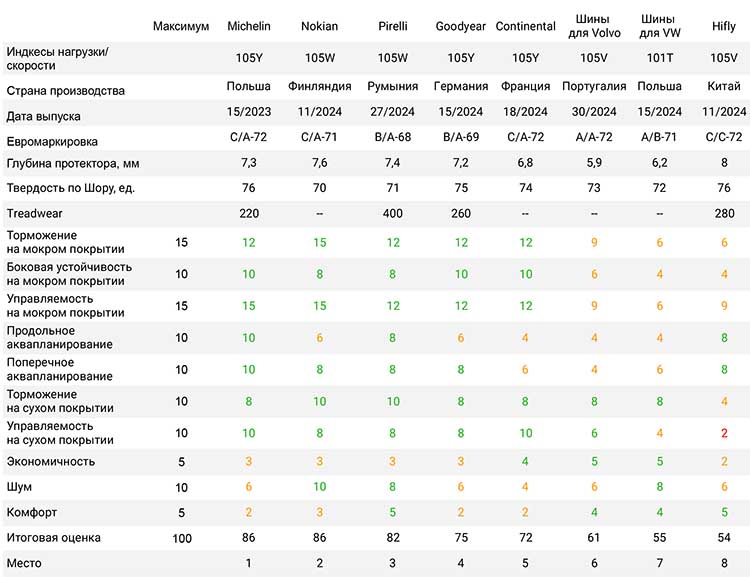
On wet pavement, Nokian demonstrated the best braking efficiency in cool weather, and it should be said that the Hakka family was developed for the "strict requirements of the northern summer". Budget Hifly took last place, and the results of the approved tires were also relatively weak.
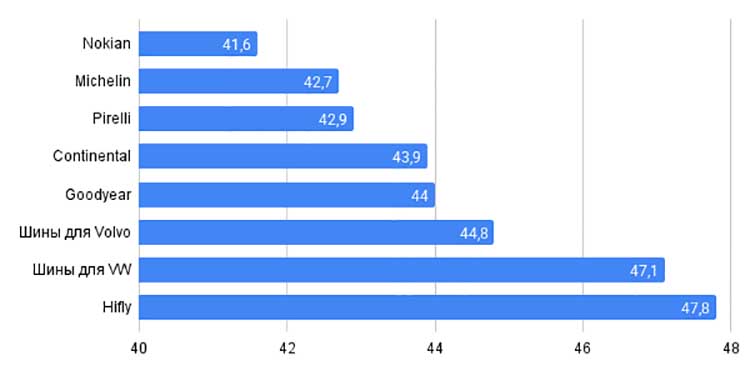
Lateral stability on a circular track was evaluated at higher temperatures, and here Goodyear and Continental were the best, while OE tires and Hifly lagged behind.
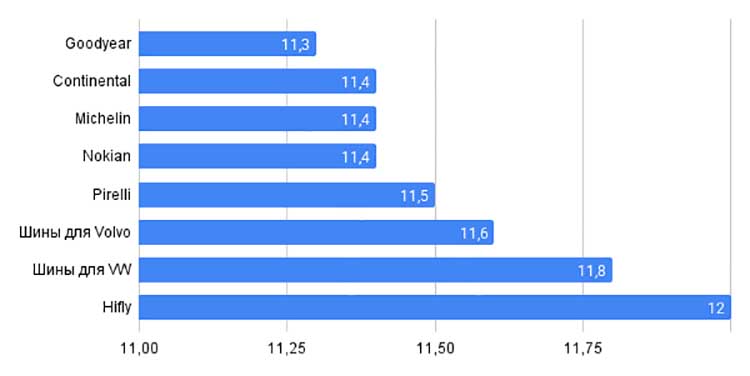
In the handling test, Nokian again showed themselves to be excellent, but still lost to Michelin, while Hifly showed a strong tendency to understeer, and the tire adapted for Volkswagen can lose grip on wet asphalt.
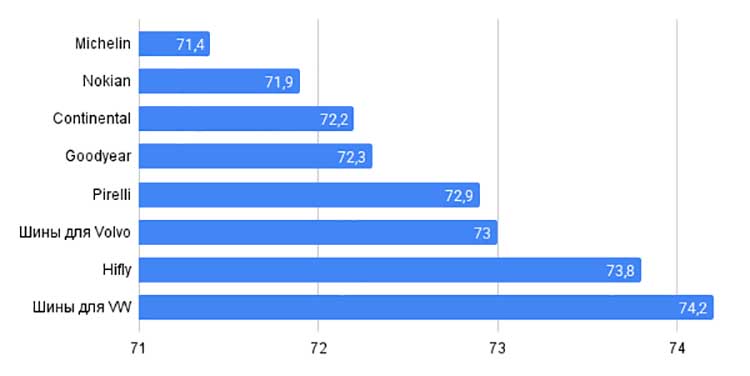
Michelin also has the best resistance to longitudinal and transverse aquaplaning among the tested tires, and the last places were taken by approved tires, which were joined by Continental.
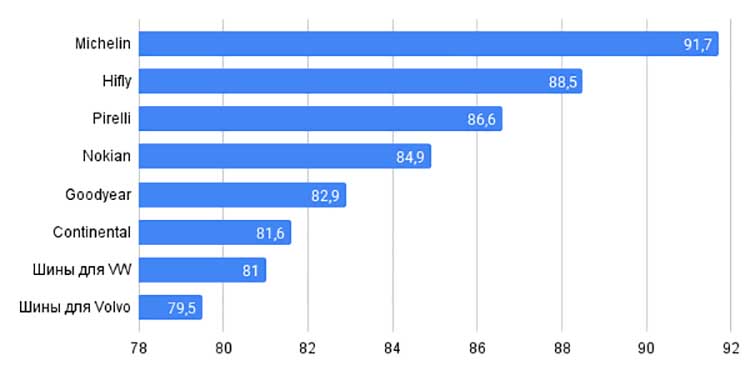
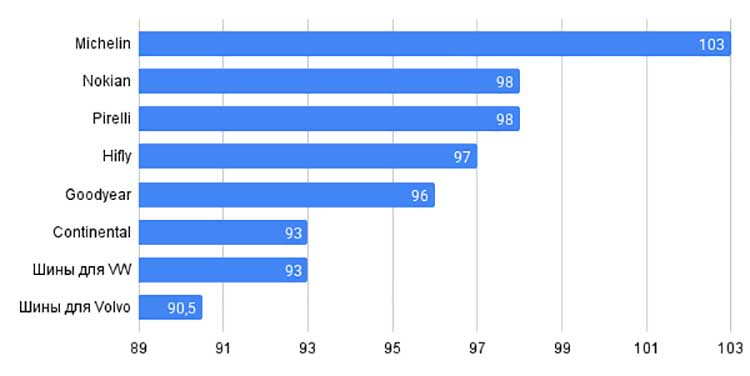
Dry asphalt
All participants in the test allow you to quickly stop the car on dry roads, and only the cheap Hifly had a fairly long braking distance.
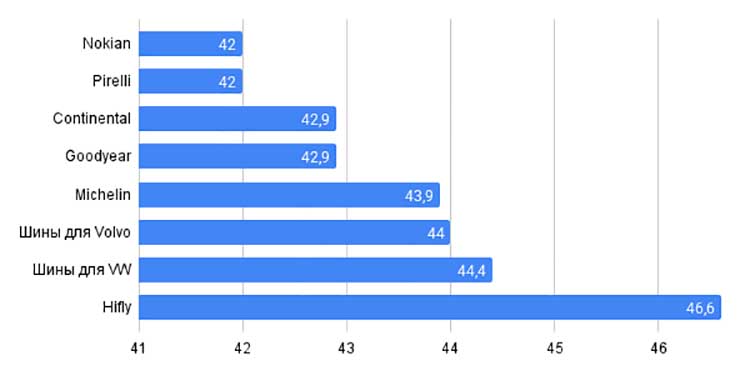
If earlier Hifly was not as effective as more expensive products, in the handling test on dry pavement, they received a rating of "Poor", as they cannot provide good controllability under load.
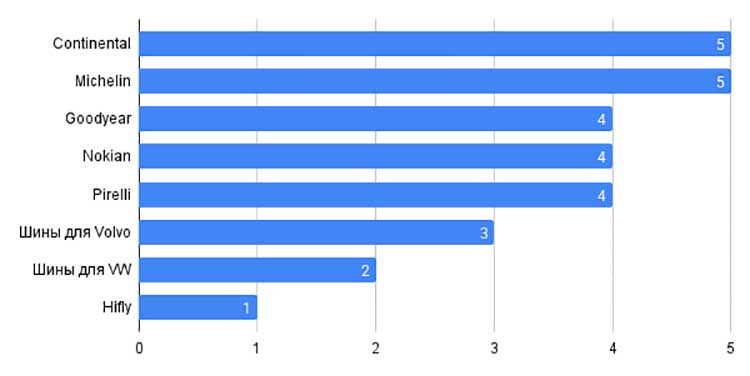
The range was measured at a constant speed on an oval track, and here the approved tires fully confirmed their "specialization", taking both first places. In addition, Continental had a very good result, and budget Hifly have increased rolling resistance.
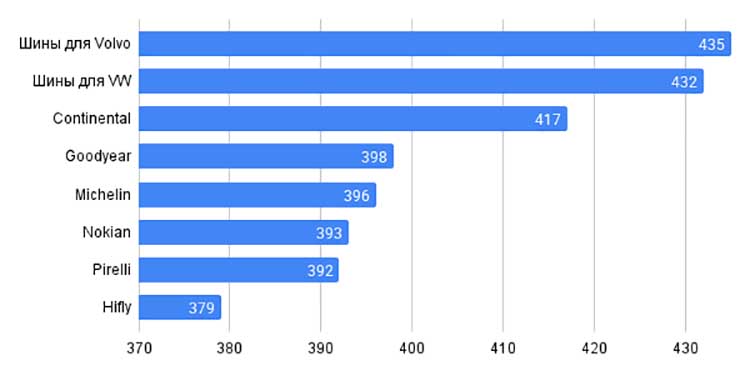
For noise, a subjective assessment was made, taking into account its volume on three types of surfaces at 70 and 110 km/h, and for comfort, points were awarded based on how the tires behave on uneven surfaces, when hitting a pothole, etc.
Test results
According to the results of all disciplines, two tires - Michelin Pilot Sport 4 SUV and Nokian Hakka Black 3 - received the same number of points and should have shared first place, however, the experts decided that since Michelin had higher ratings in tests that are important for safety, they would be the winner, and Nokian would be placed second. Michelin tires provide excellent handling on both dry and wet pavement, and they also have the best resistance to aquaplaning among the participants in the test, and the disadvantages can be considered increased rolling resistance and a relatively low level of comfort. At the same time, Nokian is clearly not afraid of cool weather and in similar conditions can stop the car very quickly. Handling is also good, but overall, the grip on wet roads is still better for Michelin.
Since Pirelli Scorpion belongs to the HP class, they should have an improved level of comfort, which the tires confirmed in the tests. Compared to UHP tires, the reactions to steering wheel turns are not as sharp, but Pirelli behaves stably and predictably, although the grip is not as high as that of the leaders. The tires also handle aquaplaning well, and Pirelli also had a short braking distance on wet asphalt.
Goodyear Eagle F1 Asymmetric 6 used to be one of the best in VB tests, and this time they were possibly hindered by the relatively low air temperature. Braking efficiency is good, handling is also good, although the reactions are more blurred than those of Continental or Michelin. In addition, the tires lost points due to reduced resistance to aquaplaning.
Continental PremiumContact 7 tires seem to work better at higher temperatures, and in cool weather, the level of grip decreases, which affected the final rating. At the same time, the experts noted that Continental responds instantly to the driver's actions and very well keeps the trajectory in sharp turns, and besides, they have extremely low rolling resistance, so if we talk about the balance between grip and economy, then here Continental PremiumContact 7 should be recognized as the best. However, it should be taken into account that Continental has reduced resistance to aquaplaning and a not very good level of comfort.
Sixth place went to the tires with approval from Volvo, which have an "A/A" rating on the EU label, which implies that they combine low rolling resistance with high grip on wet roads. At the same time, the marking only talks about braking qualities in rainy weather, but not about resistance to aquaplaning, which is lacking in tires with the VOL designation. According to the testers, at the limit of grip, the tires behave predictably and controllably, but overall, they lag behind "ordinary" tires and do not handle high speeds when cornering as well. Economy is excellent, but this is not enough to get a higher rating.
The tires for Volkswagen are also clearly designed with the aim of maximizing energy efficiency, and the grip on wet pavement turned out to be even weaker than expected. Braking distances are long, lateral stability is low, and under load, there is a risk of skidding, so the tires take only the second place from the end.
The last place was taken by Hifly Vigorous HP801, which have an attractive price, and they also have good resistance to aquaplaning, and the grip on wet pavement is not as bad as that of other budget tires. However, the braking distances are long, but what's even worse, in sharp turns, the tires do not allow you to maintain control over the car, and they clearly lack lateral stability. In general, Hifly are clearly not suitable for heavy cars, although they have the necessary load capacity, the experts summarized.
Source: Vi Bilägare