
Summer tire test from Teknikens Värld — 2025
In a new test by the Swedish magazine Teknikens Värld, tires of size 235/55 R19 were tested, and experts did not select models of a specific type, such as sports or economical ones, but took tires of different categories to see how they work in comparison and what real differences exist between them. For this reason, the list of participants included, for example, Goodyear of the UHP class and Continental from the "comfort" category, Michelin with reduced rolling resistance and Pirelli, designed specifically for crossovers and SUVs. In addition, Michelin's all-season tires with Volvo's homologation were tested, as well as the cheapest tires that could be found, namely Goodride from the Chinese ZC Rubber, and as a result, the list of participants looks like this:
Goodyear Eagle F1 Asymmetric 6
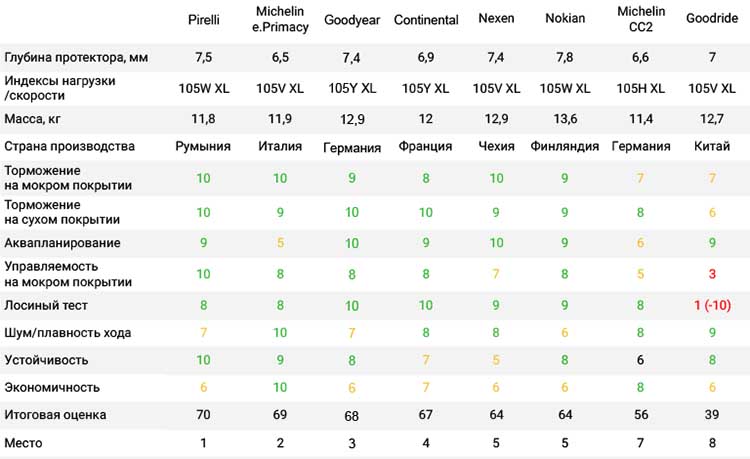
This year, all tires were able to quickly stop the car on dry pavement, and the only exception was the cheap Goodride, and on the wet track, they were also joined by Michelin's all-season tires at the bottom of the rating. At the same time, Michelin's "green" e.Primacy tires demonstrated that low rolling resistance can be combined with good traction, and on wet pavement, they even turned out to be the best in terms of braking performance. Nexen also showed a good result in this discipline, and the testers noted that the Korean manufacturer is rapidly improving the characteristics of its tires, but the developments are very expensive, so Nexen's tires were more expensive this time than in previous years. At the same time, Nexen's results indicate that with the necessary investments, there is a real opportunity to produce tires that will compete on an equal footing with premium products in tests.
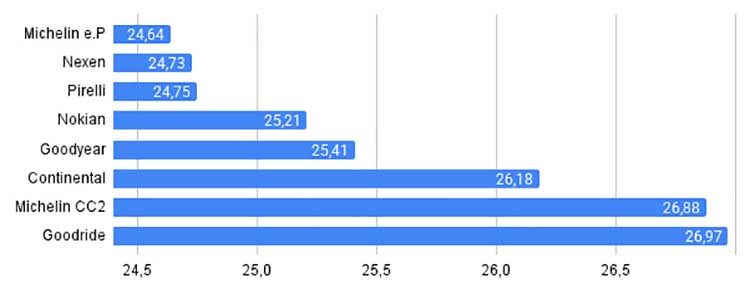
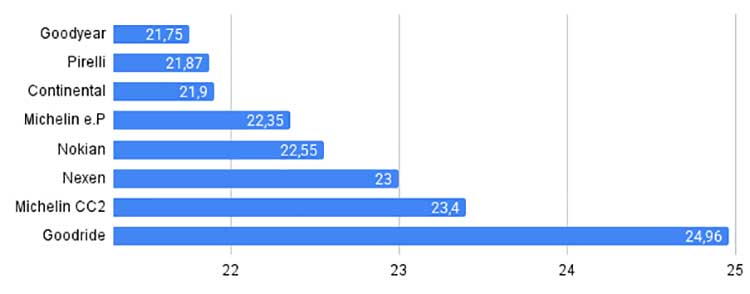
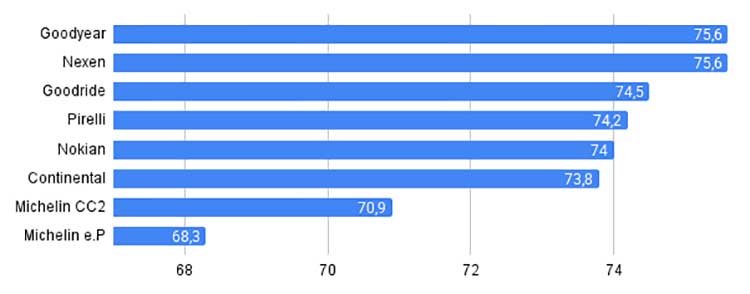
In the tests for resistance to longitudinal aquaplaning, there were two tires with really weak results, and they were both made by Michelin. It is believed that if tires can withstand speeds above 75 km/h, this is a good result, and last year all participants coped with this, but this year the situation was different, and the worst performers were the economical e.Primacy, which lose traction at 68.3 km/h. The result of the all-season CrossClimate 2 was 70.9 km/h, but at least they have an "excuse" since, due to their specialization, they are made from a softer rubber compound, while the weak performance of the e.Primacy remained unclear.
Goodyear and Nexen shared first place, and if this is not surprising for the first tires, since American brand products usually perform well in this discipline, then for the second, such a result again confirms that the Koreans are clearly moving in the right direction.
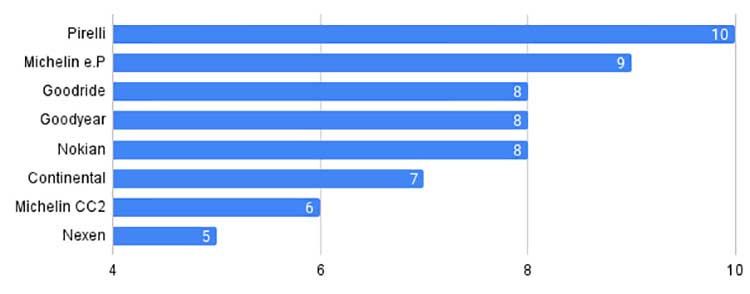
In the tests for handling on wet pavement, Pirelli was recognized as the best, providing excellent ease of handling even under heavy loads. Continental, Goodyear, Michelin e.Primacy, and Nokian slightly lagged behind, as they generally had a lower level of traction, less precise reactions to steering wheel turns, and an increased tendency to understeer. Michelin CC2 has much lower grip, and handling deteriorates, but the car still does not skid. At the same time, Goodride has very weak traction and a strong tendency to both understeer and skid, which creates a safety hazard, and it is not recommended to buy these tires.
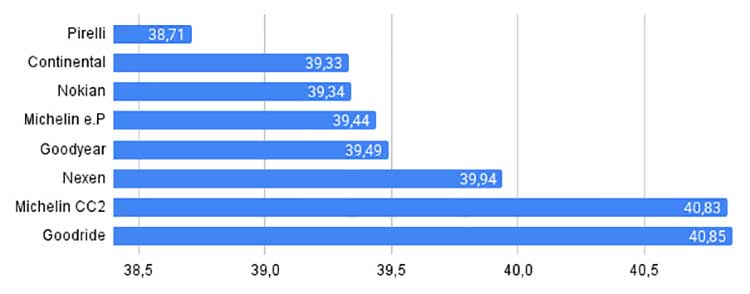
In the moose test, which simulates an emergency obstacle avoidance, Continental and Goodyear were the best, behaving almost identically with a slight tendency to understeer and a high level of traction. The rest of the tires also showed good results, and only Goodride stood out, which the experts said had indicators in this discipline that were inferior to many winter tires, which, of course, is a concern. In general, such a lag of some tires in the moose test, the testers had not seen before, so budget tires, unfortunately, can still have very low characteristics.
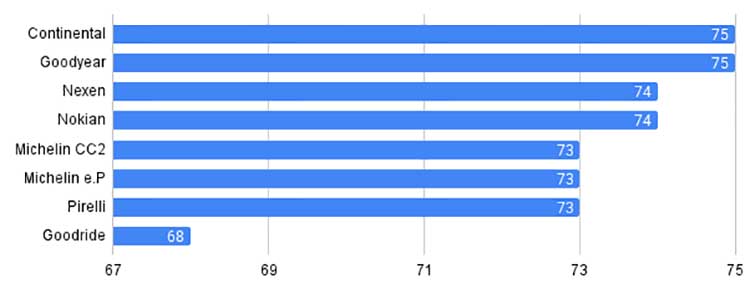
Michelin e.Primacy turned out to be the best in terms of damping properties and noise level, which significantly outperformed all other premium tires in these parameters, and the second place was taken by the cheap Goodride. On smooth surfaces, the noise level is approximately the same, and on rough asphalt, Goodride is slightly louder. The tires effectively absorb unevenness, and in general, such good results were not expected from them.
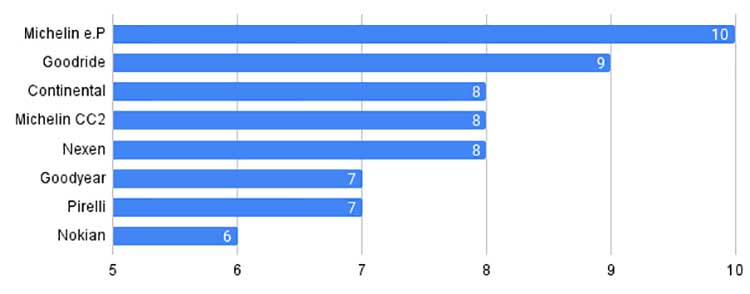
The stability in various situations was also evaluated, i.e., the experts considered how the car follows the desired trajectory in turns and whether it requires steering correction when moving in a straight line. The tests were carried out on ordinary roads at speeds from 50 to 110 km/h, and it quickly became clear that the car can behave completely differently depending on the tires. Pirelli took first place, which very accurately followed the driver's actions and provided excellent stability both on straight roads and in turns. High scores were also received by Michelin's summer tires, while Continental lost points due to poor informativeness. Michelin's all-season tires with their soft compound are inferior to summer models, and Nexen behaved very similarly, i.e., they responded sluggishly to steering wheel actions and worsened stability.
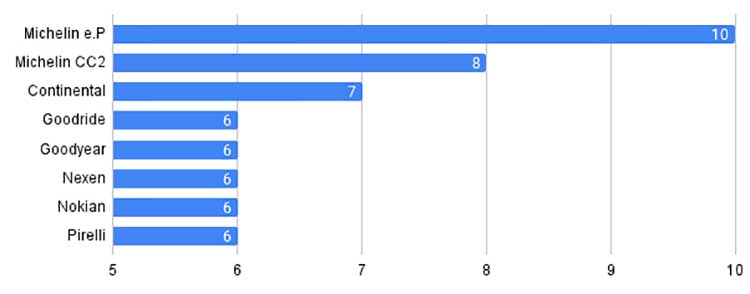
Finally, in the fuel efficiency test, Michelin e.Primacy took the expected first place, which combines low rolling resistance with very good braking performance on wet pavement. Michelin CC2 and Continental also showed good results, and the indicators of the rest of the tires differed insignificantly.
Test results
Pirelli Scorpion takes the gold, providing excellent traction in any conditions, and although the noise and rolling resistance are relatively high, this can definitely be tolerated, considering the ease of handling guaranteed by the Italian brand's tires. The Michelin e.Primacy tire took second place, which is very good at saving fuel, and at the same time, the rolling resistance was reduced without obvious harm to traction. The tires also received high scores for comfort level, but they have one drawback - low resistance to longitudinal aquaplaning. Goodyear Eagle F1 Asymmetric 6 closes the top three, which were generally similar to Pirelli and performed equally well in all disciplines, but slightly inferior to Scorpion in terms of road stability. However, this is still an excellent option.
Continental PremiumContact 7 takes fourth place, which, like the top three, works well on different types of pavement, but slightly lags behind them in terms of stability and sharpness of reactions to steering wheel turns. Next come Nexen N’Fera Sport SUV, which the experts noted are really getting better, but this leads to a price increase, and the same number of points was received by Nokian Hakka Black 3 SUV, which are effective in any conditions, but worsen the smoothness of the ride and acoustic comfort, and also turned out to be the most expensive tires in the test.
Michelin's all-season CrossClimate 2 tires are clearly inferior to the summer tires of the same manufacturer, which was expected in such conditions, and the budget Goodride ZuperEco Z-107 took the last place with a significant lag behind the CC2. According to the testers, they, of course, understood that the cheapest tires available for sale would have low performance, but such a poor result in the moose test, in which Goodride had extremely weak traction, was still a surprise.
Source: Teknikens Värld