
evo Summer Tyre Test 2025
In 2025, the British magazine evo's test featured tires such as Falken Azenis RS820, Maxxis Victra Sport 6, and Yokohama ADVAN Sport V107, which competed against the previous test winners Continental SportContact 7, Michelin Pilot Sport 4 S, Bridgestone Potenza Sport, and Goodyear Eagle F1 SuperSport. Additionally, the Pirelli P Zero (PZ5) was included in the list of participants, and the budget product this time was the Kormoran Ultra High Performance from Michelin. The Vredestein tires were not tested because the company is preparing a replacement for its Ultrac model, but it was not available at the time of the test.
The tests were conducted at the Bridgestone facility in Aprilia, Italy, in hot weather, and the BMW 135i xDrive was used as the test vehicle, equipped with 235/35 R19 tires.
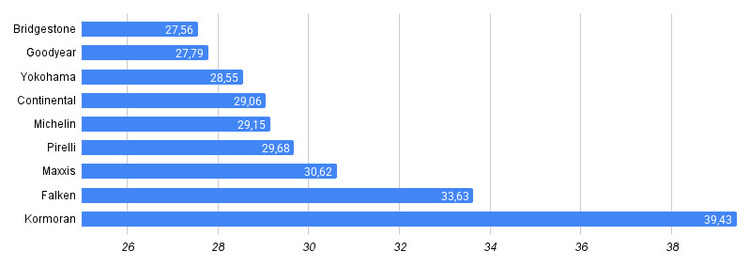
The braking distance on a wet surface was measured from 80 to 19 km/h, and the best results were achieved by Bridgestone, followed by Goodyear, and Yokohama also showed good results. The cheap Kormoran tires had a result about 40% worse than the leader, which significantly reduces the safety level on wet roads.
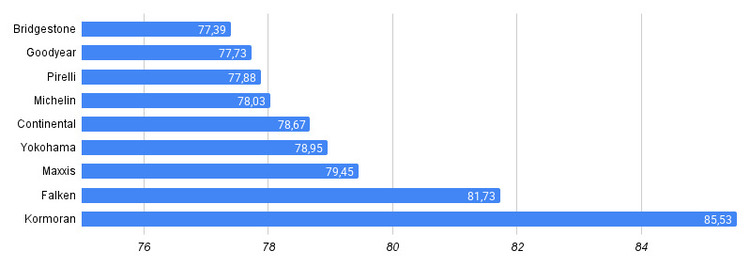
Bridgestone and Goodyear also allowed for the best lap time on the wet track, and Pirelli took third place.
Handling was evaluated both subjectively and objectively, and Bridgestone maintained its leadership, while Continental tires impressed with stable grip when cornering, taking second place. Kormoran was again at the bottom, lacking grip.
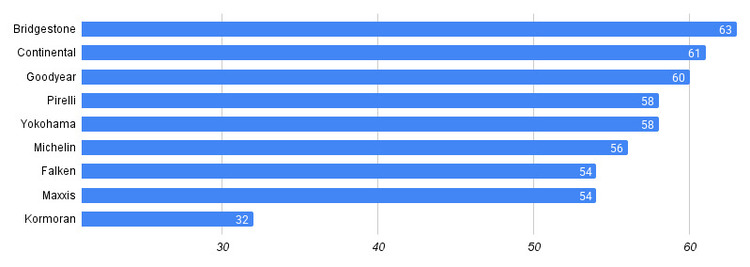
In the test of resistance to longitudinal aquaplaning, Goodyear and Michelin took the lead, while Pirelli and Maxxis showed weak results.
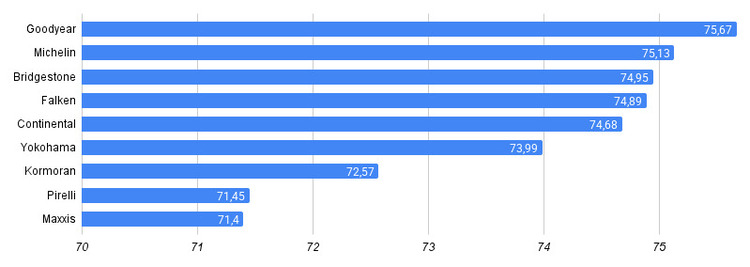
Bridgestone and Goodyear were more resistant to lateral aquaplaning, while Kormoran and Maxxis were at the bottom, joined by Continental.
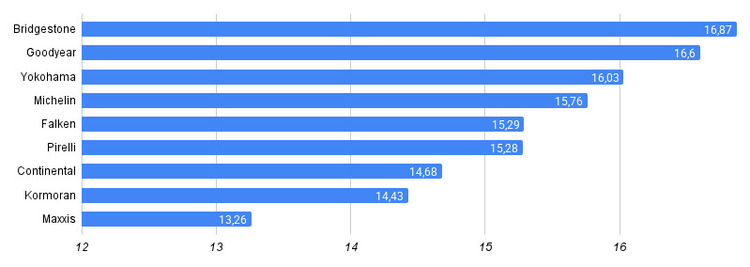
On the dry track, Continental provided the shortest braking distance, while Yokohama took second place, demonstrating very good braking efficiency, unlike Kormoran.
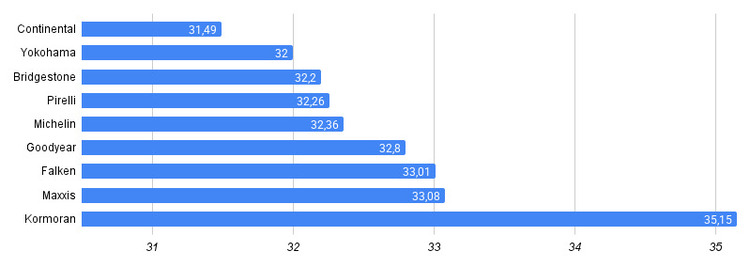
In the dry handling test, the differences between the top tires were measured in hundredths of a second, making the competition fierce, and Bridgestone took the gold. Michelin had a relatively low result, and if it weren't for Kormoran, they would have been last in this discipline.
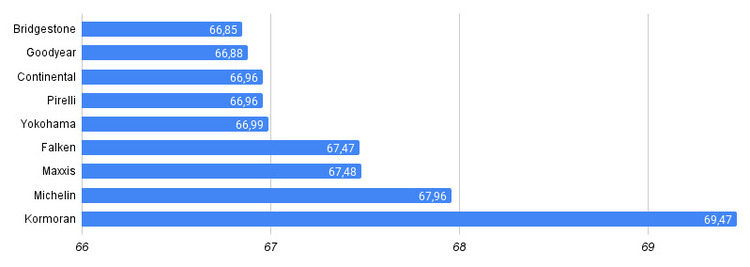
In the subjective handling rating, Bridgestone took second place, while Goodyear was named the best, providing stable handling and precise response to driver actions.
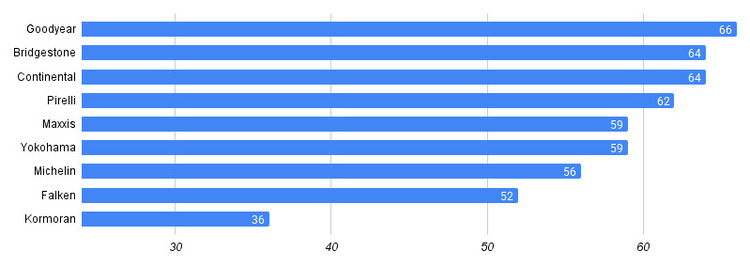
Ride comfort and noise level were evaluated on various surfaces, including those with transverse irregularities and manhole covers, and Michelin and Bridgestone were named the best, while Kormoran was again at the bottom. Additionally, Pirelli had a reduced comfort level.
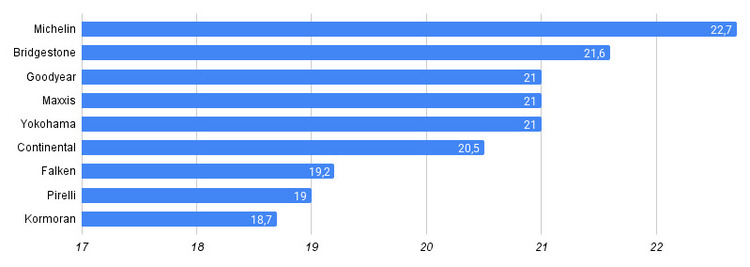
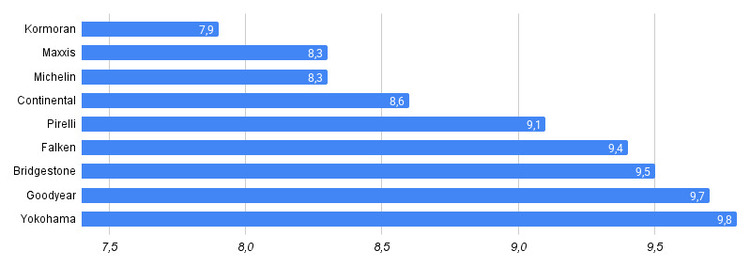
In one discipline, Kormoran won, demonstrating the lowest rolling resistance among all tested tires. The Yokohama tires had the highest rolling resistance.
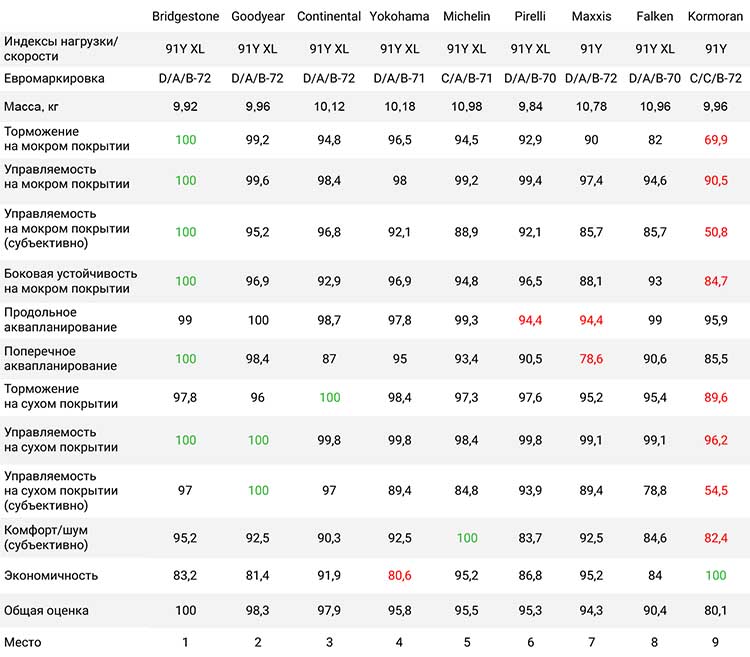
Thanks to first-place finishes in six disciplines, the Bridgestone Potenza Sport won the overall standings, demonstrating excellent efficiency on wet and dry tracks.
The Goodyear Eagle F1 SuperSport took second place, winning in parameters such as dry handling and longitudinal aquaplaning resistance, and also often taking second and third places in other disciplines.
According to the testers, on wet surfaces, Goodyear allowed for confident cornering and effective braking, and on dry surfaces, the handling was even better, with the car following the desired trajectory without error. In the dry braking test, Goodyear was only sixth, but its result was only 1.3 meters behind the leader.
The Continental SportContact 7, which won the previous year's test, took third place this time, due to not-so-high results on the wet track, where the German brand's tires had reduced lateral stability and resistance to lateral aquaplaning.
The Yokohama ADVAN Sport V107 took fourth place, demonstrating good results in many disciplines, especially on wet surfaces, where they showed clear trajectory following and impressive stability in corners.
The Michelin Pilot Sport 4 S took fifth place, showing balanced behavior on wet surfaces, but with a lower level of grip in corners compared to some competitors.
The Pirelli P Zero (PZ5) did not win in any discipline but showed good results in almost all tests, with good grip and braking on wet surfaces.
The Maxxis Victra Sport 6 showed good results, often receiving high ratings, but not making it to the top due to the high level of premium-class competitors.
The Falken Azenis RS820 also lagged behind the leading brands, but on wet surfaces, the tires provided good stability and handling, making the car obedient and allowing for enjoyable driving.
The testers noted that the Kormoran Ultra High Performance tires did not demonstrate any high performance, despite the "Ultra High Performance" label on the sidewalls, and their advantages are a low price and good fuel efficiency, but their installation significantly impairs handling and safety.
In the key test of wet braking, the Kormoran tires required 39.43 meters to brake from 80 to 19 km/h, which is almost 12 meters or 40% more than the best result.
The weight of the evaluations was determined as follows: tests on wet and dry surfaces with measuring equipment - 30% and 20%, respectively; subjective evaluation of handling on dry and wet surfaces, as well as ride comfort and noise - 40%; fuel efficiency and price - 10%.
Source, including photos: evo