Summer tyre test from Auto Motor und Sport (2024)
For its latest test, the Auto Motor und Sport magazine chose tires from the most popular brands on the German market in the size 235/55 R18 for compact crossovers such as the Volkswagen Tiguan.
The test included the Goodyear EfficientGrip Performance 2 SUV, Bridgestone Turanza 6, and Hankook Ventus S1 evo3 SUV, which have recently appeared in the selected size, as well as the Continental PremiumContact 7, which has been manufactured with a new rubber compound since the third quarter of 2023. Also included in the list of participants were the relatively new Falken Azenis FK520 and the already well-established Maxxis Victra Sport 5 SUV, Michelin Primacy 4+, and Vredestein Ultrac.
Since some tires have the SUV abbreviation in their name, while others do not, the question may arise whether they are suitable for use on crossovers and SUVs in the latter case. According to AMS, "of course, yes, since the additional marking is added primarily for marketing reasons, and whether a tire is suitable for an SUV depends on its size and load capacity, which should be increased due to the higher weight of vehicles of this type".
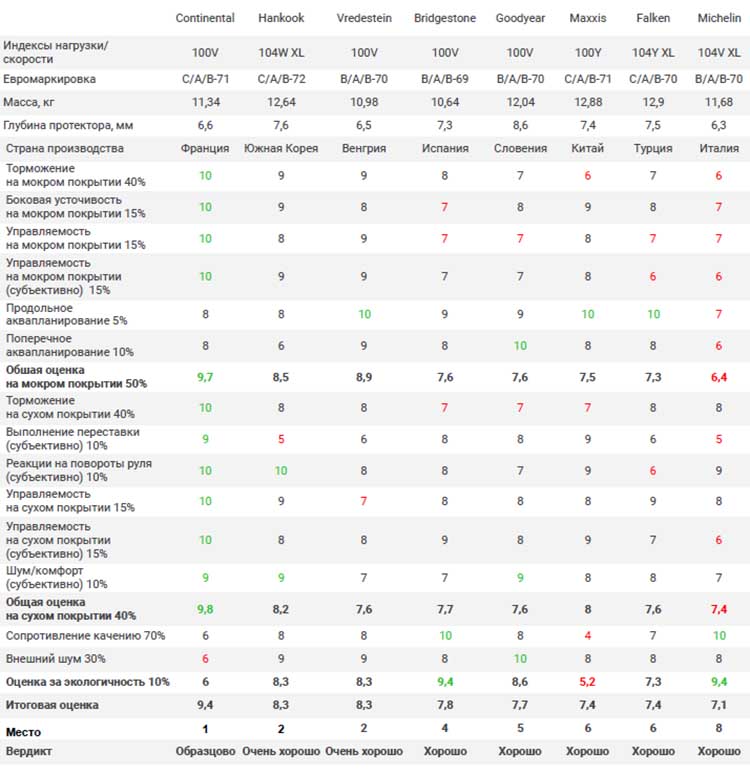
The key discipline, as always, was "wet braking", and this time the difference in braking distance between the best and worst tires (Continental and Maxxis, respectively) when braking from 80 km/h was just over three meters. It may seem like not much, but the testers note that in fact, the residual speed will be 26 km/h, which is "like driving a bicycle into a house wall at full speed". Even when braking from 50 km/h, the residual speed will be 16 km/h, and in general, three meters in this test is a 10% difference, which is quite a lot.
AMS also adds that if in recent years manufacturers have been required to reduce noise and rolling resistance in accordance with the emphasis on ecology, now they also need to increase the proportion of "green" materials used - recycled or from renewable sources - and according to the new Euro 7 standard, also reduce the amount of harmful particles that are formed during tire wear, and all this needs to be combined with "traditional" characteristics that directly affect safety.
According to experts, almost every good manufacturer can produce tires with good braking properties, high mileage, or low rolling resistance, but the complexity lies in ensuring a balance of all these parameters, and as the tests have shown, not all companies can achieve this. For example, the updated Continental PC7 was created with a focus on maximum grip on dry and wet surfaces, which allowed them to take first place in the test, but with environmental friendliness, Continental is not doing very well (only Maxxis was worse in this regard). At the same time, Bridgestone was able to combine low rolling resistance with good driving qualities in any conditions, but Michelin, again, has high energy efficiency, but relatively weak results on wet surfaces. In addition, there were complaints about the manageability and behavior of the tires when changing lanes, which cannot be compensated for by fuel savings, so Michelin, although they received "Good", fell to the last place in the overall ranking.
The top three included, in addition to Continental, Hankook and Vredestein. According to experts, Hankook is slightly inferior to Continental in terms of grip, but has very balanced characteristics and only minor drawbacks, such as reduced resistance to aquaplaning. In turn, Vredestein stops the car faster on wet surfaces, but loses to Hankook in terms of grip in turns, and besides, the Korean brand's tires have a significantly better comfort level. As for the rest of the tires, they all provide good grip on both dry and wet surfaces, but are slightly behind the leaders of the test.