
Summer tyre test by Auto Express — 2025
In the 2005 tire test, Auto Express magazine returned to the 225/40 R18 size, and before that, the publication had tested tires of this size three years ago, when due to supply problems related to the pandemic, not all major market players were able to participate, and Bridgestone Potenza Sport tires won in a fierce battle, Goodyear Eagle F1 Asymmetric 6 took silver, and Maxxis Victra Sport 5 took honorable third place.
This year, Bridgestone and Goodyear are returning, and they have to compete with very strong opponents, such as Continental SportContact 7 and Michelin Pilot Sport 5, as well as the new P Zero (PZ5) from Pirelli. Two other newcomers were Hankook Ventus evo and Kumho Ecsta Sport from Korean brands, and in addition, the list of participants included Yokohama ADVAN Sport V107, and Indian Ceat SportDrive acted as a "dark horse".
According to the rules of Auto Express, manufacturers themselves choose the tires that will participate in the test, after which they are purchased in open sale. This year, due to tire inventory problems, Maxxis was unable to participate, and Vredestein reported that only Ultrac tires were available, but they are already being replaced by new Ultrac+.
Wet Asphalt
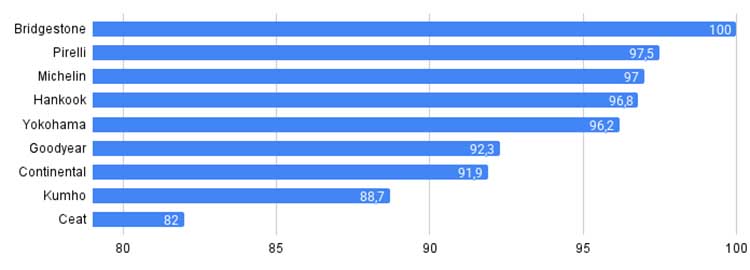
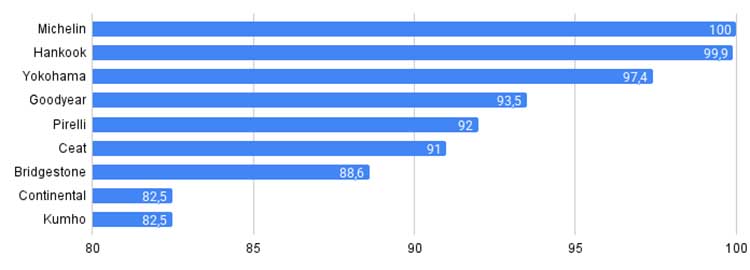
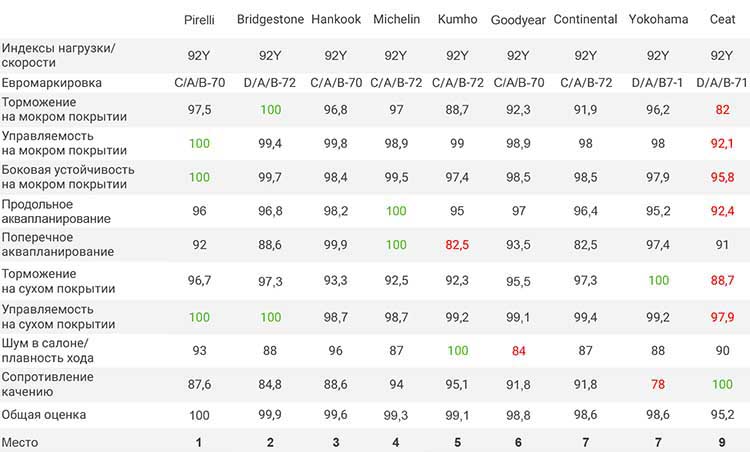
The main indicators were on a wet surface, and the key discipline in this part of the test was braking on a wet surface. The braking distance was measured when decelerating from 80 to 20 km/h (in order to avoid the influence of ABS), and the first place was taken by Bridgestone, and the second by the new product from Pirelli. At the same time, the result of Ceat was 18% worse than that of the leader (here and further in the tables, the best indicator is taken as 100%, and the lag of the others is calculated, and the final rating is compiled in the same way).
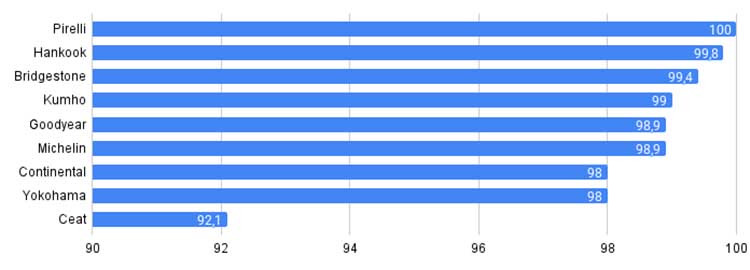
In the handling test, not only the lap time was taken into account, but also the subjective assessments of the experts, and Bridgestone could not maintain the lead, giving way not only to Pirelli, but also to the relatively inexpensive Hankook, and a weak result was unexpectedly shown by Continental, who were worse than only Ceat.
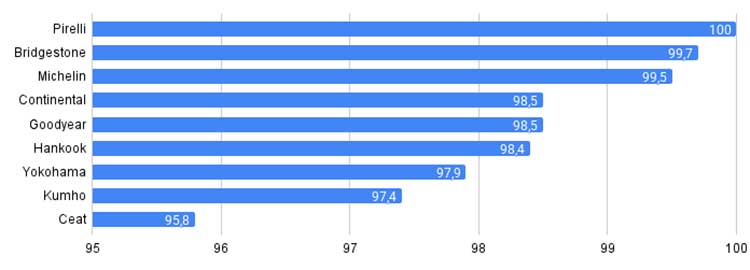
Pirelli also excelled in the lateral stability test, making a serious bid for victory in the entire test, and Bridgestone again received a very good assessment.
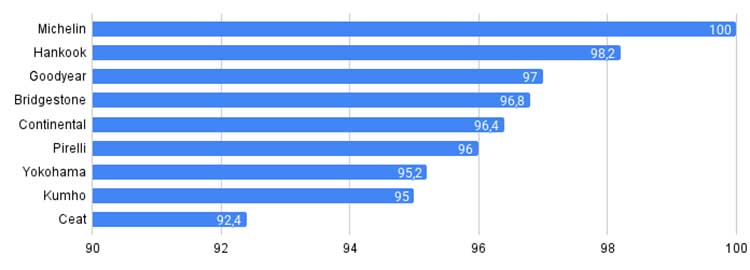
Aquaplaning was not handled so brilliantly by P Zero, and here Michelin took the lead, which was slightly behind by Hankook - by 0.1% in the test for resistance to transverse aquaplaning, in which the last place was shared between Kumho and Continental, that is, SportContact 7 again spoiled their final rating.
Dry Asphalt
While on wet surfaces, Yokohama performed moderately, on dry ones they showed the shortest braking distance (from 100 km/h), and this is an impressive result, given the presence in the list of participants of such sports tires as Bridgestone Potenza Sport, which quite expectedly took second place. Ceat has weak traction on this type of surface as well.
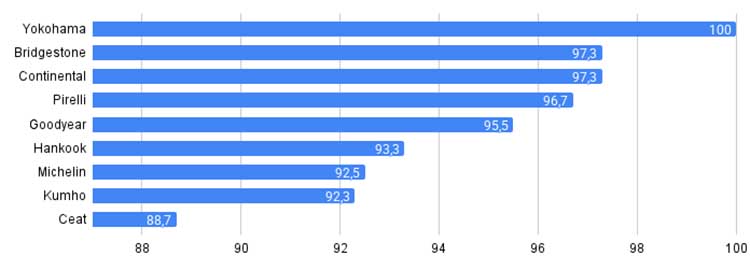
In terms of handling on a dry surface, Bridgestone was recognized as the best, but they still had to share the victory with Pirelli, and Continental was only 0.6% behind. In this discipline, Michelin was somewhat surprising, which became only seventh, along with Hankook.
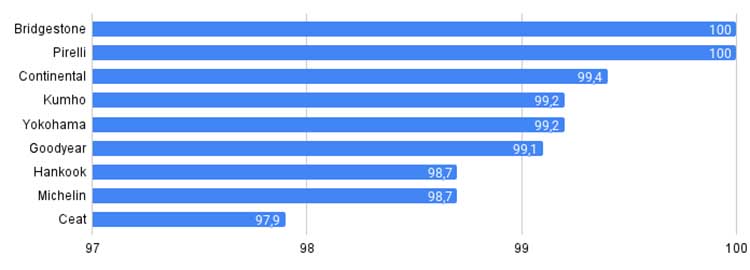
The testers also measured the noise level in the cabin (and not outside the car, as when issuing ratings for euro labels) and evaluated how the tires behave on uneven surfaces, and the most comfortable ones were Kumho and Hankook, while the last place was taken by Goodyear.
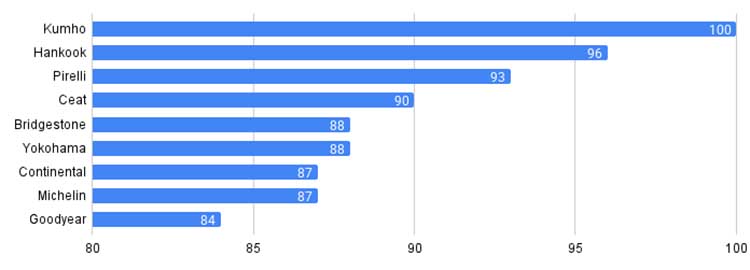
Ceat's participation in the test would have remained inglorious, but they still managed to win the rolling resistance test, and with a significant margin from other tires. The worst in this discipline were Pirelli, Bridgestone, and Yokohama. It is believed that a 4% reduction in rolling resistance is equivalent to a 1% reduction in fuel consumption.
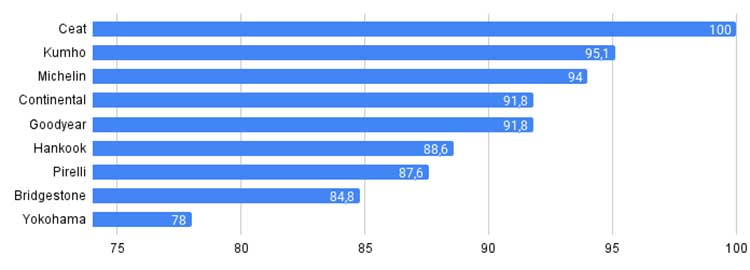
The weight of the assessments was determined as follows: wet surface - 50%, dry surface - 40%, other tests - 10%.
Verdict
Pirelli P Zero (PZ5) takes first place in the overall standings, which, after the premiere, have already managed to win the Tyre Reviews test. In the AE tests, the tires were the best in three disciplines, which no other tire managed to do, but more importantly, they managed to outperform their competitors in tests on handling and on dry and wet surfaces, and such a balance of characteristics is indeed impressive.
On a wet surface, Pirelli provides good maneuverability and stability, although there were tires with more acute reactions to steering wheel turns. The aquaplaning resistance was not outstanding, but overall worthy, and in addition, Pirelli has very good braking properties in similar conditions. On a dry surface, Pirelli also has reliable grip, and the tires behave confidently and stably, and they also have low noise and smooth ride, and the only drawback was increased rolling resistance.
In the previous tire test of this size from AE, Bridgestone Potenza Sport tires were the winners, but this time they had to be content with second place, even despite the impressive improvement in braking performance on a wet surface: if three years ago in this discipline they were the last, then this time - the first, and with a distance of almost a meter from the nearest competitor.
Bridgestone also has good resistance to longitudinal aquaplaning, and in the wet handling test, the tires were not as confident as some competitors, which required more careful handling, and it was not easy for them to maintain grip on sections with standing water, which, apparently, reflected on the low result in the aquaplaning stability test.
On dry asphalt, the tires behaved much more confidently, showing, along with Pirelli, the best lap time, and although the handling was not ideal, the grip was reliable in any situation. Bridgestone also quickly stops the car on dry pavement and produces a low level of noise, but the rolling resistance is high, again, like Pirelli.
Bronze goes to Hankook Ventus evo tires, which, although they did not win in any discipline, were most often, especially on a wet surface, among the leaders, so the third place is well-deserved.
On a wet surface, Hankook is quite effective in terms of braking, and the tires also have very good handling, and experts noted that the tires combine high grip with excellent stability, which allows them to stay on the desired trajectory in turns. In addition, Hankook has very high resistance to aquaplaning.
Unfortunately, on a dry surface, Hankook's results were relatively low, and they lacked traction to keep up with the more powerful competitors. The rolling resistance is acceptable, and the comfort turned out to be another strong point of Hankook, which can effectively soften shocks and reduce noise in the cabin.
Michelin Pilot Sport 5 again, as three years ago, became fourth and demonstrated a similar set of characteristics, including the highest among the participants' resistance to aquaplaning. On a wet surface, Michelin does not have the best handling, which is curious, because they have excellent braking properties and good lateral stability, which is confirmed by the results of the corresponding tests. According to the testers, the tires also have high traction on exit from a turn, and they are stable during fast maneuvering, it's just that the lap time does not fully reflect this.
On a dry track, the braking is quite acceptable, although Michelin was seventh in this discipline. In the handling test, Michelin is again in seventh place, but experts noted that in fact, the tires behave very predictably, although they did not have such a high grip as some competitors, which made it difficult to maintain contact on sections with standing water.
The debut of the new Kumho Ecsta Sport in AE tests was called both impressive and somewhat blurred, as the handling was good in any conditions, but everything was spoiled by a relatively long braking distance on a wet surface.
Kumho did not stand out for good lateral stability on a wet surface or outstanding aquaplaning resistance, however, the handling was almost impeccable, and the tires guarantee excellent grip, and the car behaves stably, which allowed Kumho to show the fourth lap time.
On a dry track, the results were similar, and a long braking distance contrasted with good handling indicators. Moreover, to follow the desired trajectory, it was necessary to turn the steering wheel more strongly, and under load, the tires turned out to be quite noisy. At the same time, Kumho was recognized as the most comfortable, as the lowest noise level in the cabin was recorded, and the tires effectively absorb sharp shocks on uneven surfaces, and another advantage is high fuel efficiency.
In the test three years ago, Goodyear Eagle F1 Asymmetric 6 won in three disciplines and took silver, and this time the results were also worthy, but clearly not as high: sixth place in braking, fifth in handling, and fourth in lateral stability on a wet surface. According to experts, the tires behaved balanced and required only a light press on the gas pedal when exiting a sharp turn to avoid wheelspin, and at less high loads, they were also very effective, which allowed them to lag behind the leader by less than a second.
A similar situation was on a dry track: average braking and a not very high result in the handling test, despite a small gap from the best tires. The response is not as sharp as that of some competitors, but there are no unpleasant surprises, and the tires behave reliably, providing good grip on exit from turns and the same stability during maneuvering.
Only the last place in the "comfort" category spoils the picture, which is due to the fact that Goodyear is quite loud and does not particularly effectively suppress vibrations on uneven surfaces, but if we take into account the low rolling resistance, then Eagle F1 Asymmetric 6 can be recognized as a quite competitive tire with a good balance of parameters.
Yokohoma ADVAN Sport V107 tires, as the testers noted, showed worthy results at the level of products from leading European brands, but they take only seventh place, and the reason is, among other things, a relatively long braking distance on a wet surface. In addition, in terms of handling in similar conditions, insufficiently high traction on exit from a turn was noted, and in the middle of a turn, the grip was also uncertain. Moreover, Yokohama has relatively low resistance to aquaplaning on a straight line.
On a dry surface, Yokohama works much better, and their braking distance from 100 km/h was 32.2 meters, which is almost a meter shorter than that of the tires in second place. The acoustic comfort is good, although an increased noise was noted when driving over raised manhole covers, and in addition, Yokohama had the highest rolling resistance among the tested tires.
Continental SportContact 7 takes seventh place in the final rating, which, as they say in AE, says how strong the competition is in the modern tire market. The reason why Continental did not make it to the top three was the relatively low grip on a wet surface, which affected the braking distance. In addition, Continental was seventh in the handling test, as although the traction was high, the tires behaved uncertainly on standing water, and in smooth turns, the grip on the rear axle was not as reliable as that of individual competitors.
On a dry track, the results were better, and throughout the lap, Continental worked very efficiently and stably. As for comfort, SportContact 7 was not the quietest tire in the test, but the smoothness is quite good. The rolling resistance is average.
Ceat SportDrive from the Indian manufacturer takes the last place, about which AE said that "in general, they showed themselves decently, although they significantly lagged behind other tires on a wet surface", and their braking distance (from 80 to 20 km/h) was more than six meters longer than that of the leader - 33.6 versus 27.5 meters. Even in comparison with the tire on the penultimate line, the result was worse by more than 2.5 meters.
On a wet track, Ceat also could not provide high grip and behaved very uncertainly, and the driver had to constantly adjust and work the gas pedal to avoid deviating from the desired trajectory. In general, Ceat took the last places in six disciplines, and they also had a long braking distance on a dry track, where they also had problems on exit from sharp turns.
The comfort level is good, and Ceat also had the lowest rolling resistance among the tested tires, and the corresponding rating on the euro label was the worst among all participants except Yokohama. In addition to everything else, Ceat was more expensive than all the tires in the test, except for Michelin and Pirelli.
Source, including photos: Auto Express