Test of 19-inch summer tires from AutoView — 2025
Despite impressive car sales in South Korea, drivers in the country show little interest in tires, resulting in limited offerings on the local tire market compared to other regions. Nevertheless, Korean brands regularly "revive" the situation and introduce new products to their home market, as Hankook and Kumho have recently done.
In 2025, Hankook began selling the new summer tire Hankook Ventus evo, which replaced the Ventus S1 evo3 model. Previously, the S1 evo3 was the top model in the brand's lineup, and although a more sports-oriented tire, the Ventus S1 evo Z, was later introduced, its application area is too limited, so the new flagship will likely be considered the Ventus evo.
In turn, Kumho introduced new Ecsta Sport UHP class tires and Ecsta Sport S UUHP category tires, which replace the Ecsta PS71 and Ecsta PS91 models, respectively. In AV, it is noted that over time, Kumho has lost its competitiveness in the Korean market, as the company had to reduce costs, which led to both a deterioration in product characteristics and a decrease in customer satisfaction.
The new sports tire test by the Korean portal AutoView was divided into two parts, and this one tells about how the new Hankook and Kumho Ecsta Sport S size 275/35 R19 performed in comparison with Western brand tires: Continental SportContact 7 and Michelin Pilot Sport 4 S with homologation for BMW M3, which was also used in the tests, as well as Pirelli P Zero (PZ4), which have gained wide popularity in the Korean market.
The tests were started in April, but the results were made public only in June, since in the spring, the new Kumho tires were not yet ready for sale, and the tires provided by the manufacturer were tested. And since it was necessary to check if specially prepared tires were sent, the experts waited for the start of sales and conducted control tests. If the deviations were significant, the tire would have to be removed from the test, but this time it did not happen, and the results of the tires sent by Kumho are published, which, by the way, ultimately turned out to be disadvantageous to the manufacturer, as will be discussed later.
First, the weight of the tires was measured, which is important because lighter tires improve acceleration dynamics and contribute to fuel savings. The weight of the tires can vary depending on factors such as tread depth and materials used. For example, tires with deep grooves and, therefore, a thick tread are heavier, but potentially have a higher resource, and if a tire is lighter with the same tread depth, materials that reduce weight while maintaining strength were used. In general, the lighter the tires, the better.
Among the tested tires, the Pirelli tires were the lightest, and the Kumho tires were the heaviest, weighing 1 kg more than the Italian brand's tires.

The variability of the weight of the four tires was also evaluated, which is also important: it is unlikely that anyone would like to run in sneakers that weigh differently. The smallest spread - 35 grams - was noted in Michelin, and the largest - in Continental and Pirelli (219 and 320 grams, respectively).

The tread depth was also measured, which gives an idea of the potential mileage of the tires, but one of the journalists accidentally did not record the Continental and Pirelli readings, so this parameter was not taken into account when compiling the rating. Among the other tires, the Hankook tires had the deepest tread (7.15 mm), followed by Kumho (6.91 mm) and Michelin (6.19 mm).
In Europe, the driving qualities of summer tires on wet roads are considered key, and manufacturers optimize their products accordingly, which can lead to a decrease in performance on dry asphalt. Tire development is such a complex process because improving one characteristic can lead to a deterioration in another, and consumers care not only about traction but also about parameters such as noise, economy, and wear resistance.
In South Korea, unlike in Europe, the characteristics of summer tires on dry pavement are considered primary, especially when it comes to owners of high-power sports cars. In the first discipline, the braking distance from 100 km/h was measured, and the new Kumho tires performed best, allowing the car to stop in just 33.4 meters (it was also noted that they interact well with the BMW M3 braking system), and the Pirelli tires came in last with a surprisingly weak result for tires of this brand, performing at the level of "all-season" tires.

On the circular track, the lateral stability was evaluated, and the Continental tires withstood the highest speeds, also informing the driver that skidding was beginning and quickly restoring traction. The Kumho tires took second place with a minimal gap, and the result of the serial tires was 1 km/h better, i.e., if the test had involved tires from free sale, they would have easily taken first place.
The Michelin tires came in third, and the spread in the results of the leading trio was only 0.2 km/h, i.e., they all received the same score. The Hankook tires showed a relatively weak result, and perhaps this is where the difference with the S1 evo Z manifested. At the same time, the Ventus evo tires belong to a lower price segment and will most likely compete with Continental MaxContact MC6 and Michelin Pilot Sport 5, rather than with the tires they compete with in this test. The Pirelli tires came in last again, which, as noted in AV, are comparable to summer tires of the economy segment or all-season tires in terms of transverse stability. At the same time, in some regions of the world, fifth-generation tires are already available - Pirelli P Zero (PZ5).
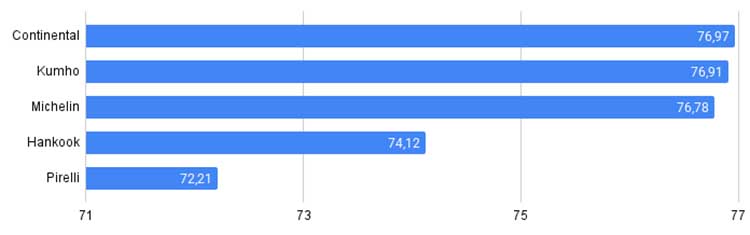
When Korean experts conduct handling tests on dry pavement, they usually include emergency maneuvers and sometimes evaluate tires in a slalom section. However, they are not the only ones using the available test polygons, which is why some tests may be impossible to conduct, and this time they had to abandon the slalom - but not the emergency maneuvers.
The tests were carried out at the Korea International Circuit (KIC) in Yeonam County, South Jeolla Province, and the AV expert and experienced driver Jung In Ho acted as the pilot, thanks to whose skills the difference in lap time did not exceed 0.2-0.3 seconds. The weather was good, and the temperature fluctuations of the environment and the track surface were 2 and 5 degrees, respectively.
The Michelin tires took first place, which, as expected from tires originally equipped on the M3, behaved in the most balanced way, informed the driver about reaching the traction limit, and allowed easy exit from skidding. What is remarkable is that after the pilot showed good time on the first lap, on the second lap, it became even better, and the traction remained stable even after that. According to Jung, the main advantage of Michelin is that the tire maintains high grip and "allows you to continue moving forward even when skidding and countersteering."
The Continental tires took second place, which, although they conceded to Michelin in terms of lap time, did not yield to the tires developed jointly with BMW M specialists in terms of characteristics. That is, if the SportContact 7 tires had been refined taking into account the M3 features, they would have shown an even higher result. (In 2022, AV compared Continental SportContact 7, Hankook Ventus S1 evo Z, Michelin Pilot Sport 4 S, and Pirelli P Zero (PZ4) in size 245/35 R19, and at that time, the Mercedes-AMG A45 4Matic was used, and the Continental tires were recognized as the best.)
The Kumho tires closed the top three and also showed good results, in particular, due to the overall high level of traction. At the same time, the driving qualities "were a little disappointing" to the experts, and if they are improved, the tires have a chance to start competing with products from the highest-level brands. Moreover, one should not forget that Kumho is significantly cheaper than Michelin or Continental.
The Hankook tires took fourth place and also did not reach the level of premium-class tires, but they were better than Kumho in terms of predictability and stability of behavior. At the same time, after the first lap, the grip decreased, which was also a disappointment.
Finally, the Pirelli tires took the last place, and, as the experts said, although the P Zero provides good handling, the overall traction level was lower than that of the competitors.
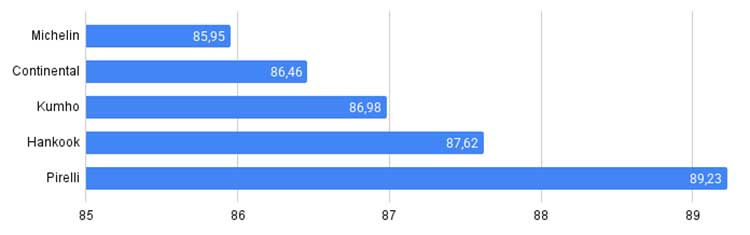
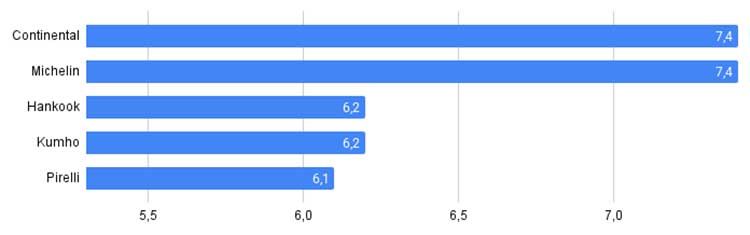
Potent cars, for which the tested tires are intended, often have stiff suspension, which means that drivers sacrifice comfort for improved dynamics and other characteristics. At the same time, improving ride smoothness still increases driving pleasure, and the Michelin tires were found to be the most effective in suppressing both minor vibrations and strong shocks - probably due to the fact that the tire was specifically developed for the M3.
The Kumho tires provided by the manufacturer demonstrated good shock-absorbing properties, but the serial tires, as it turned out, behave slightly differently. As already mentioned, they have higher lateral stability on dry asphalt, but, probably, due to this, the comfort of the ride at high speeds has deteriorated. At the same time, serial tires could have shown a better result in the handling test, in which it was possible to earn more points.
The Hankook and Continental tires provide approximately the same ride quality, although the SportContact 7 tires have slightly better characteristics, while the Pirelli tires "left a sad impression" due to their ineffective shock absorption.

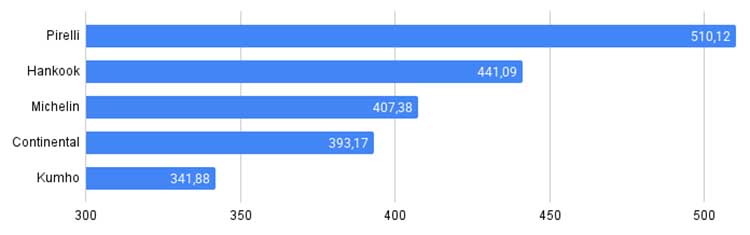
In the rolling resistance test (free roll), the Pirelli tires significantly outperformed all their competitors, which means they will improve fuel efficiency, and the Kumho tires came in last. The Michelin tires also did not show the best result, but, apparently, BMW M is satisfied with such efficiency.
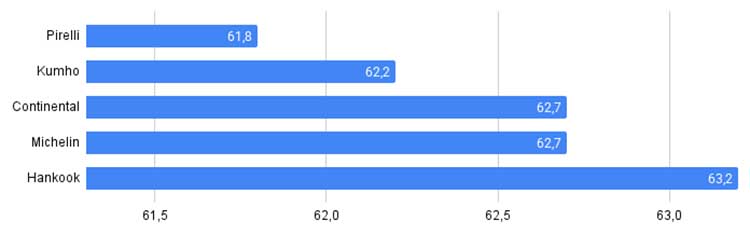
Noise was measured using equipment and evaluated subjectively. The reason is that if one tire produces sounds of 60 dBA at 80 km/h, and another - 61 dBA, then the noise of the latter may seem less tiresome. Approximately the same thing happened in this test, because the Pirelli tires had the lowest noise level - 61.8 dBA, but at the same time, they received the worst subjective assessment, as the noise was very pronounced and noticeable.
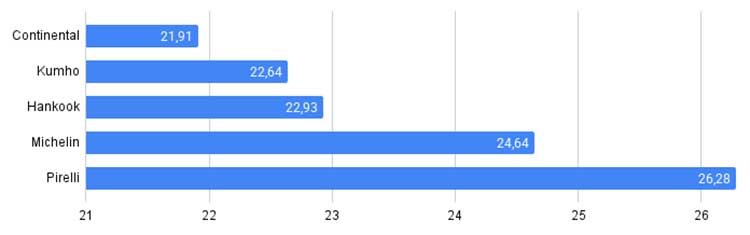
On wet pavement, AV only evaluated the braking qualities of the tires, and the reason is that there is no publicly available test center in Korea where all the necessary tests can be carried out, and in the future, it is planned to appeal to manufacturers and other organizations that can provide their test polygons.
The braking distance was measured from 80 km/h, and the Continental tires took the first place, followed by the Kumho and Hankook tires. The Michelin tires showed only an average result, and perhaps the reason is that, according to BMW M requirements, it was necessary to improve performance on dry pavement, due to which the properties of the tires in rainy weather deteriorated.
Verdict
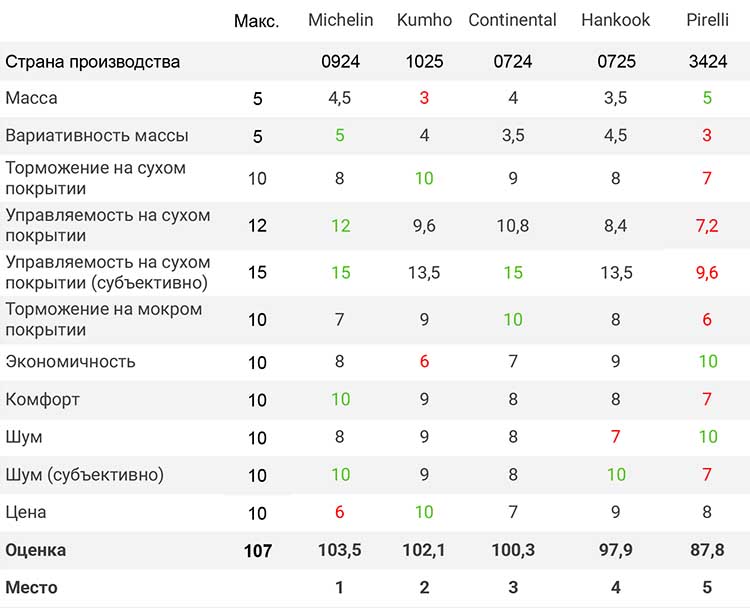
The Michelin Pilot Sport 4 S tires, homologated for the BMW M3, were the best in the overall test results. The tires have excellent driving qualities on dry pavement but have not the highest braking efficiency on wet pavement, and the second premium tire in the test - Continental SportContact 7 - took third place and was noted for its very balanced characteristics, and the experts said that "if you don't make serious mistakes, the tires won't let you down."
The Kumho Ecsta Sport S tires took second place, having outperformed the Continental SportContact 7 tires, which means that the development team has certainly done a great job. The tires have very good characteristics on both dry and wet pavements, but they do not have the best ride smoothness, and in AV, they say that Korean tires often have a small but still noticeable drawback that spoils the overall picture, while leading foreign companies often do not allow this.
Regarding the Hankook Ventus evo tires, the testers noted that the main disappointment was their price, which is too high for tires with such characteristics. The Hankook tires are not as effective as the Kumho tires but are more expensive, and their characteristics were called "acceptable for a mid-range tire." At the same time, the strong point of Hankook is that the company is constantly expanding its model range, added in AV.
The main disappointment was the low result of the Pirelli P Zero (PZ4) tires, and the experts noted: "Reviews of Pirelli are always contradictory, and someone likes them, while someone does not, and the tires that we have tested recently have not shown their best side. We hope that Pirelli will return to its former glory, because if this continues, their image will be seriously undermined."
Source, including photos: AutoView