
Wide or narrow tires for winter. What's better?
When driving on snowy and icy roads, the choice of tire width can significantly impact a vehicle's performance and safety. This article is dedicated to the long-standing debates about choosing wide and narrow tires for winter driving. Wide tires, often praised for their stability and larger contact patch, contrast with narrow tires, which are believed to provide better pressure distribution and traction on winter roads.
The purpose of this article is to unravel the complexities and provide a clear understanding of which type of tire truly offers superior performance on snow and ice, helping drivers make informed decisions based on their winter driving needs.
It's worth noting that the choice should be made based on the vehicle manufacturer's recommendations. We want to break down an example for clarity, taking tires with a significant difference in profile width, while the manufacturer considers the characteristics of a specific vehicle and calculates the tire parameters for it.
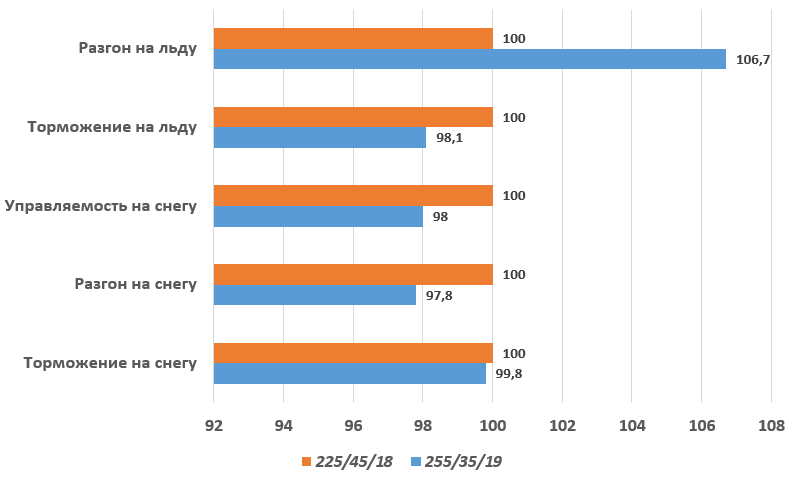
The results below are taken from the "Tire Review" winter tire test. The graph below shows a comparison of wide and narrow tires on snow and ice. We set the narrow tire as the benchmark, therefore, taking it as 100%. The narrow tire has a size of 225/45R18, while the wider tire has a size of 255/35R19. The test vehicle is the BMW 3 series. In this test, the winter tires Hankook i*cept EVO 3 were used.
Performance on Snow
The differences on snow are minimal, if not to say, nonexistent. In snow braking, the difference is minimal. The braking distance on narrow tires was 18.02 meters, while wide tires stopped at 18.06 meters. This negligible difference of 0.04 meters indicates that both types of tires provide comparable braking performance on snow. Acceleration on snow shows that narrow tires demonstrate slightly better performance. They provide the necessary traction in 6.65 seconds, compared to 6.8 seconds required for wide tires. The difference of 0.15 seconds indicates that narrow tires can provide a slightly faster response when accelerating in snowy conditions. Finally, considering handling on snow, which is reflected in the time it takes to complete a circle on a snowy track, narrow tires again demonstrate a slight advantage. They complete the circle in 82.29 seconds, while wide tires complete it in 83.93 seconds. This indicates that narrow tires can provide better maneuverability and control on snowy surfaces, although the difference is less than two seconds. Overall, although the differences in performance on snow between narrow and wide tires are relatively small, they are equal in various aspects, with narrow tires slightly outperforming their wider counterparts in braking, traction, and handling on snow.
Performance on Ice
When comparing on ice, the difference becomes more apparent. In the case of braking on ice, when the distance required to come to a complete stop is measured, narrow tires have a slight advantage. The braking distance is 16.11 meters, while wide tires require 16.42 meters. The difference of approximately 0.31 meters suggests that narrow tires can provide better braking efficiency on icy surfaces. In acceleration, wide tires perform better, requiring only 9.69 seconds to achieve traction compared to 10.34 seconds required for narrow tires. The difference of 0.65 seconds indicates that wide tires can provide faster acceleration on ice. Each type of tire has its strengths in various aspects of performance on ice, highlighting the importance of considering specific driving conditions and needs when choosing tires for icy roads.
Conclusion
The advantages in performance of each type of tire are indeed present, but they are extremely minimal. For example, in snowy conditions, narrow tires slightly outperform wide tires in aspects such as braking, traction, and handling. On the other hand, on icy surfaces, while narrow tires demonstrate a slight advantage in braking, wide tires lead in acceleration. Nevertheless, it is crucial for drivers to understand that these differences are so minimal that they should not be the deciding factor when choosing between wide and narrow tires.