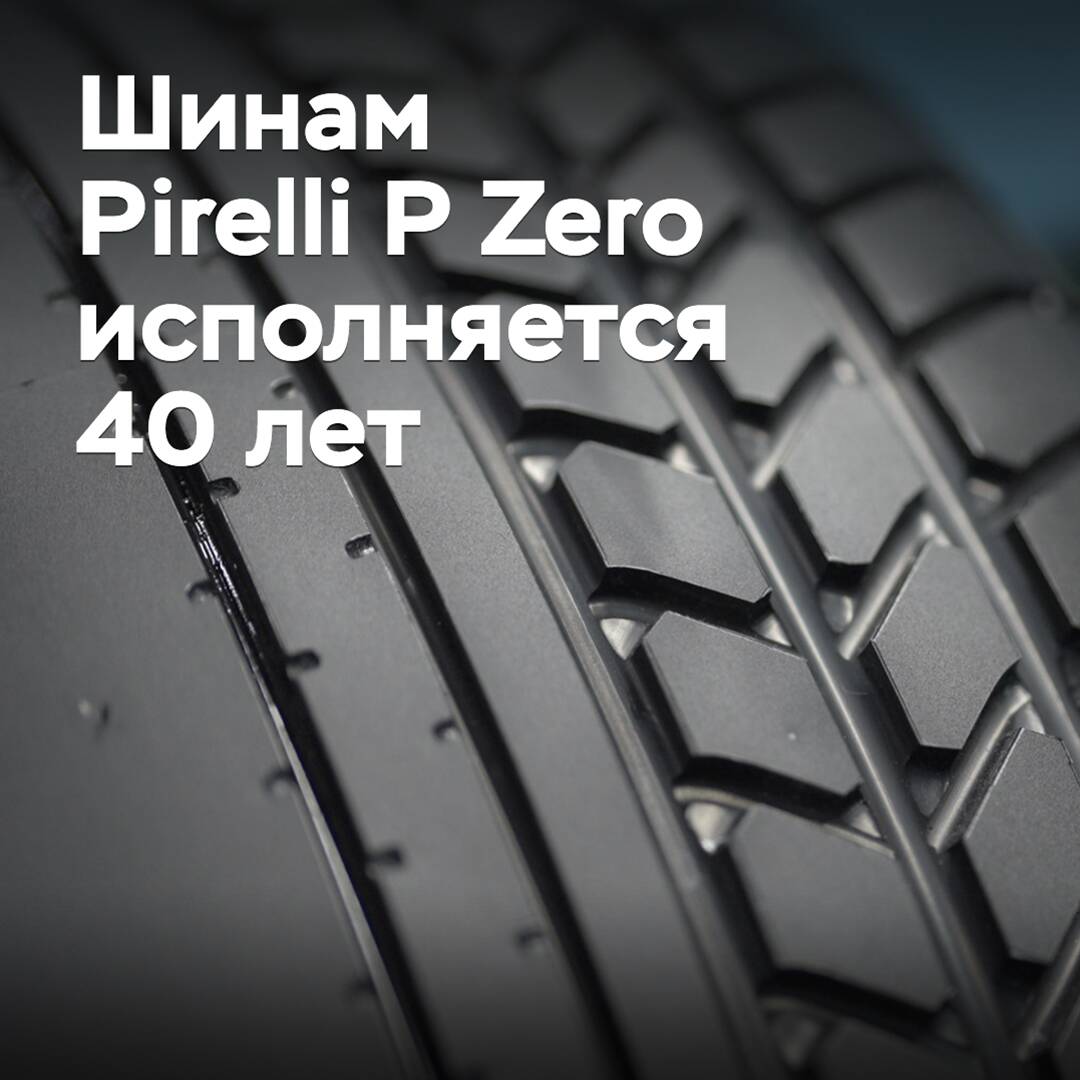
Pirelli P Zero tires are 40 years old
In 2025, the Pirelli P Zero model, which the company calls the first Ultra-High Performance tire, celebrates its 40th anniversary. At that time, one revolutionary idea was taken as the basis, and now P Zero is one of the most well-known brands in the industry, and tires from this line are still installed on their cars by the most prestigious manufacturers in the world.
Over four generations, P Zero tires have been homologated an unprecedented number of times for various cars. To date, more than 3,000 individual versions have been created, and P Zero has been approved, among other things, for real icons of the automotive world, such as the Ferrari F40, 512 Testarossa and LaFerrari, Lamborghini Countach, Diablo, Murciélago and Aventador, McLaren MP4-12C and P1, Pagani Zonda, Huayra and Utopia, Aston Martin Vanquish, DB9 and V12 Vantage, not to mention the various versions of the Porsche 911, Cayenne and Macan.
Now, the fourth-generation tires - P Zero (PZ4) - remain one of the best road sports tires, which is regularly confirmed by the results of comparative tests published by leading automotive publications. The line has also always been "at the forefront of innovation", and, for example, in 2019, it was P Zero that was the first to be made using the Elect technology package (tires adapted for use on electric cars and hybrids), which, according to Pirelli, has now become the "industry standard". In 2023, P Zero E was released - the first UHP tires with at least 55% eco-friendly materials (recycled or biologically derived), which received an "A/A/A" rating according to the European labeling system. In motorsport, where the first P Zero was born, this brand is still used at the highest level, including in Formula 1.
The first road Pirelli P Zero, which debuted in 1985, was created for the Lancia Delta S4 Stradale, and at that time, the basis was the racing tires used on the Lancia Delta S4 rally car from the Group B category. That racing Lancia became a legend due to its technological innovations and advanced dynamics, and Pirelli became a logical choice when developing tires that could match the car's exceptional characteristics. As a result, the collaboration between the two brands revolutionized the tire industry, and the UHP category was created, and the name P Zero was supposed to "symbolize a new beginning" for Pirelli, as it combined the traditional "P" letter from the company's logos with the word "Zero".
At that time, the automotive world was also undergoing revolutionary changes. In the 1980s, the emergence of turbocharging allowed for the creation of sports cars with unprecedented power levels, and since there were no electronic driver assistance systems that we take for granted today, tires played a crucial role in providing the necessary traction, stability, and safety.
Then, the flagship Pirelli model was the P7, the first low-profile tire in history, released in 1976, and the knowledge gained from operating these tires, both on public roads and on racing tracks, combined with the ideas of Pirelli engineer Mario Mezzanotte, paved the way for the creation of P Zero.
The concept was simple but innovative: to combine three key attributes of racing tires in one tread pattern. The inner zone with grooves, like rain tires, increased traction on wet surfaces; the outer zone, created in the style of slicks, increased traction on dry surfaces; and the central zone borrowed some distinctive features of intermediate tires. This solution clearly went beyond the traditional approach to tire development, and, as one automotive journalist said: "Let's hope the traffic police have heard about this development. I wouldn't want them to think we have worn-out tires because of the slick part!"
Pirelli's experience in motorsport played a crucial role during the transfer of this concept to the production of road tires, and the capabilities of the new civilian P Zero were fully demonstrated by one particularly notable case. During the San Remo rally on the Lancia Delta S4, Massimo Biasion was on the new P Zero (which had not yet gone on sale and was not available to the general public), and they performed so well that he decided to leave them on during the stage, which took place on very wet pavement. As a result, he won that stage, overtaking competitors on specialized racing tires.
P Zero tires not only became pioneers in the UHP segment but also laid the foundation for Pirelli's Perfect Fit strategy, under which tires are adapted to the specific requirements of premium and luxury car manufacturers. Now, the line includes various versions of tires (summer, all-season, and winter), which are manufactured to order and installed on a wide range of cars, including supercars and sports SUVs.
After the innovative tire developed for the Lancia Delta S4 Stradale and released in a small batch, in 1987, the first generation of P Zero tires was created for the Ferrari F40, and in the coming months, the long-awaited fifth-generation model will be presented.