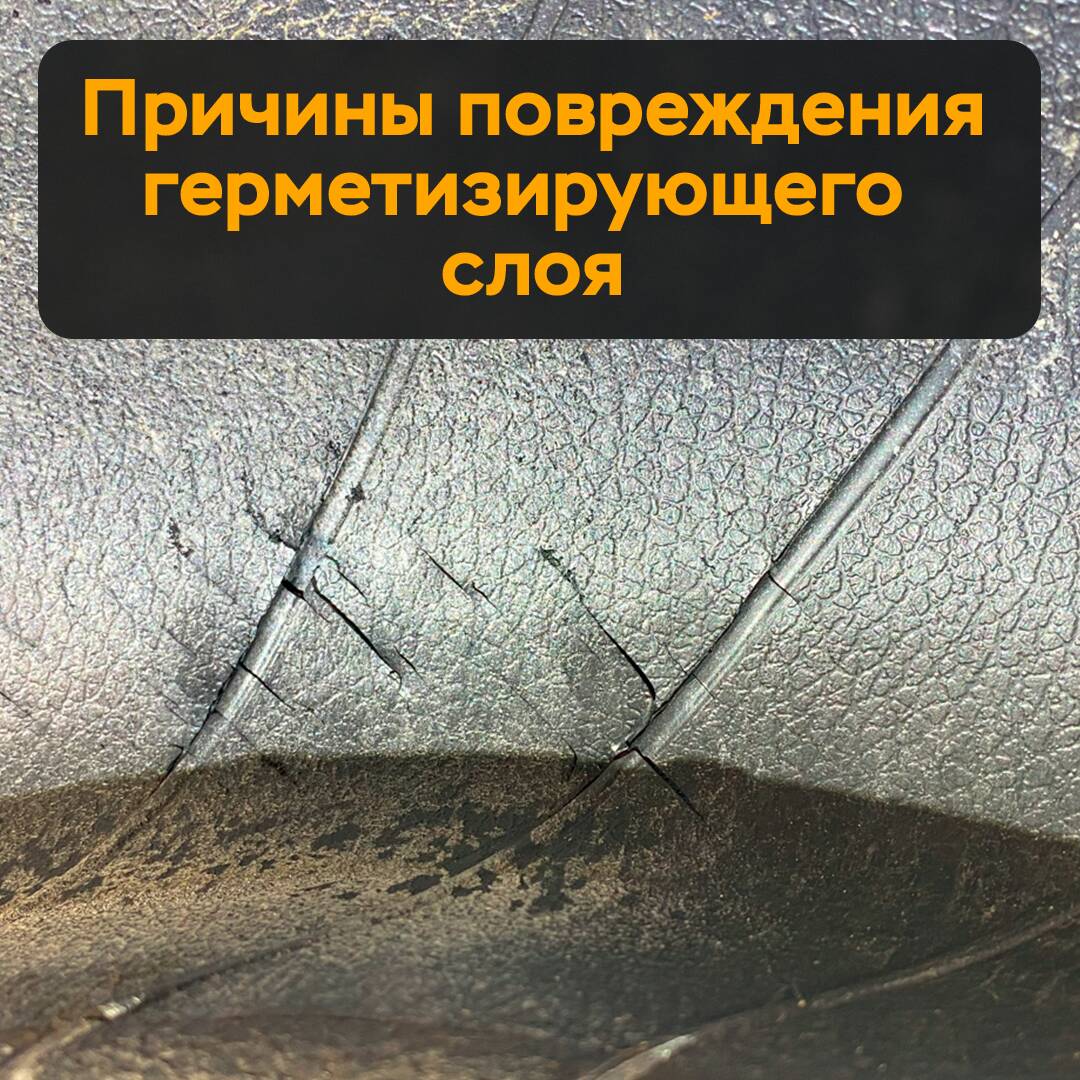
Causes of damage to the sealing layer
What is the difference between a tire and a tire cover?
Strangely enough, these are two completely different terms. A tire cover can be called the first-generation automobile tires, because they literally covered the chamber that held the air inside the tire and provided the necessary pressure for handling. But as you know, progress does not stand still, and despite their widespread use, chambers had a number of drawbacks. The most striking of which can be highlighted is the loss of pressure in case of damage. Tire developers decided to improve the tire covers and securely fix the chamber inside the tire. It was then that the tire covers with chambers turned into tubeless tires. In fact, there is no chamber inside the tire, and its function of holding air inside the tire is now performed by the internal sealing layer. Now, in case of tire damage with a self-tapping screw, which happens very often, the tires do not lose pressure or lose it slowly.
However, it should be noted that the properties of the chambers, thanks to which they hold air inside, are provided by a special rubber compound. It is more dense, elastic and more prone to damage than the tread rubber mixture of the tire. That's why, when the rules for operating tires are violated, it is not uncommon to damage the internal sealing layer, even without damaging the tire itself.
How can this happen?
The fact is that the tire is most susceptible to damage on the sidewall. It is in this place that the tire is thinnest and it is this part of the tire that is subjected to the greatest deformations when rolling, therefore, it heats up. It is important to follow the recommended pressure in this case. When driving with low pressure, the tire cyclically deforms, and forces arise that tend to tear the sidewalls of the tire, and damage the sealing layer first. The sealing layer begins to peel off from the heat generated in the zone covering the joint of the sidewall and the tread in the inner cavity of the tire. If the pressure is not critically low, then this can only lead to more intense overheating, and the main damage can be avoided. You can, but only if it's not very cold outside.
With a sharp temperature difference, the sealing layer cannot withstand and begins to crack and crumble. At first glance, it may seem like a flaw in the design engineers, but this is not the case. The tire is designed to work correctly only when the recommended pressure is observed. If the pressure is not observed, then loads arise, both physical and thermal, which can destroy the tire and put it out of operation ahead of time. That's why it's so important to follow all the recommendations of tire and vehicle manufacturers.