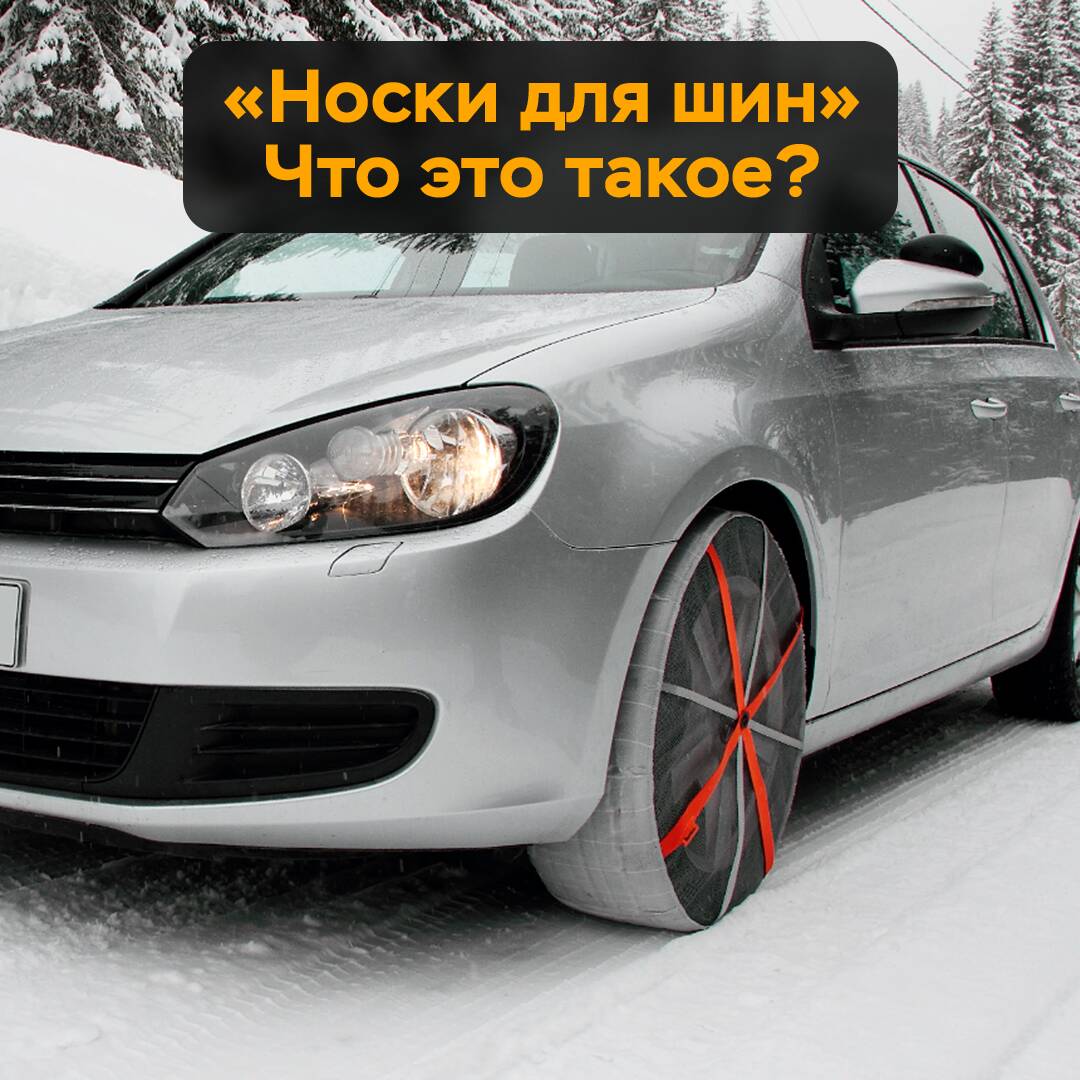
"Tire socks". What are they?
Textile wheel covers, called "SNOWSOCKS" by manufacturers, which literally means "snow socks", at first glance resemble tire covers, but that's not the case. They are needed to improve the vehicle's passability on snow. At the same time, many claim that they are a more effective solution than anti-skid chains. Let's consider the advantages and disadvantages of this technology.
First of all, it should be noted that both chains and covers are emergency measures. That is, neither one nor the other is used constantly and is only needed for sudden or emergency passage of a difficult road section with a large amount of snow. In addition, they are often a complete solution to the problem if you have all-season or even summer tires. Winter tires have everything you need, so you won't need chains or covers at all.
Advantages of covers:
- Easy to put on wheels. It can't be said that they are mounted easier than chains, but still, they can be installed on wheels when needed right on the road.
- They have a significantly lower weight and do not take up much space
- Do not damage the road. Unlike chains, they do not cause any harm. While when used on the road, they are significantly damaged themselves.
The online publication Tyre Reviews tested wheel covers and compared them with classic anti-skid chains, comparing them on ice and snow on a classic passenger car in size 225/50/17. The comparison was made of how each technical solution improves acceleration and braking characteristics.
Snow characteristics
On snow, "covers" provide a slightly more intense acceleration. They manage to accelerate the car to 16 km/h in 3.5 seconds, while on chains this can be done in 3.7 seconds. Braking, on the other hand, remains with the chains. Moreover, the difference is already significant: braking from a speed of 20 km/h took 13.5 m, while "covers" braked at 14.7 m. The difference is more than a meter!
Ice characteristics
Here the difference is obvious. The advantage is clearly with the chains. The braking distance from a speed of 16 km/h on chains was 4.4 m, while "covers" braked at 11.4 m, the difference is more than twice. In acceleration on ice, the advantage is also with the chains. They accelerate the car in 1.4 seconds, while "covers" need 5.4 seconds.

In conclusion, it can be concluded that the best option would be to use more suitable tires. But if you still need to make a choice in additional equipment, then chains are, of course, safer. They can be said to be no worse than "covers" on snow, and significantly safer on ice. But at the same time, they are not without drawbacks. We detailed how they damage both tires and wheels, and can also damage the car itself. Covers, in turn, do not damage either the car or the wheels, but are less durable and provide additional benefits only on snow.