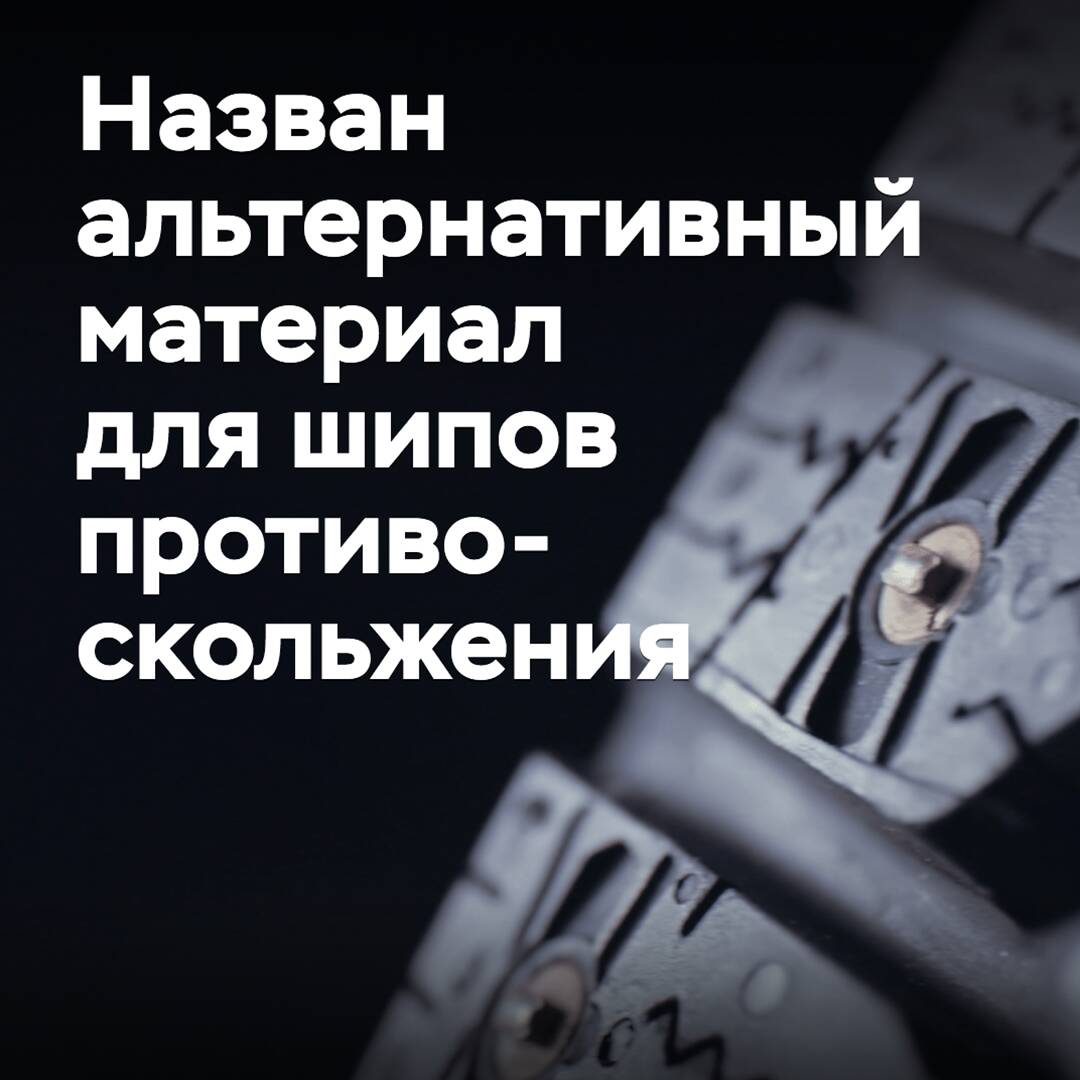
An alternative material for anti-skid studs has been named
On an icy surface, studded tires can save lives, but they grind down the road surface, releasing harmful particles into the air that are detrimental to human health, and, as scientists from the Stockholm Royal Institute of Technology (KTH) claim, the harmful effect of studs can be reduced by using a new material.
In KTH, tests were conducted in which the wear of asphalt and particle emissions caused by standard cobalt-containing studs and studs made of an alternative hard alloy with ferro-nickel were compared. According to the institute, the test results show that studs made of the new alloy provide the same level of traction on ice and compacted snow, but cause significantly less damage to the road surface.
"Cobalt is a cheap solution," noted Ulf Olofsson, professor of engineering design at KTH. "It's so hard that it doesn't wear out, and that's why it's also widely used in the manufacture of tools for drilling rocks. At the same time, asphalt is soft enough for cobalt-containing studs to grind it down and turn it into micro-particles that penetrate deep into the body when inhaled."
According to him, studs should be only 20-30% harder than asphalt to provide the necessary safety on ice. "Meanwhile, the studs used today are twice as hard as the road surface and nine times harder than glacier ice at -40 °C," Olofsson said, adding that scientists are now studying materials for studs for durability to find an alternative to cobalt.
Tech Xplore portal notes that while studded tires save the lives of about 70 people on Swedish roads every year, some cities in the country have banned them on certain roads due to the danger posed by asphalt particles in the air. In most US states, the use of studded tires is restricted, and in several, it is prohibited, as in a number of European countries, such as Germany, the Netherlands, and Poland.
As Olofsson points out, in the EU, non-exhaust emissions from tire, road, and vehicle brake wear are equivalent to exhaust emissions in terms of PM10 (particulate matter with a diameter of up to 10 microns). At the same time, in Northern Europe, non-exhaust PM10 emissions are significantly higher, which is due to the widespread use of studded tires. The KTH professor adds that studs also increase road maintenance costs, and, according to his calculations, in Sweden, the lifespan of road surfaces is half that of Germany, where studded tires are banned.
The full report on the study is available on sciencedirect.com.