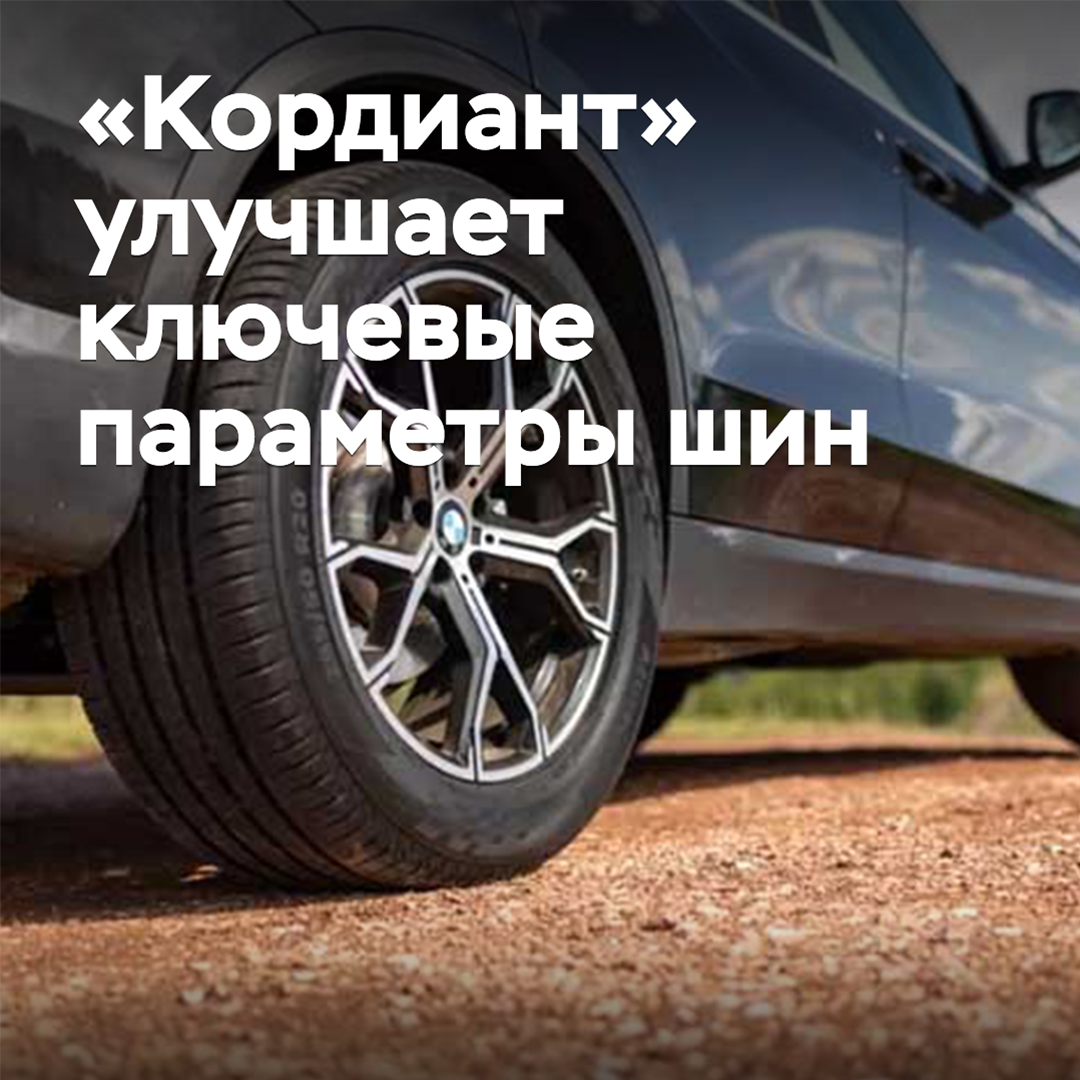
«Cordiant» improves key tyre parameters
Experts at the Scientific and Technical Center "Intair" of the Kordiant holding have developed a new technology that simultaneously improves several key tyre performance parameters—such as grip, durability, and fuel efficiency. This technology has already been implemented in the production of premium-branded Gislaved products, the company reported.
The foundation of the development is a new rubber compound formula based on a combination of synthetic rubbers with different chemical compositions and properties. The key feature of these materials is the presence of functional groups at the ends of the polymer chains. According to Kordiant, these "active sites" enhance molecular interaction between rubber and other components of the compound, such as fillers, thereby improving the tyres' operational performance.
Testing showed that using the new compounds can reduce rolling resistance by 10–15%, while grip and wear resistance improve by more than 5%.
Tyre durability was evaluated during real-world road tests. Several vehicles equipped with prototype tyres of various specifications travelled 40,000 km on public roads, with tread depth measurements taken every 10,000 km. Rolling resistance was measured on a drum test rig in accordance with UN Regulation No. 117.
The company adds that one of the key advantages of the new technology is its versatility, making it suitable for both winter and summer tyre production. The development has been ongoing for over five years and continues today, as rubber manufacturers improve their product properties and Intair STC engineers adapt compound formulations to new generations of elastomers. In the future, functionalized materials with modifications not only at the chain ends but along the entire polymer backbone are expected to be used, which will "enable more precise control over rubber characteristics and expand the technology's application potential in new product lines."
"Developing and implementing tyre manufacturing technology based on functionalized synthetic rubbers is an important step toward the sovereignty of Russia's transport industry," said Dmitry Golubev, Director of the Intair STC. "It is also significant that Intair STC specialists have expanded the list of approved raw material suppliers, which represents another major achievement in import substitution and strengthening the resilience of the production supply chain."
The creation of this new technology was made possible in part by upgrading the STC's laboratory infrastructure. Engineers are now working to implement it in the production of commercial vehicle tyres to enhance their wear resistance.