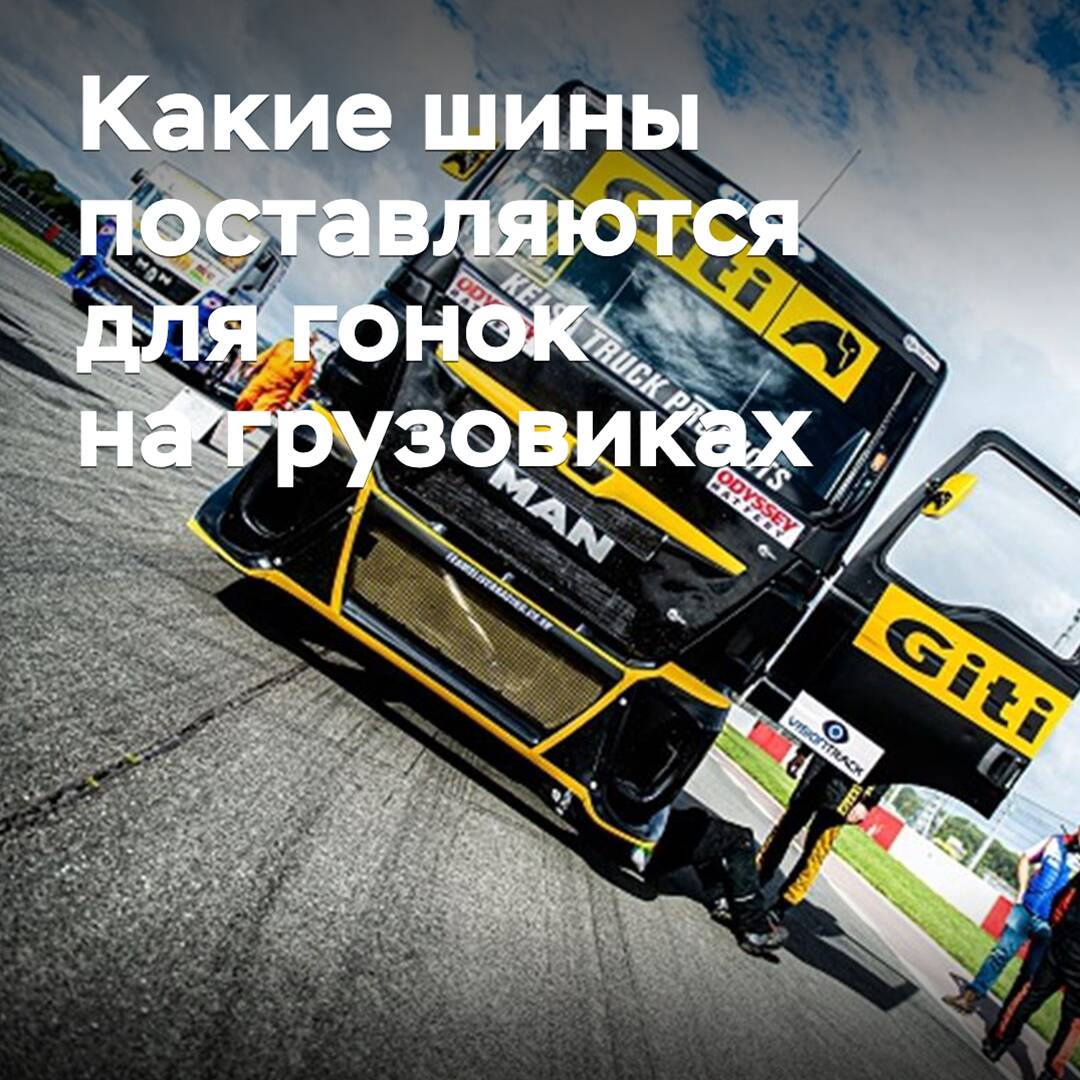
What tires are supplied for truck racing
This year, the British Truck Racing Championship (BTRC) celebrates its 40th anniversary, and the first competitions of this type were held in 1979 in the USA, after which they gained popularity in Europe. The current season of BTRC consists of seven stages, and the participants are divided into two divisions, in the first of which they pilot seriously modified trucks with special braking systems and suspension, and in the second, cars are closer to their serial versions.
Racing trucks are equipped with engines with a capacity of over 1000 horsepower and more than 5000 Nm of torque, and they weigh between 5 and 5.5 tons. The maximum speed is limited to 160 km/h, so acceleration speed is crucial. Two-axle vehicles are equipped with six tires, two in the front and four in the back, and the supplier is the official partner of the series, Giti Tire.
Giti introduced its truck racing tires in 2017 when it began supplying them to the Australian Super Truck Nationals championship, and the same tires, which are manufactured in China, are used in the UK.
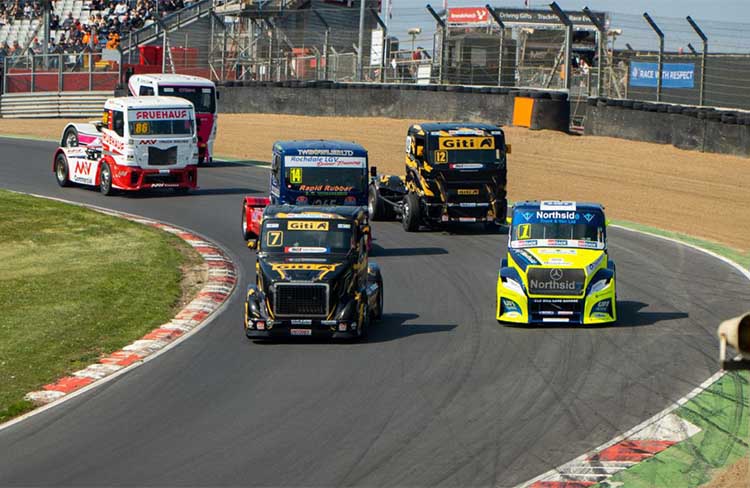
"The Giti Race-Tuned V1 tire, size 315/70 R22.5, was specifically designed for truck racing," said Alistair Brown, technical director of Giti's British branch, in an interview with TTI. "Visually, there are two main differences from standard road tires: asymmetric design and tread depth, which is about half that of standard tires."
By asymmetric design, Brown means, among other things, that the inner shoulder zones of racing tires are stiffer and more square, while the outer zones are more rounded. According to him, the square inner shoulders improve handling when driving in a straight line and traction, while the rounded outer profile increases stability when cornering. Since the shoulder zones are subject to different loads, a strong internal structure is required, and the tires have a load index of 154 (up to 3750 kg), while the weight of racing trucks is much less than that of regular trucks, which can weigh up to 44 tons. "In terms of design, racing tires are 95% identical to road tires, and only the design of the sidewall area and the stiffness of the sidewalls have been changed," Brown says.
The pressure in the racing tires is much lower than in ordinary life, usually 4 and 2 atmospheres on the front and rear axles, respectively, while for road trucks it is around 8 and 6 atmospheres at the front and rear. Thanks to this, according to Brown, the tire's contact patch is optimized.
The tread pattern is also asymmetric and features two longitudinal grooves 5.3 mm deep that drain water and reduce the risk of aquaplaning. This option was chosen because in the BTRC, participants can only use one type of tire in any weather, so it was necessary to ensure water drainage in case of rain.
"Ideally, we would develop a racing slick, like in other types of motorsport, but here we can't do that because the tires must be the same in all conditions," Brown says. "So we added longitudinal grooves, but with minimal depth, so that handling is like on slicks. If the tread depth were greater, it would affect handling characteristics."
The depth of the lamellas is 3.5 mm, and their shape and arrangement were designed to increase traction both when accelerating and maneuvering, as well as to provide the necessary stiffness of the tread. In addition, the developers sought to improve the even distribution of loads in the support zone to increase the life of the tires.

In both shoulder zones, there are wear indicators that can signal, among other things, which axle the tire was used on. On the steering axle, the lateral loads on the tires are higher, and when the indicators wear out, the tires need to be replaced or rearranged. "This doesn't mean that the entire tread is worn out, but this way, wear on the under-tread layer in the outer shoulder zone is prevented," Brown explains. "Usually, new tires are installed on the inner rear wheels, after which they are rearranged on the front axle. Then they are moved to the outer rear wheels, where they reach the maximum wear level. If the tires are well maintained, a set of six should be enough for the entire racing weekend."
If the vehicles come into contact with each other and a tire is damaged, it may need to be replaced, and in this case, two tires are replaced. In addition, the tracks differ in the abrasiveness of the surface, and the tires are made from a rubber compound with a special polymer and functional resin that improve traction and handling, while the nano-filler increases the stiffness and strength of the compound, and the combination of technical carbon and silica increases resistance to tears. "The rubber compound is designed to function optimally at temperatures from 80 to 100 degrees, depending on the tire pressure, track characteristics, and weather conditions," Brown says.
Like all tire manufacturers involved in motorsport, Giti uses its partnership with BTRC for marketing purposes, since the audience includes potential customers of the company. Although truck racing does not have as many fans as other types of motorsport, spectators and participants are likely to need tires for similar vehicles. In 2022, the Brands Hatch race on Easter weekend was attended by 100,000 spectators, and live broadcasts and social media increased the audience to almost half a million people. And since Giti's racing tires have almost the same design as tires available to regular buyers, the company considers BTRC an ideal platform for demonstrating the strength of its products in extreme conditions. At the same time, perhaps even more importantly, Giti uses the championship as a laboratory for developing new technologies.
Goodyear, which has been the supplier of the European Truck Racing Championship (ETRC) for nine years, has been developing racing truck tires since 2003. The 2024 season consists of stages in Italy, Slovakia, Belgium, Germany, the Czech Republic, France, and Spain. Initially, standard Goodyear Regional RHS tires (size 315/70 R22.5) with a "cut" tread were supplied for the competitions, but then the company developed special tread patterns and rubber compounds at its Innovation Center in Luxembourg.

This year, ETRC debuted tires made from a new compound that enhanced traction, especially on wet surfaces. The tires were tested by championship participants at Goodyear's test grounds and racing tracks across Europe, and the new rubber compound, combined with an optimized contact area, also helped improve wear evenness and provide a stable level of grip throughout the life of the tires.
The FIA does not allow the use of retreaded tires in racing, and since the organizers intend to make ETRC carbon-neutral by 2038, Goodyear retreads the tread of worn-out tires after the races, which are then used on regular roads, if the carcass is not damaged. In addition, electric and hybrid trucks have recently been allowed to participate in ETRC, which will likely require the company to rework its tires to combine high traction with resistance to increased loads.