
Hankook and Rotoboost are working on eco-friendly technocarbon
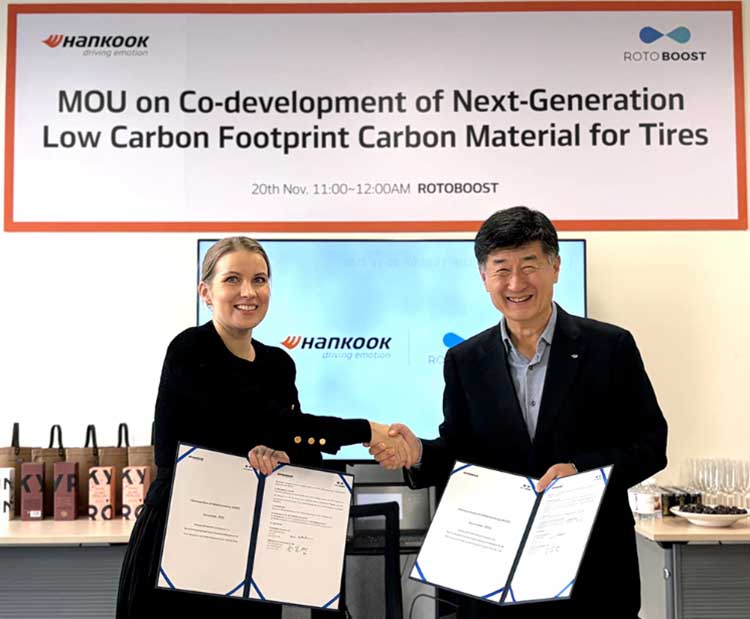
Hankook Tire and the Finnish company Rotoboost, specializing in thermocatalytic methane decomposition technologies, have signed a memorandum of understanding regarding the joint development of an eco-friendly carbon material intended to replace traditional industrial carbon used in tires.
The new material is characterized by a low carbon footprint, and as part of the project, Hankook intends to reduce CO2 emissions at the raw material procurement stage, which will be another step towards achieving the company's goal of becoming fully carbon neutral by 2050.
In cooperation with Rotoboost, a carbon material will be developed that is produced during the production of turquoise hydrogen through methane decomposition in a high-temperature reactor. Hankook indicates that since this raw material is a closed-loop material, it has recently attracted significant attention, especially in the automotive and tire industries, as participants work to reduce harmful emissions.
Hankook and Rotoboost will be engaged in optimizing the properties of the new raw material and verifying its suitability for use in composite materials for tires. It is expected that the intensity of greenhouse gas emissions can be reduced by more than 50% without compromising the performance characteristics of the products. Additionally, Hankook plans to create a quantitative verification system based on Life Cycle Assessment (LCA) and Environmental Product Declaration (EPD) to transparently confirm the reduction of CO2 emissions from raw material procurement to tire production.
Hankook notes that industrial carbon is one of the main types of materials used in tire manufacturing and is a fossil raw material whose production is associated with high CO2 emissions. To reduce these emissions, the company is conducting scientific research aimed at developing eco-friendly materials, such as recycled Tread.
Like other tire manufacturers, Hankook is currently actively working on various eco-materials, including through strategic cooperation with major Korean and international organizations and companies. For example, in May 2025, Hankook became a participant in a government-funded project in South Korea to develop technologies for the large-scale production of turquoise hydrogen. In addition, in January of this year, work began with Solvay on an eco-friendly silicon dioxide produced using sand, which is an industrial waste.
Last year, as part of the Tire-to-Tire Circular Economy Model consortium, created to improve technologies for converting used tires into raw materials for the production of new tire products, Hankook successfully launched mass production of three types of industrial carbon with ISCC Plus eco-certification obtained from pyrolysis oil produced by recycling old tires. Furthermore, Hankook also became the first Korean company to use cord made from chemically recycled PET, a project that also involved SK Chemicals and Hyosung Advanced Materials, with the new material being applied in the production of iON line tires designed for electric vehicles.
"Hankook Tire intends to further increase the eco-friendliness of the tire industry by reducing dependence on petroleum products, preventing the depletion of natural resources, and consistently reducing CO2 emissions through cooperation with strategic partners," the company emphasizes.