Large test of summer and all-season tires from UTAC — 2025
Every year, experts from the Finnish company UTAC Ivalo conduct large tire tests, and this year it was decided to test not only summer tires but also all-season tires. The reason, presumably, is that "all-season" tires are entering the North European market, and thanks to the 3PMSF marking, they can even be legally operated in the winter season, although they are clearly not suitable for harsh winters. The tires were tested in the 225/45 R17 size, and this time there were no budget models from China, and the newcomers were Michelin Primacy 5 and Nordman South, which Nokian released after leaving Russia.
List of participants:
Summer tires:
Falken Ziex ZE320
Goodyear Eagle F1 Asymmetric 6
Michelin Primacy 5
All-season tires:
Bridgestone Turanza All Season 6
Continental AllSeasonContact 2
Goodyear Vector 4Seasons gen-3
Pirelli Cinturato All Season SF 3
Wet Asphalt
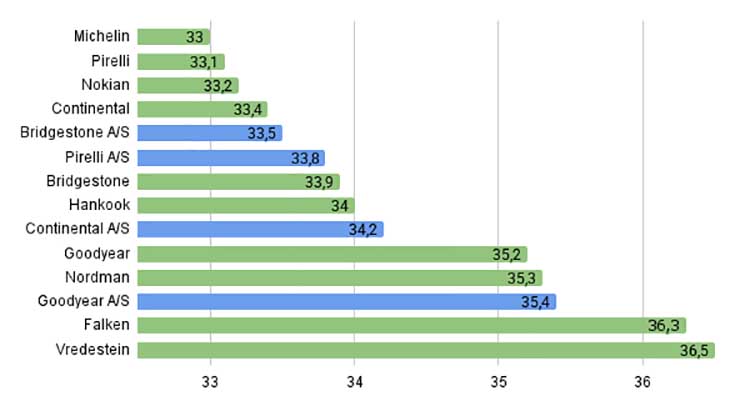
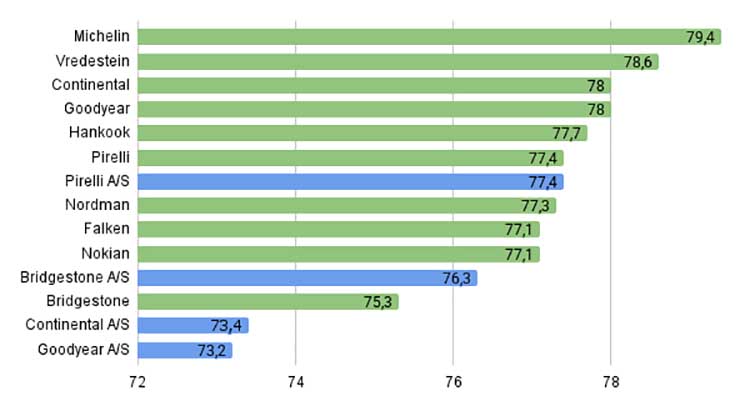
Braking distances on wet surfaces were measured at 17°C on the Pirelli track in Vizzola (Italy), as well as at 2, 7, and 12°C in the covered UTAC complex in Ivalo (Finland), after which the average result was determined. Tests at almost zero temperature gave an advantage to all-season tires, while in Italy, the best were undoubtedly specialized summer tires. At the same time, the temperature had a very significant impact, and at 2°C, the braking distance of all-season tires was much shorter than that of summer tires. According to the average results, the first place was taken by the summer Michelin, followed by Pirelli.
Handling tests were conducted at a temperature of 7-14°C, i.e., in fairly cool summer weather, and summer tires were again more effective, with gold shared by Continental and Pirelli.
If in the previous disciplines the differences between the tires were generally insignificant, then in the tests for resistance to aquaplaning, the difference was more noticeable, and the all-season tires from Continental and Goodyear had clearly weak results.
Dry Asphalt
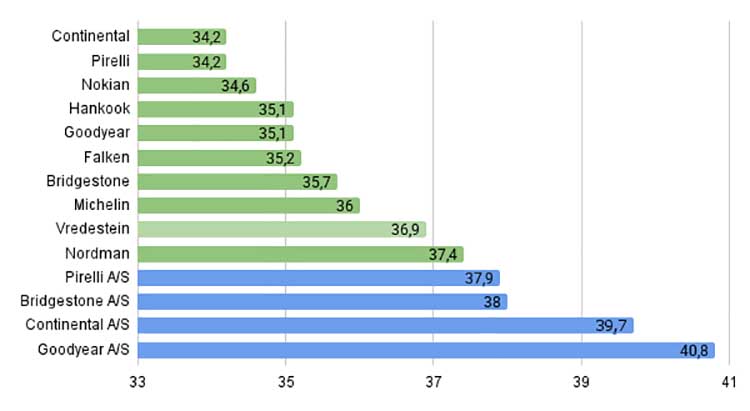
All-season tires, due to their softer rubber compounds and lugged tread, cannot compare to summer tires in terms of braking efficiency on dry surfaces. The best in this discipline was Pirelli Cinturato P7 (P7C2), which has already been replaced by Pirelli Cinturato (C3), and Continental.
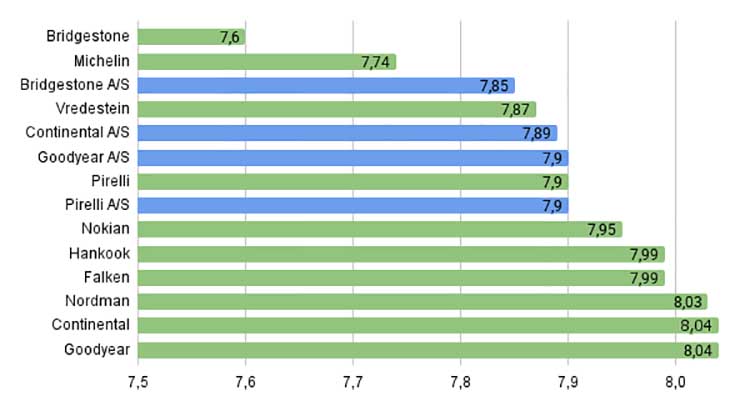
Handling tests were conducted in Vizzola at 20-30°C, and here the highest subjective ratings were given to Continental, but it should be said that most participants had a very good rating. At the same time, Nordman and Vredestein tires performed at the level of all-season tires, and they also had slowed-down reactions to steering wheel turns and a tendency to skid, and the deterioration of handling becomes more noticeable at high air temperatures.
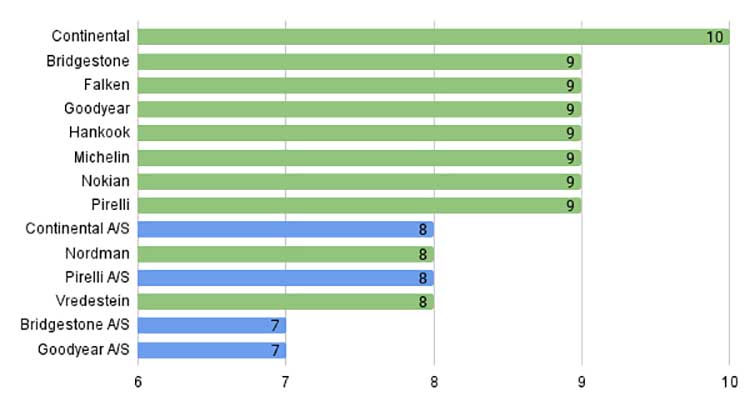
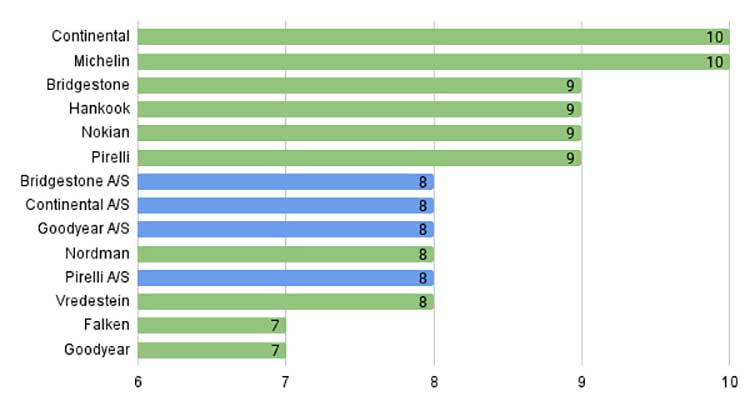
Noise was evaluated subjectively, and the maximum score of 10 points was received by the summer Bridgestone, Falken, and Michelin, as well as the all-season Continental.
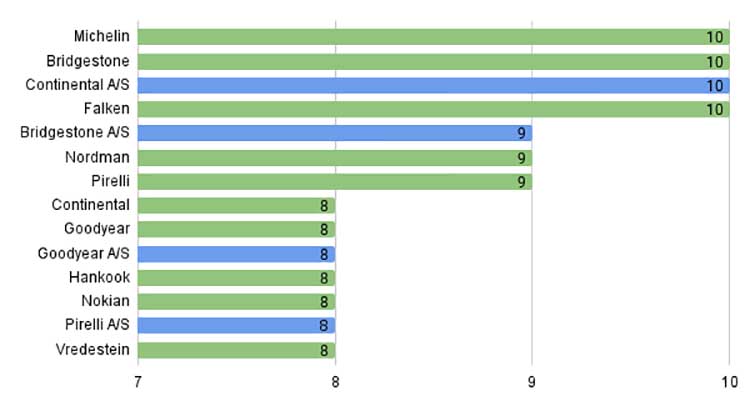
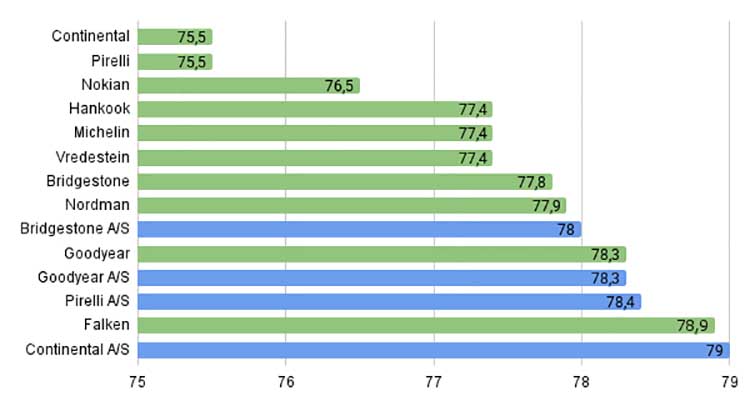
While UTAC traditionally evaluates the economy of tires based on the difference in fuel consumption, Jonathan Benson, the creator of the Tyre Reviews portal, from which the test results were taken, calculated the rolling resistance, and the most economical were the summer Bridgestone and Michelin.
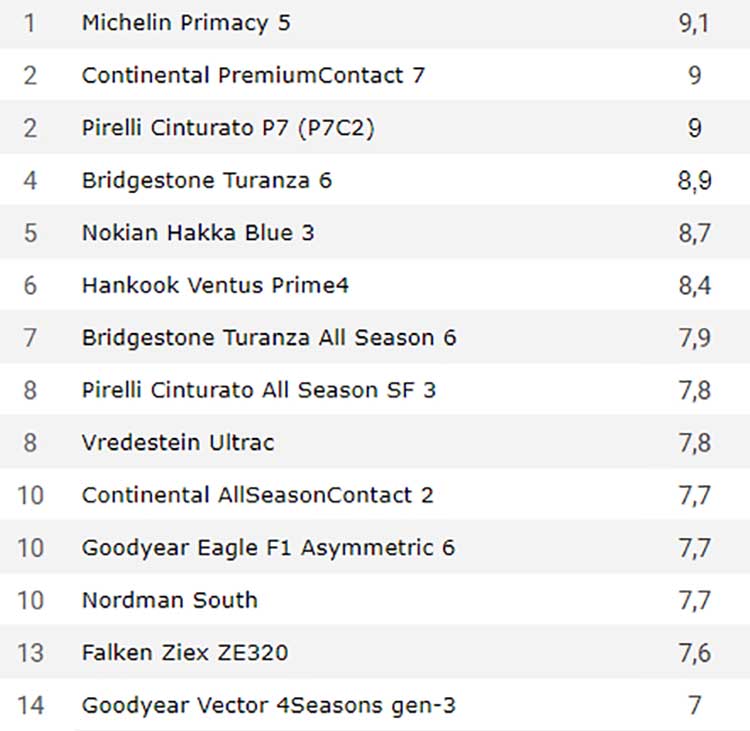
Test Results
The first place with a minimal gap from the competitors is taken by the Michelin Primacy 5 tire, which on wet surfaces provides good handling and allows for quick stopping of the vehicle. On dry asphalt, the tires behave stably, although they concede to several competitors in terms of braking efficiency, and the reactions to steering wheel turns are slightly slowed down during emergency maneuvers. Michelin tires are also quite quiet and economical.
Silver was shared by Continental PremiumContact 7 and Pirelli Cinturato P7. The tires of the German brand can guarantee excellent controllability on a wet road in any situation, and their drawbacks can be considered increased noise and poor fuel economy, while the product from the Italian company works well on wet surfaces, but during sharp maneuvers, there is a risk of skidding, which experts called traditional for Pirelli. There are no complaints about noise, but the rolling resistance is relatively high.
Next were Bridgestone Turanza 6, which have low noise and excellent fuel efficiency, but the situation is worsened by weak resistance to aquaplaning and a tendency to skid on dry surfaces, and they are followed by Nokian Hakka Blue 3, which provide very high transverse grip on wet surfaces and good handling on dry surfaces. At the same time, in rainy weather, skidding can start too sharply, and Nokian also has increased rolling resistance. Hankook Ventus Prime4 tires resist aquaplaning well, and they also have high lateral stability on wet roads. However, during sharp maneuvers on dry asphalt, the rear tires do not hold traction very stably, and the noise and rolling resistance are relatively high, which affected the final rating. The Vredestein Ultrac tire seriously worsened its rating due to the longest braking distance on wet surfaces among all the tested tires. In addition, the Ultrac has unstable behavior during emergency maneuvers in any conditions, especially in cool weather.
The tenth place is taken by Continental AllSeasonContact 2, which have decent braking efficiency on wet surfaces, but clearly weak resistance to aquaplaning, which is an important factor in ensuring safety. On dry surfaces, Continental also has a long braking distance, regardless of temperature. The same number of points as Continental was scored by the summer Goodyear Eagle Asymmetric 6, which usually ranks among the leaders in tests, but not this time, and the reason, presumably, lies in the fact that the tire reveals its full potential in warmer weather. On relatively cold wet asphalt, Goodyear extends the length of braking distances, and the rear tires can suddenly go into skidding. On dry surfaces, everything is much better, and Goodyear also has very low rolling resistance.
The Nordman South tires were prevented from getting a higher score, in particular, by the reduced fuel economy, while on wet surfaces, handling is decent, although traction is lower than that of premium-class tires, and during sharp maneuvers, there is a risk of skidding. On dry surfaces, the characteristics are good.
Only in 13th place were the Falken Ziex ZE320, which have a long braking distance on wet surfaces in cool weather. When it's warmer, traction is higher, but there is still a tendency to both insufficient and excessive turnability. On dry asphalt, the tires work well, and the driver can expect no unpleasant surprises, but the economy could be improved.
The last place was taken by the all-season Goodyear Vector 4Season gen-3, which, with an increase in ambient temperature, begin to lose traction on both the front and rear axles. In addition, the tires have very weak resistance to aquaplaning, and on dry surfaces, experts noted both a long braking distance and slowed-down reactions to steering wheel turns, although the transverse grip is quite acceptable.