ADAC tested off-road tires
Experts from the All-German Auto Club ADAC tested All-Terrain class tires, noting that they are becoming increasingly popular among owners of SUVs and pickups, as well as motorhomes, which is why new tests were conducted. At the same time, experts note that if in Africa or Australia, vehicles of these categories are really used most of the time on surfaces that require tires with increased passability, then in Europe they are mainly operated on asphalt, so the focus when setting ratings was on what level of safety A/T class tires provide on paved surfaces, i.e. how well they are suitable for everyday life.
Tires in the size of 225/65 R17 were tested, which is suitable, among other things, for Volkswagen minivans, which are considered classic cars for camping, and for comparison, one model of all-season road tires was taken - Pirelli Cinturato All Season SF 3.
The list of participants included the following tires:
In asphalt tests, A/T tires showed themselves to be significantly worse than "all-season" tires, which are specifically designed for such conditions and do not have off-road capabilities, and ADAC even noted that off-road tires have "shockingly weak grip on wet pavement", so none of them can be recommended for everyday use in cities.
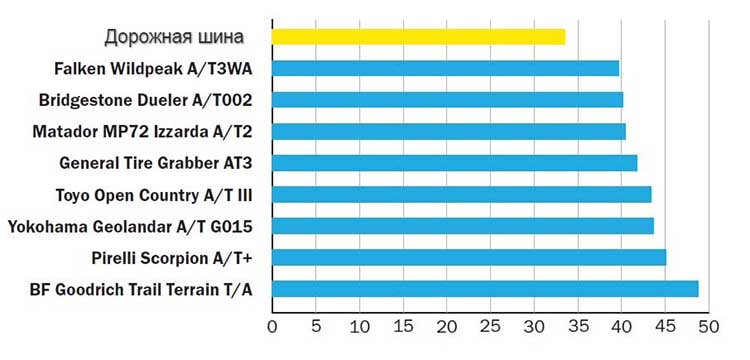
The longest braking distance on a wet surface was recorded by BFGoodrich, which stopped the car at a speed of 80 km/h only after 48.8 meters. Even the best All-Terrain tires in this discipline (Falken) had a braking distance six meters longer than road tires, which is the length of a van. On wet asphalt, road tires were also expected to be better, and off-road Pirelli showed particularly poor results, with a strong tendency to skid.
On gravel, Matador showed the highest traction, but the road tire showed the second result, so even here, the "atэshki" did not have a clear advantage. In the handling test, the situation was similar, but after the tests, it became clear that off-road tires are better suited for increased loads in difficult conditions, since road tires "lost part of the tread". For mud tests, a grassy area was watered, and even here, according to experts, All-Terrain tires were unable to significantly improve the level of grip compared to road tires, and it was much more important whether the car had four-wheel drive.
All tested tires had a snowflake marking, which means they were approved for winter conditions (not in the northern climate), and therefore snow tests were conducted, in which the difference in tire performance was most noticeable. Yokohama turned out to be the most effective on a snowy surface, while Bridgestone had an assessment that was almost as bad as that of road tires.
Summing up the tests, Steffan Kerbl, a technical specialist at the Austrian Auto Club ÖAMTC, one of ADAC's partners, noted that "none of the products tested can compare with the all-season tire we used as a standard".
"We found a number of glaring flaws, especially in terms of braking on wet roads, so we cannot unequivocally recommend any of the off-road tires we tested, — he said, adding that A/T class tires have their advantages. — Probably, most often they are used by camping enthusiasts in our country, and here improved grip can be very useful when exiting the grass. In such conditions, as well as on gravel, off-road tires do not concede to road tires, and in some cases even surpass them in terms of grip and durability. Therefore, for those who plan long trips to remote areas on dirt roads, off-road tires can be recommended, at least due to their high resistance to punctures".
Results
The first place in the tests was taken by Yokohama tires, which showed their best qualities on snow, but were also one of the best on other types of surfaces. Yokohama has the highest ratings for handling on both snowy and wet surfaces, and since they, along with Bridgestone, stopped the car the fastest on dry asphalt and did not allow themselves obvious weaknesses, they deservedly win the test.
Falken tires have the smallest tread depth, but, as it turned out, this does not affect the resistance to aquaplaning, and in general, Falken Wildpeak A/T AT3WA did not have significant drawbacks, and they occupied a place in the list of leaders in all tests, except for the gravel test. According to experts, Falken can be considered a tire with the most balanced characteristics among the tested, and on wet asphalt, it was the most effective.
The third place was taken by General, which have their strengths, but on wet surfaces, they conceded to three other tires, i.e. the balance of parameters is good but not outstanding. At the same time, excellent results in tests for braking efficiency and handling on a snowy road allowed General to receive silver in the overall standings.
Matador tires (both models are produced by the Continental concern) scored the same number of points as General, which showed excellent results on gravel, but received a not very high rating on dry asphalt due to inaccurate reactions to the driver's actions and not the best lateral stability.
Pirelli tires are in fifth place, with a strong tendency to skid, and, as experts noted, if on gravel this is still tolerable, since the speeds are initially low, then on snow and wet asphalt, where in difficult situations, the grip of the tires is crucial, Pirelli Scorpion A/T+ has strong excessive steering, which requires increased caution from the driver. In general, on snow, Pirelli had the weakest results among the participants, and on wet roads, the ratings were not much better.
Toyo Open Country A/T III distinguished themselves with the highest results on dry asphalt, and besides, they deserved praise for maximum strength. At the same time, Toyo has low grip on wet surfaces, which affected the overall rating, and particular claims were made to handling, as well as to resistance to lateral aquaplaning.
Bridgestone showed themselves well on wet surfaces, where only Falken was better, and Dueler A/T002 also provides very fast braking on dry roads, and the reason why they took only the penultimate place is that they have very weak performance on snow, both in terms of braking and traction properties, as well as handling.
BFGoodrich tires were the heaviest and most expensive in the test, and they also provide the lowest level of safety on asphalt, both wet and dry. At the same time, BFGoodrich has excellent results on gravel, and on snow, only Yokohama was better, so this is a tire created with an emphasis on off-road characteristics.