The Bridgestone WT12 winter tire belongs to the friction type models, being designed for operation in regions with a very cold climate. It demonstrates reliability of handling on snow and ice, stability of coupling properties, a comfortable smooth and quiet ride, along with increased wear resistance and fuel efficiency.
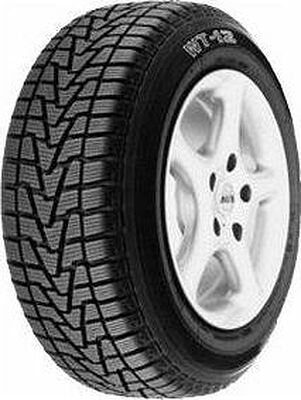
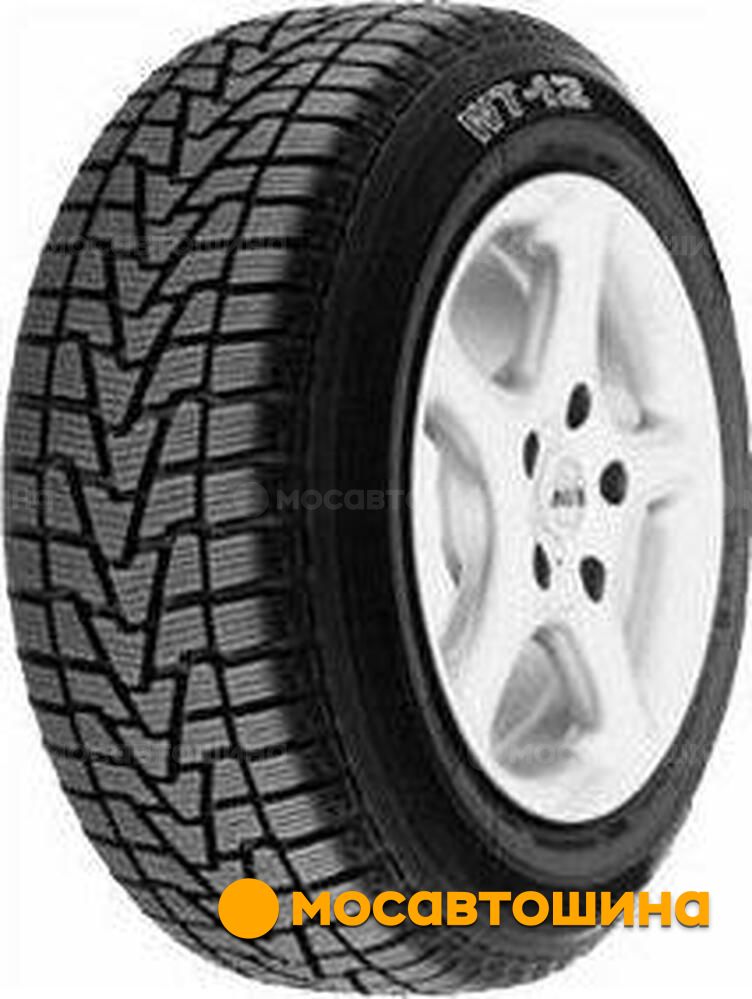
The tread pattern is made in a directional design, consisting of numerous blocks. In the central part, the elements, due to their shape and location, overlap each other, forming a very wide continuous longitudinal rib. This significantly reduces rolling resistance, wear, and noise, while improving directional stability. The blocks are arranged in such a way that they form virtually continuous transverse edges, which improve traction and braking properties on wet and snowy surfaces. The next important distinction of the pattern is the extremely dense cutting of lamellas. This was made possible by the "three-dimensionality" of the profile of their vertical walls. Such cuts, when in contact with the road surface, are fixed in an open position, preventing deformation of the blocks. As a result, high intensity of braking and acceleration on an icy surface is ensured, simultaneously with an increase in the stability of coupling properties and ease of management of longitudinal acceleration. It is also worth noting the use of a specialized rubber compound, the composition of which was selected based on the characteristics of winter operation. It contains a large amount of "silica", which allows the tread to maintain optimal elasticity, even at extremely low temperatures, while ensuring a uniform distribution of stiffness. This significantly enhances the coupling properties on slippery winter surfaces, giving the tire increased resistance to abrasive wear, increasing its mileage.
Main features of Bridgestone WT12:
- a large number of blocks forming continuous transverse edges provide excellent traction on snowy surfaces;
- optimized placement of tread elements in the central part reduces wear, rolling resistance, improving directional stability at high speeds;
- increased contact patch width and its ellipsoidal shape provide ease of handling during maneuvering;
- "winter" compound, remaining elastic at low temperatures, providing reliable handling on any winter surfaces.
 Enlarge
 Enlarge