
-
 Enlarge
 Кама 405
Description Кама 405
Unlike most tire products produced at the Nizhnekamsk Tire Plant, the Kama 405 truck tire has a fairly specific scope of application. It is limited to the driving axle of agricultural tractors T-40. In such challenging operating conditions, this model demonstrates excellent reliability, excellent cross-country ability on sandy and earthy soils, as well as a long service life.
Aggressive tread pattern design
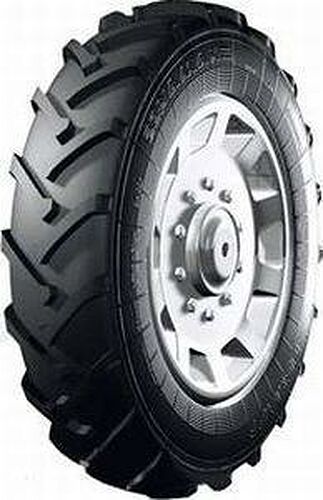
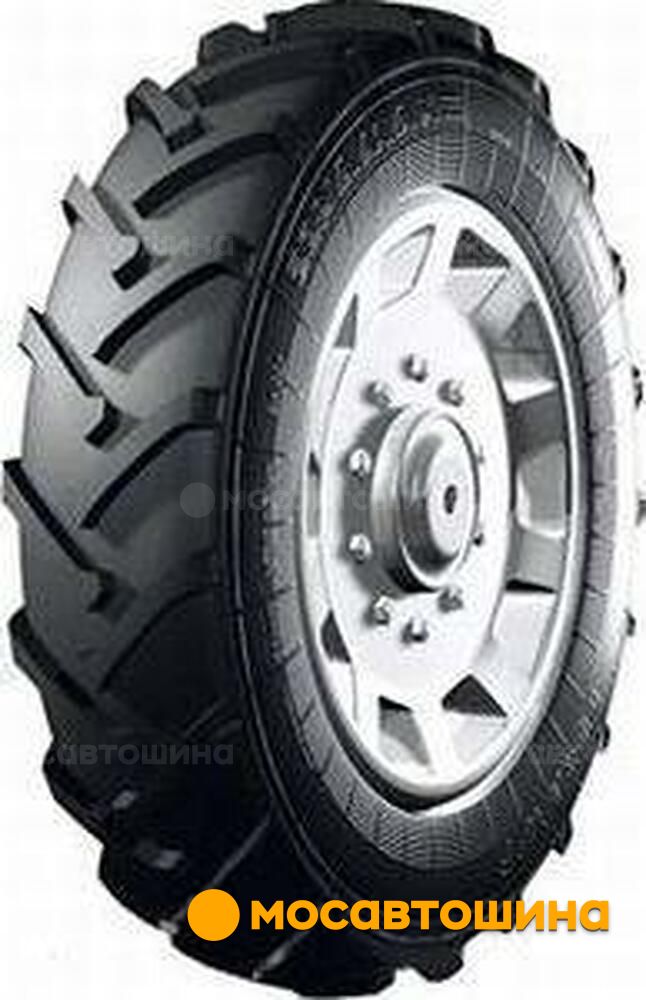
Like most modern tires designed for off-road operation, this model is equipped with a symmetrical directional tread pattern with a V-shaped design. It is formed by numerous soil-gripping elements that start in the shoulder areas and converge in the central part. At the same time, it is impossible not to note the massive size and significant height of these tread elements.
Low rolling resistance
Unlike the shoulder areas, the tread blocks in the central part are located at a very small distance from each other. In addition, they have a thickening in this place, which allows forming a kind of longitudinal rib. Such a design of the central part of the tread makes it possible to significantly reduce the rolling resistance, which gives the Kama 405 tire increased fuel efficiency.
Excellent traction properties
As mentioned earlier, this model is favorably distinguished by excellent cross-country ability on sandy and earthy soils. It is achieved due to the design of the shoulder areas, where the tread blocks are located at a very large distance from each other. This feature allows the tread to effectively self-clean from even large stones that get into it, which, in combination with the large height and significant length of the traction edges, provides the tire with excellent traction properties, primarily in the longitudinal direction.
Main features of the Kama 405 tire
- the tire is designed for operation on tractors used in agriculture;
- the aggressive V-shaped design of the symmetrical directional pattern has excellent performance off-road;
- low rolling resistance due to the close location of tread elements in the central part;
- excellent cross-country ability on sandy and earthy soils is ensured by the design of the shoulder areas, where the tread blocks are located at a significant distance from each other, forming very long and high traction edges.