
Winter tyre friction test from Vi Bilägare — 2024
For the winter season, the Swedish magazine Vi Bilägare traditionally tested not only studded, but also friction Scandinavian-type tires, and for comparison, one model of so-called all-season tires was taken — Michelin CrossClimate 2, which has a 3PMSF marking, meaning it can be legally used in winter in northern countries.
The main intrigue of this year's test was how the novelty from one of the leading manufacturers, namely Continental VikingContact 8, which replaced the VikingContact 7 tire, which had previously won several tests by VB, would perform. The new Continentals have also already managed to outperform all competitors in their first two tests (UTAC and Teknikens Värld), so they had a chance to continue their winning streak, although the competitors were the most serious, namely Goodyear UltraGrip Ice 3, Michelin X-Ice Snow, and Nokian Hakkapeliitta R5.
The test also included Hankook Winter i*cept iZ2 from the medium segment and two budget tires: Linglong Green-Max Winter Ice I-15 (the company has started to remove the word Linglong from the name of these tires in Scandinavia, possibly to make it "less Chinese", but we will continue to call them as before), as well as Radar Dimax Ice from the Singaporean Omni United, tires that are produced by various partners. The selected tire size (as in the test of studded tires): 225/45 R17.
In the traction and braking tests on ice, Michelin, Nokian, and Continental became the leaders, while Linglong encountered very big difficulties, and they performed at the level of all-season tires, which is absolutely unacceptable for "Scandinavians". The braking distance of Linglong and all-season Michelin was almost twice as long as that of the best tires, for which they, of course, received a "Poor" rating in this discipline. At the same time, Radar, which is not much more expensive than Linglong, had noticeably better grip and was able to compare with Hankook.


In the handling tests on an icy surface, the new Continentals were recognized as the best, which predictably behave at the limit of adhesion, as well as Nokian, which impressed with the ease of handling in turns. Experts also noted that Radar can handle higher speeds when turning than Michelin, but at the same time, they sharply switch between insufficient and excessive turnability. As for all-season tires, they take a very long time to restore adhesion after the start of skidding, but in general, they are not designed for such conditions.

On snow, the differences between the tires in terms of traction and braking qualities decreased, and in the acceleration efficiency test, the difference in the results of Goodyear and the other six tires did not exceed 10%, and only Radar lagged behind the rest. The braking distances also differed insignificantly, and the last line in this discipline was occupied by Michelin CC2.

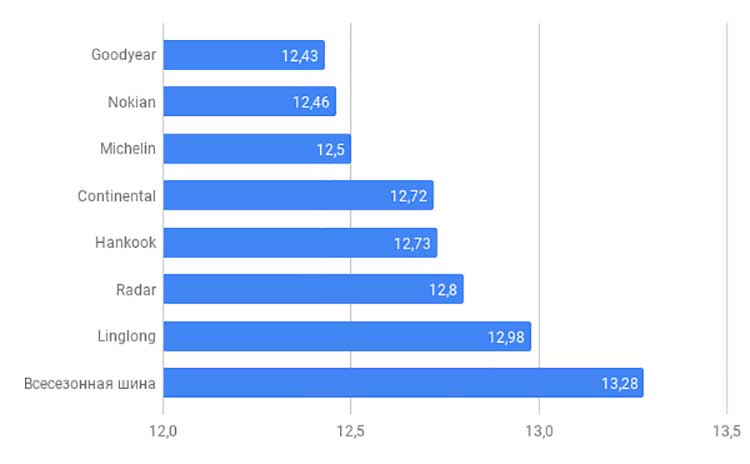
In the handling test, the situation was slightly different, and if Goodyear allows for quick maneuvering due to reliable adhesion on the rear axle, and Nokian responds very quickly to the driver's actions, then the car on Linglong tires "was skidding in every turn".

On wet asphalt, all-season tires, of course, come out on top, and, for example, the best "Scandinavians" — Goodyear — needed 10 meters more to slow down from 80 to 5 km/h, and the braking distance of Linglong and Radar was another five meters longer.

Goodyear also provides the best handling on wet surfaces among tires of its class, followed by Continental. Experts note that Nokian also guarantees good controllability, while Michelin has a tendency to understeer, and Hankook has a reduced level of adhesion, although it is better than that of both budget tires.

Friction Scandinavian-type tires traditionally have weak resistance to aquaplaning, and here the lag behind all-season tires was most noticeable, and the last places were occupied by Nokian and Radar.

On dry surfaces, the soft rubber compound of "Scandinavians" is an advantage, and all tires were able to quickly stop the car, and Linglong was in last place again. For handling, only subjective assessments were given, and the testers put Goodyear in the first place, while Continental's stability has increased compared to VC7, and Radar and Linglong are generally unable to provide acceptable handling, and it turns out that Chinese brand tires, whatever they are called, do not work well in any conditions.

Linglong also has the highest rolling resistance among all tested tires, and the best in this parameter were Goodyear, Continental, and Nokian.

Noise was measured in the cabin at two speed modes, and Continental and Goodyear were recognized as the quietest. Linglong and Hankook tires also provide good acoustic comfort, while Radar has increased noise already at low speeds, and Michelin CC2 was the noisiest, which in terms of rubber compound stiffness is close to summer tires.

The novelty from Continental did not manage to make a hat-trick in the 2024 tests, and the first place in the overall standings was taken by Goodyear tires, which stood out from the competitors in that they surpass them all in terms of adhesion not only on snow but also on wet asphalt. On ice, there were more efficient tires, and on Goodyear, skidding begins relatively sharply, but there were enough points in other disciplines for victory.
Continental eventually won silver, and experts noted that the tires have the same good and balanced characteristics as the previous generation model, but the stability on asphalt has improved, which may be due to the fact that VC8 was adapted for use on heavy electric vehicles, as indicated by the special EV marking on the sidewalls. At the same time, in order to improve the performance on asphalt, it seems that the winter performance had to be sacrificed to some extent, and Continental is no longer the leader in terms of braking and acceleration efficiency, although it still provides good ease of handling under load.
Nokian took the third place, which, as always, showed excellent results on ice and snow, while on asphalt, the adhesion is slightly reduced, both longitudinal and transverse, but the tires still behave predictably when performing a sharp maneuver. The resistance to aquaplaning is average, and in general, Nokian is clearly focused on providing maximum adhesion on snowy and icy surfaces.
Next are Michelin, which, despite the increased stiffness of the compound, were able to outperform all competitors in terms of braking efficiency on ice. At the same time, the transverse adhesion is not so impressive, and skidding begins earlier and more sharply than with some other tires. On asphalt, Michelin also has excellent braking qualities and good directional stability, but in turns, there is again a certain lack of adhesion.
Another line below is occupied by Hankook, released nine years ago, and this year giving way to new Hankook Winter i*cept iZ3. According to experts, the age is already noticeable due to a certain imbalance of characteristics, and if on ice Hankook is clearly inferior to the leaders both in braking and in maneuvering, then on snow the situation is better, and on asphalt, the tires provide very good handling sensitivity and directional stability, although the braking distances are relatively long.
The sixth place is occupied by all-season Michelin CrossClimate 2, which, as expected, showed poor results on ice, but worked well on snow. In both cases, the longitudinal grip is better than the transverse one, and the adhesion takes a very long time to recover after the start of skidding. At the same time, on asphalt, the indicators are much better than those of "Scandinavians", which is also expected.
Radar Dimax Ice tires, as VB writes, were developed with the participation of former Nokian engineers, which may have led to their focus on maximizing adhesion on ice. The Radar rubber compound is one of the softest among the tires in the test, and they surprised with good grip on ice, and in the handling test, they even outpaced Michelin. On snow, the indicators are also generally acceptable, but on asphalt, they increase the braking distance, poorly resist aquaplaning, and also make a lot of noise, so, according to experts, even a very low price is not justified.
Linglong took the last place, which has low noise levels and good resistance to aquaplaning, but everything is very bad in terms of all other parameters, and the adhesion on ice is approximately at the level of all-season tires. Linglong is very willing to skid sharply and unexpectedly in any winter conditions, and they behave in the same way on asphalt, making it difficult to control the car. In addition, Linglong also has high rolling resistance, and it is strongly not recommended to purchase these tires.

Source: Vi Bilägare.