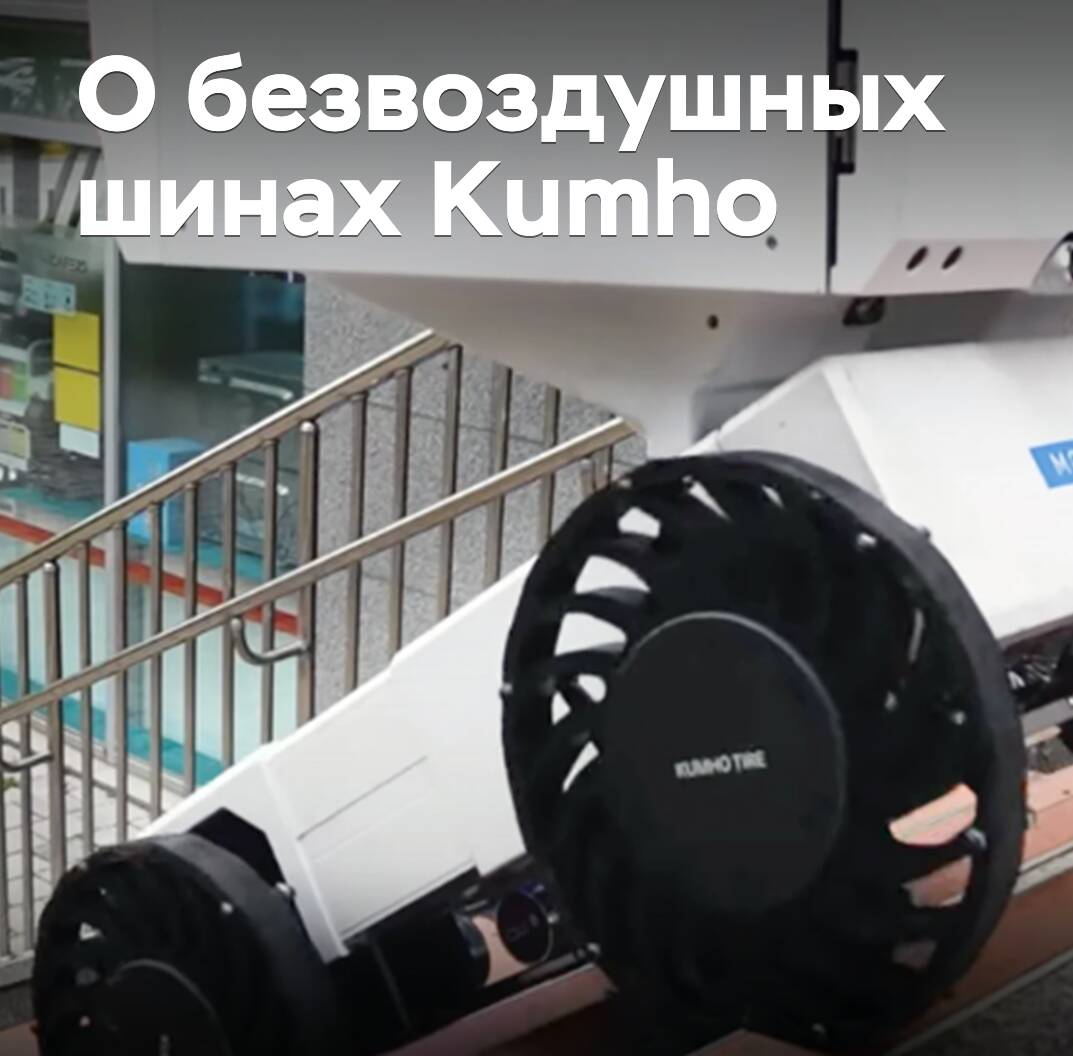
First — micro-mobility. Kumho told about the development of airless tires
South Korean tire manufacturer Kumho Tire, like many other manufacturers, is investing in the development of non-pneumatic tires (NPT), and not so long ago, the company shared an update on its progress in this area, noting that it has decided to start with the production of tires for so-called micro-mobility, i.e., for ultra-compact vehicles.
Kumho began developing NPT in 2016, and to date, it has unveiled two conceptual airless tires — BON and e-NIMF — which received the iF Design Award in 2018 and 2021, respectively.
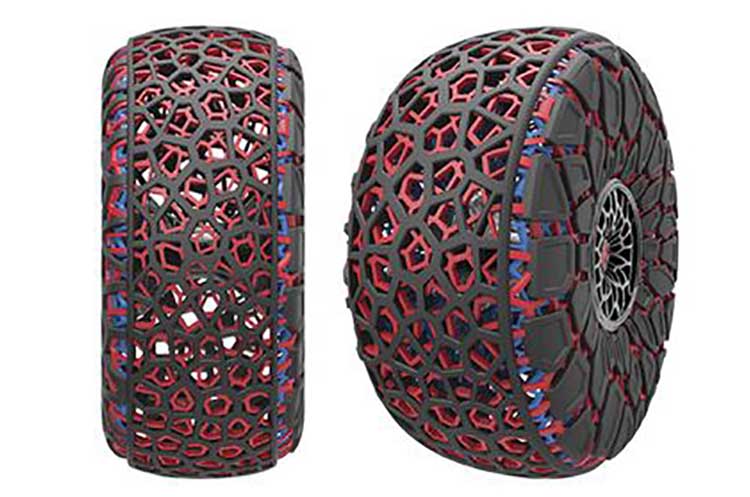
The BON tire features a structure created in accordance with the Voronoi diagram, named after the Russian mathematician. This type of plane division is found in nature (BON stands for "Bon on Nature"), for example, in the structure of insect wings and leaf veins, and Kumho notes that the production of such tires will require special rubber crumbs suitable for use with 3D printing technologies.
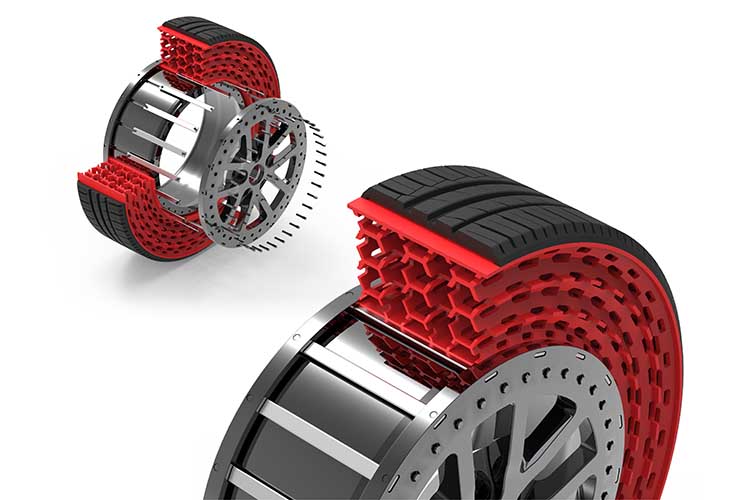
In turn, the airless tire e-NIMF is designed for passenger cars and has a honeycomb structure with numerous spokes made of thermoplastic elastomers. The approach chosen for e-NIMF provides high load-carrying capacity, but it also has its drawbacks. "Such wheels have separate spokes and disks, which makes them more structurally complex and heavier — and also more expensive," Kumho says. "In addition, they lose to pneumatic tires in terms of overall characteristics, such as vibration absorption and ride comfort, so we decided to develop a new tire design."
Currently, Kumho is developing tires for delivery robots and autonomous platforms, PBV (Platform Beyond Vehicle). "To commercialize NPT, our company is cooperating with manufacturers of unmanned transport and robot developers, and together with them, we are creating airless tires suitable for this type of mobility," Kumho notes, adding that tires for this segment must have a number of characteristics, such as spoke strength, puncture resistance, and good ride smoothness at low speeds.
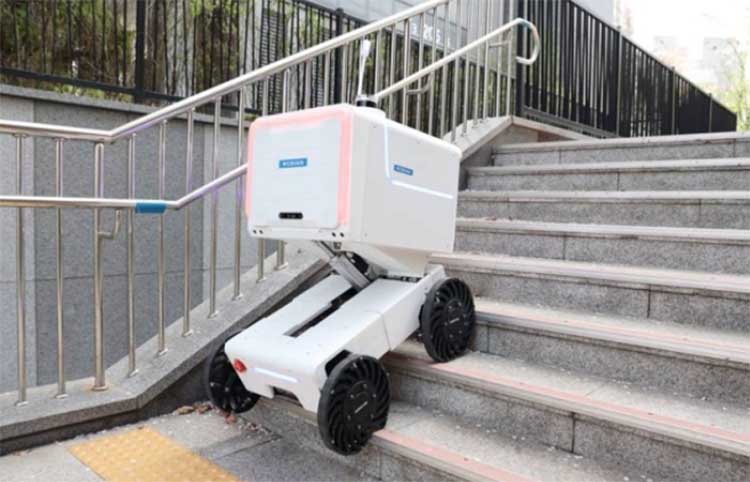
For delivery robots, spoke strength is of particular importance, as in the future, they will be able to climb stairs, the company emphasizes. In general, the results of Kumho's work in this sector are confidential, but it is known that the company collaborated with Mobinn — a "daughter" of Hyundai, engaged in developments in the field of autonomous transport — as part of the creation of the M3 robot, which can climb stairs.
The Mobinn M3 is currently being tested in South Korea, and during the Consumer Electronics Show 2024, a robot equipped with "flexible" tires with elastic spokes was presented at Kumho's booth and received an innovation award — the CES Innovation Award.
Although Kumho is currently focusing on NPT for micro-mobility, the company does not plan to limit itself to this segment. "Ultimately, we intend to work in all sectors where pneumatic tires can be replaced," the company says. "To do this, we plan to accumulate technologies in the development of tires for slow-moving transport in the first stage and then use them in the creation of faster automotive tires."
Kumho expects that NPT suitable for high speeds will be developed by 2027, and for them, a completely new design is planned. When such tires can enter the market, the company does not undertake to say, as first, vehicles adapted for use with NPT must appear, and it is also necessary to determine the rules and regulations for the use of airless tires.
Kumho intends to start supplying tires of the new type to manufacturers of various slow-moving equipment in 2026-2027. According to Richard Kunat, managing director of Kumho's American Technical Center, cooperation with partners in the OEM sector is crucial for bringing such technologies to market.
"When it comes to technologies of this type, cooperation with any automaker is actually mandatory," he stated. "Such projects should not be carried out only by tire companies. As with pneumatic tires, the development of NPT should be a team effort. When we create new [pneumatic] tires, they are tested on the cars of our OEM customers, and when the required level of characteristics is achieved, they are sent to production. Airless tires should be developed in the same way [...] It's hard to create something inside the company, as tires must work as a whole with the vehicle."