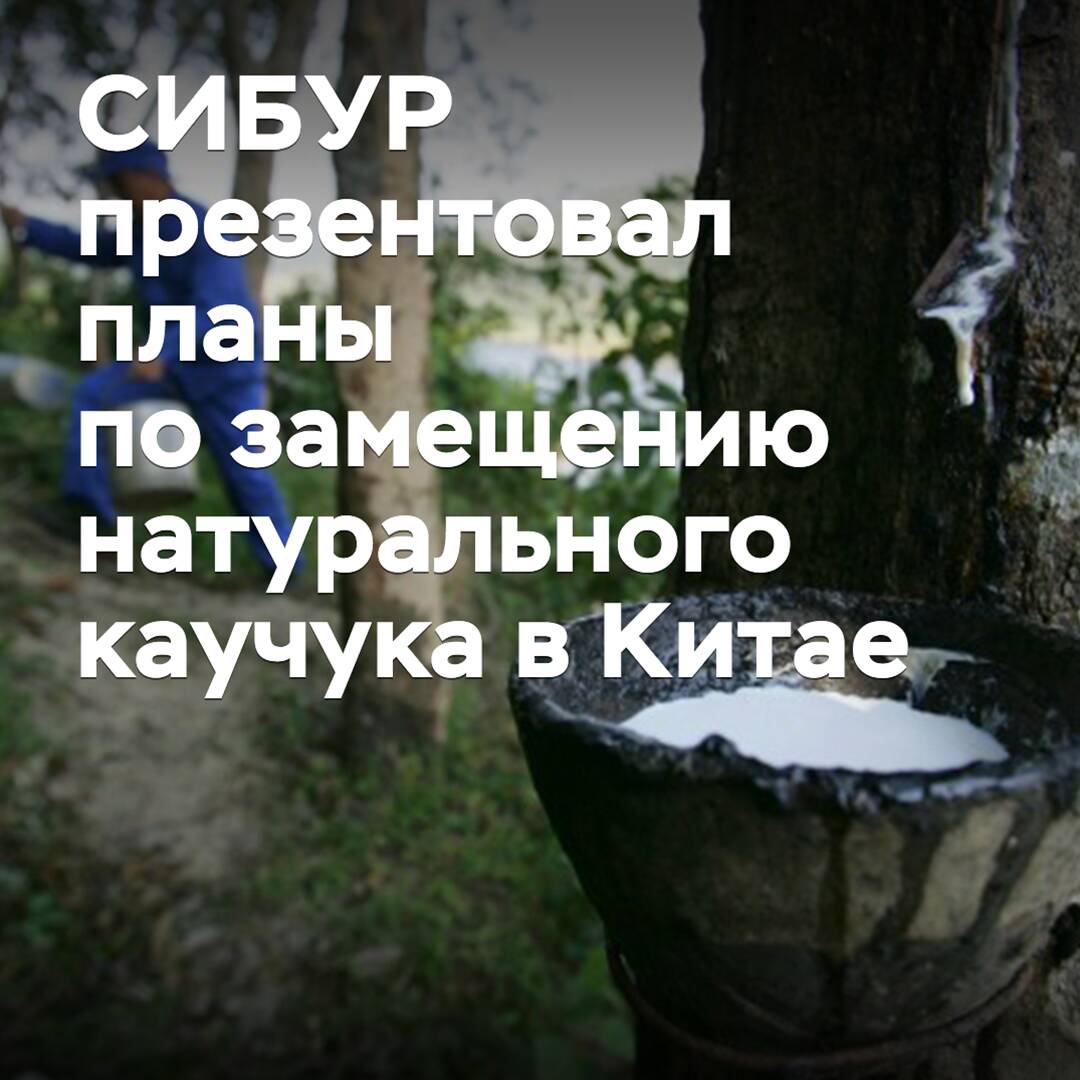
SIBUR presented plans to replace natural rubber in China
Currently, SIBUR, in collaboration with Russian tire manufacturers, is working to completely replace natural rubber with its synthetic analogue, and not so long ago, the company spoke about the results of its work in this area at the specialized RubberTech exhibition in Shanghai.
Natural raw materials, which have to be imported from Southeast Asia, are planned to be replaced with isoprene rubber - a synthetic material that, as the company notes, is very close to natural rubber in its chemical properties and characteristics and has advantages such as the absence of impurities and stable viscosity.
Tests have shown that replacing up to 50% of natural rubber allows the properties of the rubber mixture of tire treads to remain virtually unchanged, while simultaneously reducing costs. In addition, isoprene rubber provides high dimensional stability of the rubber during calendering and molding, reducing the amount of waste.
In the case of tire carcasses, mixing isoprene rubber with natural rubber makes it possible to obtain a material with increased fatigue strength and slowed heating under the influence of dynamic loads. At the same time, with a content of isoprene rubber in the mixture of more than 55%, its technical characteristics deteriorate.
When replacing up to 50% of natural rubber in the sidewalls of tires, the main properties of the rubber, such as strength, elasticity, and resistance to rupture, remain virtually unchanged, the company says, and in addition, research has shown that rubber mixtures with isoprene rubber content have higher resistance to aging.
Replacing up to 20% of natural rubber in the inner liner has a negligible effect on its parameters and can even slightly improve its properties, SIBUR notes, adding that in general, isoprene rubber can now partially replace natural rubber in various tire and RTI components while maintaining operational characteristics and reducing costs.
The use of isoprene rubber also ensures compliance with the EU Deforestation-free Products Regulation (EUDR), which will ban the supply of products whose production is associated with deforestation. The origin of natural rubber can be difficult to track, which is not the case with isoprene rubber, which is produced at petrochemical plants.
Photo: theatlantic.com