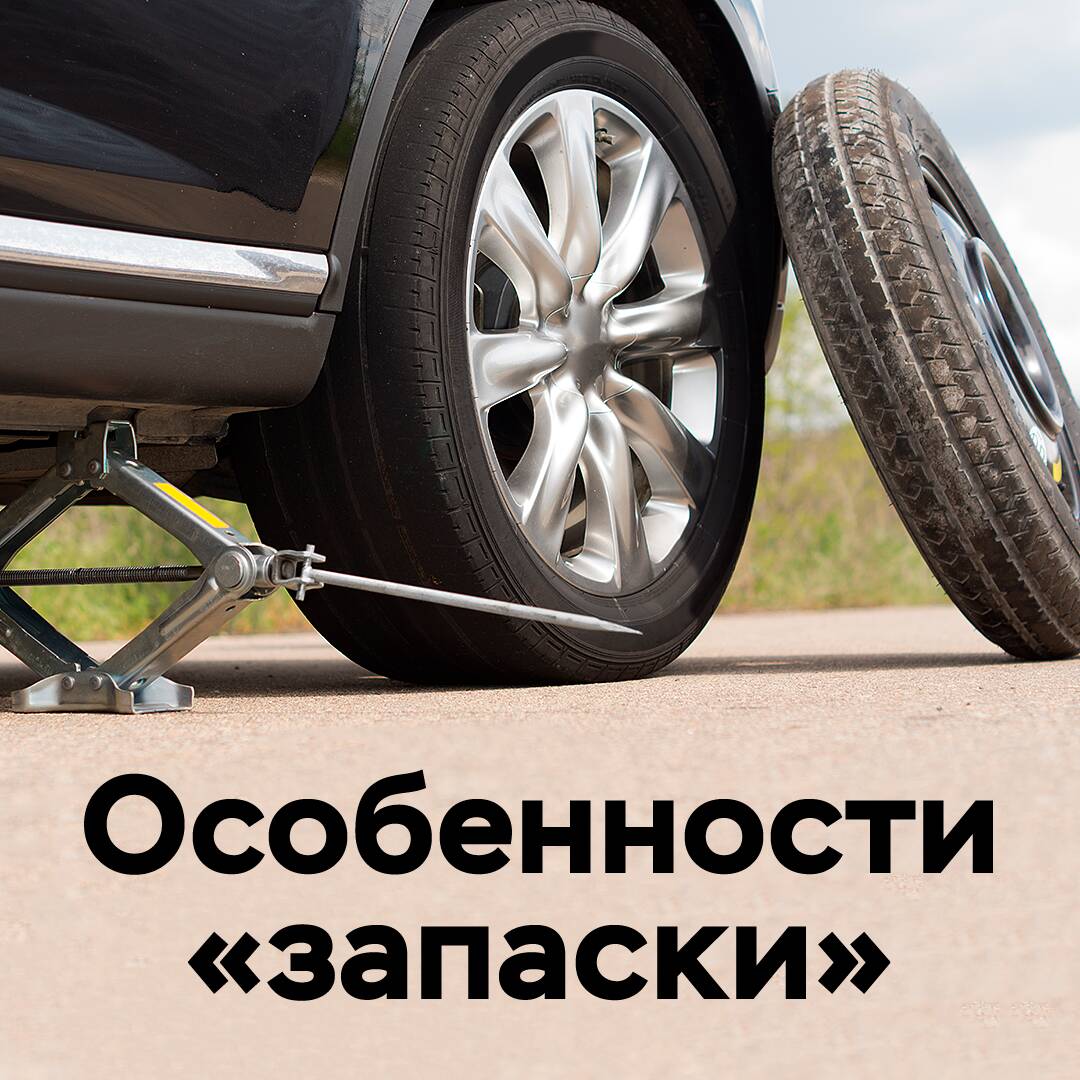
Features of the "donut" <br />
Until necessity arises, few people check the spare tire compartment of their car. Over time, a full-size wheel is becoming less common, while most cars are equipped with a so-called "doughnut". The name essentially explains the purpose of this wheel. It is not intended for constant use, but only to get to the place of repair of the main wheel. At the same time, few people understand the difference between a full-size wheel and a "doughnut".
1. First of all, you need to remember that you cannot drive faster than 80 km/h on a "doughnut". This is stated not only by the speed index, but also by the often encountered inscription "Maximum speed 80 km/h". Obviously, observing the speed is important, and the manufacturer does not particularly rely on the tabular knowledge of car enthusiasts.
2. Be sure to check the pressure in the "doughnut". As a rule, it is significantly higher than in a standard wheel and is 4 - 4.5 BAR.
3. Obviously, due to the narrow profile width, the handling of the "doughnut" will be significantly worse. Therefore, even a speed of 80 km/h may be excessive. Due to the significant difference in traction between the wheels on one axis, the car can simply spin around.
Of course, it's worth mentioning that a lack of time cannot be an excuse for prolonged use of a "doughnut". First of all, of course, due to safety considerations. But also because the resource of the "doughnut" is significantly lower. The initial tread depth, as a rule, is not more than 4 mm.
When installing a "doughnut", pay attention to the recommendations of your car's manufacturer. Often, the installation of such a wheel is completely prohibited on the front axle. If the car perceives the reduction in wheel diameter as slippage, it will try to counteract it with the help of assist systems.