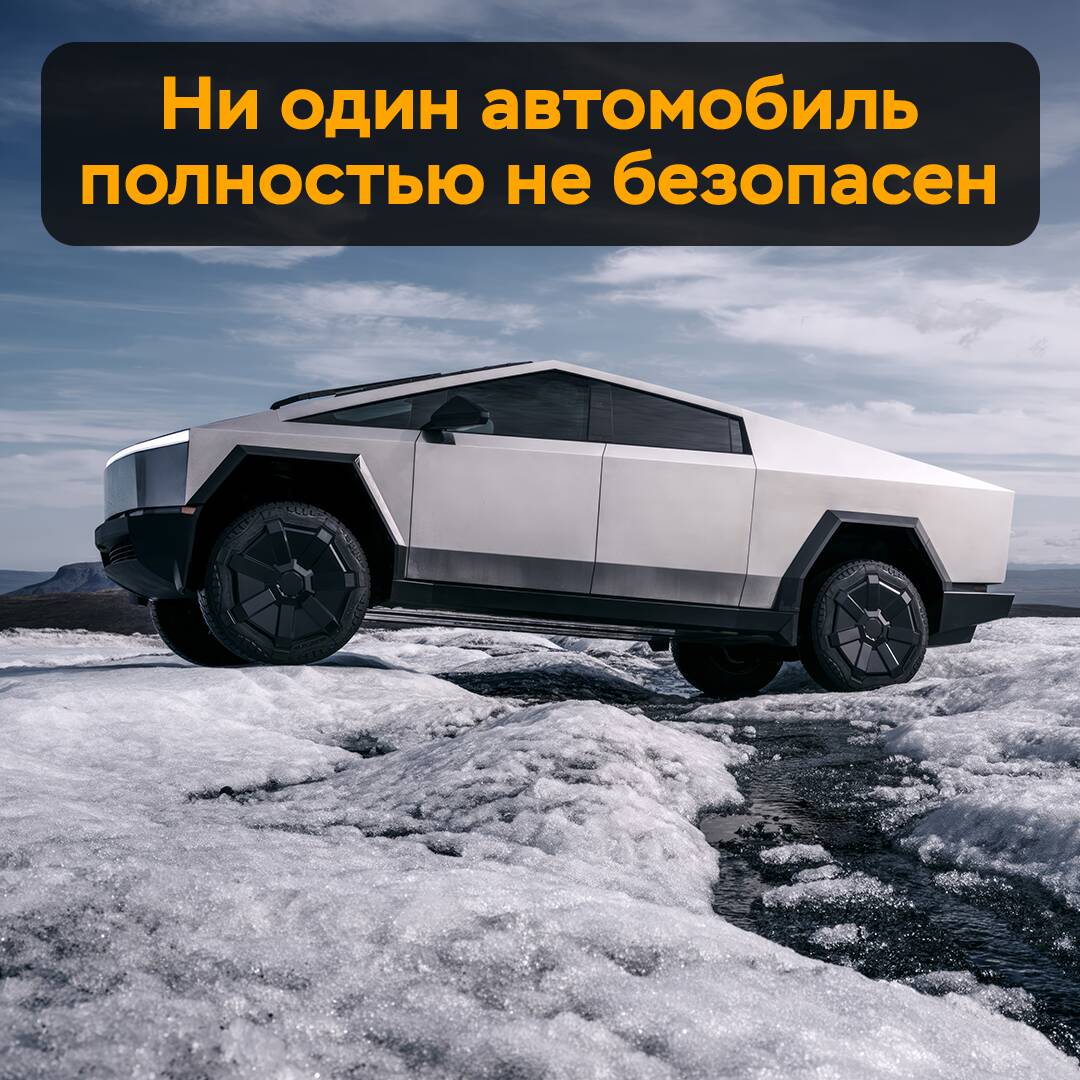
No car is completely safe
We've already gotten used to the fact that in case of serious weather changes, the Ministry of Emergency Situations can send an SMS, and some car owners are already paying little attention to it. Most likely, it's all about the deceptive comfort that is created inside the car. Its own climate, pleasant music, often heated seats, and possibly even a heated steering wheel create comfort that simply cannot be compared to what's outside the car - harsh winter conditions and serious danger to life.
Particular attention deserves all-wheel drive cars, as high passability and four-wheel drive can create a feeling that all-wheel drive characteristics will more than compensate for the shortcomings of the tires. This is not only incorrect but also a potentially dangerous statement.
Pay attention to the tire tests that we regularly review. The braking distance from a speed of 30-50-60 km/h can easily exceed 50 meters, while no one maintains such a distance on the road. Add to this the mass and inertia of a heavy car, and possibly even a full load, and we get a doubling of the braking distance on an icy road. Here, neither tires nor the car's super abilities can simply perform a miracle.
Most people believe that traffic accidents on icy roads are caused either by an inexperienced or reckless driver or by a car with poor/worn-out tires. Advertising of tires and vehicles with new safety technologies is misleading, showing that cars can easily accelerate on snow. This is certainly a factor contributing to the increase in the number of traffic accidents with black ice, indirectly implying that the product allows the driver to continue driving normally in icy conditions without reducing speed.
Every time you drive on icy roads at a speed of over 70 km/h, your car becomes extremely unstable on the verge of losing control. At this stage, all that is needed is some kind of trigger that sets off the loss of control, which you are unlikely to be able to restore. Such a trigger can be a slight movement of the steering, changing lanes, a gust of wind from a passing truck, or pressing the brake. Even at speeds below 70 km/h, there is a risk of losing control (especially on black ice) - the difference is that at lower speeds, the likelihood of leaving the roadway decreases, and if you do hit something, the impact is less likely to result in serious injury.
The only safe way to travel on icy roads is to maintain a speed below 70 km/h, regardless of the type of tires or safety technologies that may be installed on your car.