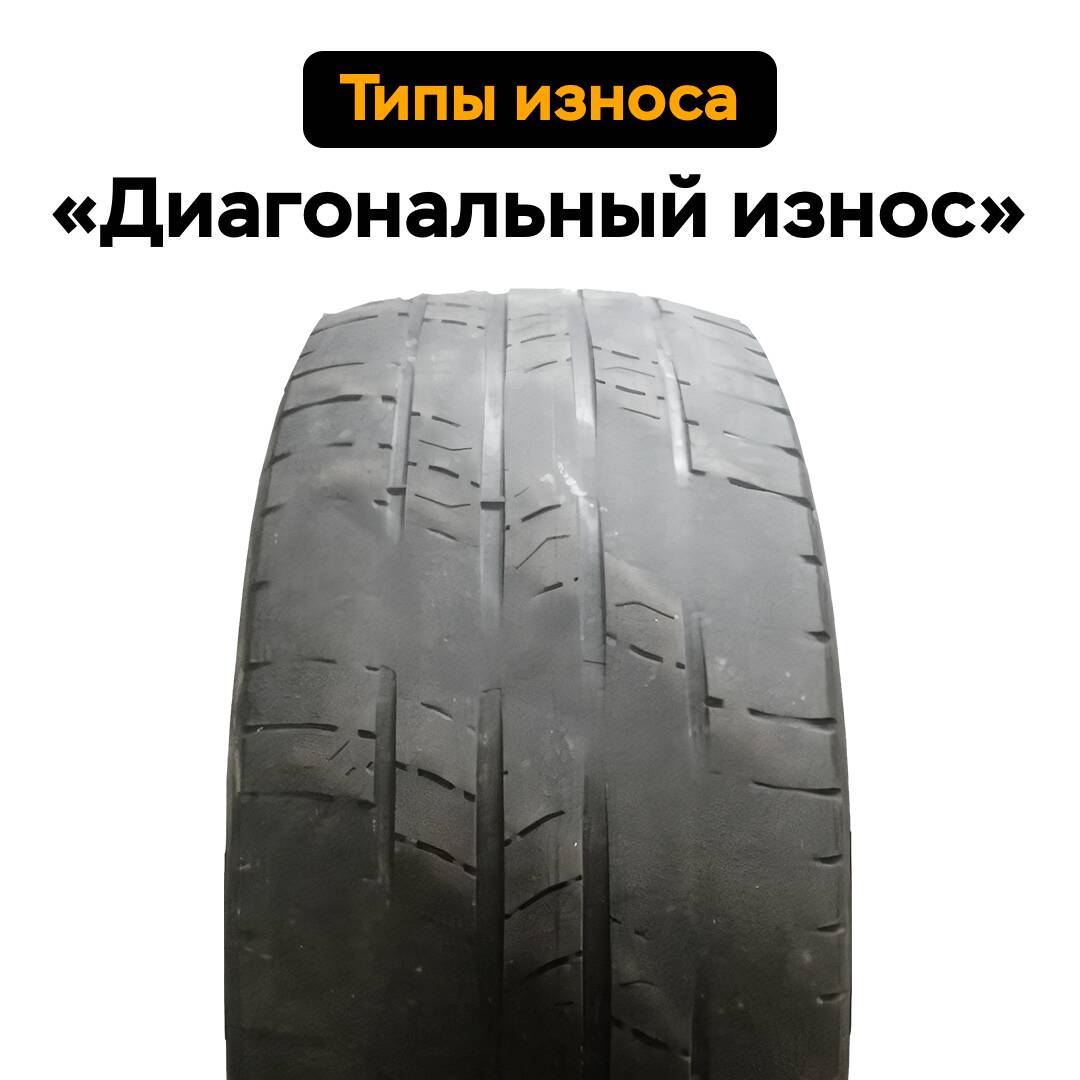
Diagonal tread wear
All tire manufacturers build a resource into their product. It can be measured in thousands or tens of thousands of kilometers, depending on the segment and operating conditions. However, all efforts may be in vain if the tire fails prematurely. The cause can be a puncture, a sidewall cut, or one of the variants of uneven wear. We will break down each type of wear separately and share with you possible causes, as well as tell you how to operate the tires to avoid this.
In this article, we will discuss diagonal wear.
Diagonal wear is a intermittent wear at an angle across the entire surface and around the entire circumference of the tread. It is associated with incorrect wheel rotation during movement.
The wear pattern is usually the result of weakening or breakage of suspension components or a malfunction of the braking system. In this case, this type of wear is most often found on the rear axle of a front-wheel drive vehicle.
Wear can be exacerbated by regular operation of the tires without maintaining the recommended pressure.
It should be noted separately that if your tires have uneven diagonal wear, it is no longer possible to repair or rectify this.
How to avoid diagonal wear?
- Maintain the vehicle manufacturer's recommended tire pressure.
- Monitor and maintain the proper functioning of the suspension and braking system components.
- Perform regular tire rotation to redistribute wear.
- It is also not superfluous to conduct a tactile inspection of the tires, as a difference of 1 mm may not be immediately noticeable visually, but it can be felt by hand.