
-
 Enlarge
 Roadstone N6000
Description Roadstone N6000
The Roadstone N6000 tire is designed for operation during the summer period, predominantly for movement on highways with high-quality road surfaces. In this case, the manufacturer guarantees compliance with the declared technical characteristics of the model.
When designing the Roadstone N6000 tire, Korean tire manufacturers did not seek a compromise in pursuit of universality, and, in order not to burden themselves with research in the field of off-road driving, they took a sports direction as the basis of the concept. To the credit of the designers, they did their job at a qualitatively high level: traveling in a car with N6000 tires will bring a maximum of adrenaline from speed, while not at all compromising the feeling of comfort.
Symmetrically arranged tread elements actively suppress acoustic vibrations, and the noise level when driving on roads with high-quality surfaces does not cause discomfort.
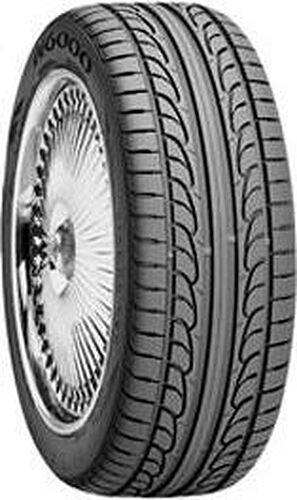
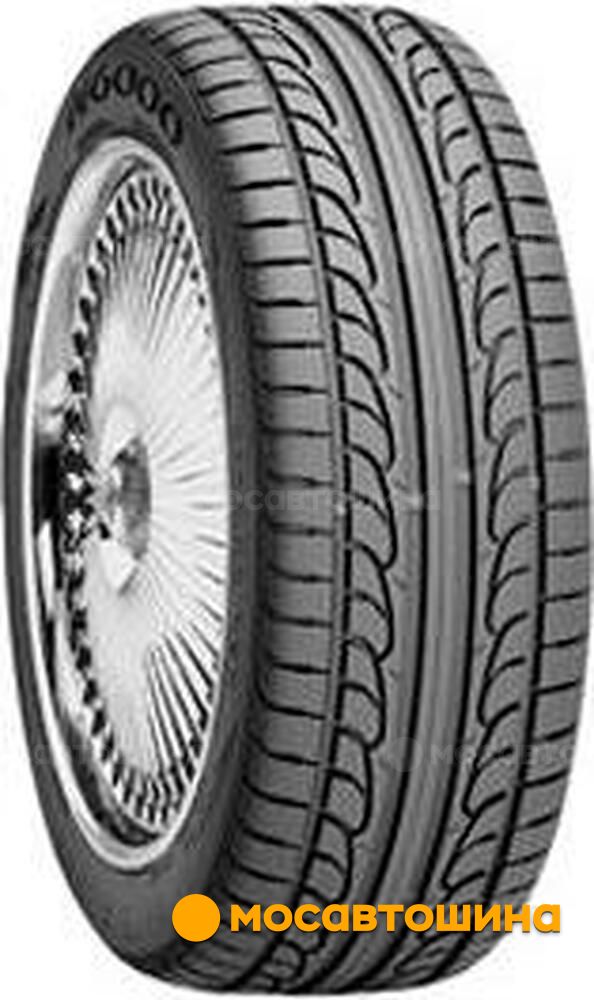
The tread design does not provide for a clear division into independent blocks and consists of several sections, some of which are segmented by hydrochannel cuts. In the center of the tire, there is a solid section designed for directional stability during straight-line movement.
The low-profile tread of the Roadstone N6000 and the large contact area provide reliable handling and traction characteristics, both in dry weather and when driving through wet sections.
The branched system of drainage channels promotes the rapid removal of moisture accumulations and self-cleaning from contaminants.
Among the advantages, one can also include the microporous structure of the rubber. This approach provides for obedient steering.
Tires of the N6000 model are classified according to the W index, which provides for a speed mode above 270 km/h.
The model range is represented in more than 30 sizes.
Main features of the Roadstone N6000 tire
- Specific use (summer tires for high-speed vehicles);
- Excellent speed characteristics and handling during straight-line movement, as well as on turns;
- Maximum dense contact with the road surface;
- High directional stability on sections with increased humidity;
- A branched system of drainage channels provides for the rapid removal of moisture and contaminants;
- Increased resistance to aquaplaning, which is very relevant at high speeds.