
-
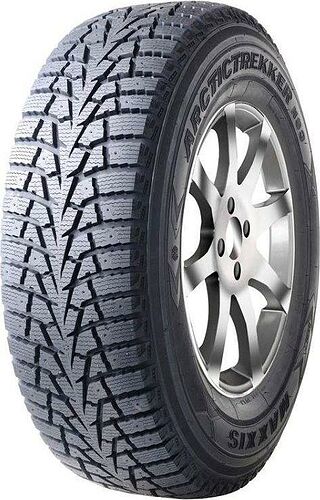 Enlarge
 Maxxis NS3

Description Maxxis NS3
The Maxxis NS-3 winter studded tire for SUVs is one of the novelties from the well-known Asian manufacturer. Domestic car owners are expected to be attracted not only by an attractive cost but also by high operational properties, ranging from excellent traction to a very long service life.
Shoulder zones with independent blocks
A significant part of the traction properties in unfavorable road conditions is ensured by the design of the shoulder zones. The design of each of them is a series of separate rectangular blocks. In combination with their transverse arrangement, it provides the tire with excellent traction and coupling properties in the longitudinal direction, and due to the massive size of the blocks, it provides stability during maneuvering and cornering.
"Winter" tread pattern
When creating this tire, the company's specialists certainly took into account the experience of their Scandinavian colleagues. The central part of the tread contains a wide, arrow-shaped rib of a continuous design with numerous "branches" on both sides. This feature gives the tire a number of important advantages. The main ones are controllability on snowy and icy surfaces, clear feedback when turning the steering wheel. Additionally, the rigid continuous structure of the longitudinal rib in the center reduces rolling resistance and optimizes the distribution of external pressure on the contact patch.
Another factor that determines the excellent traction properties of this tire on snowy and icy surfaces is the lamellas. These tread elements, due to their large number, form several thousand traction edges. At the same time, the three-dimensional structure of their walls ensures the fixation of the block shape, limiting its mobility. This feature additionally improves controllability on hard surfaces.
14-row stud arrangement
Another solution "borrowed" from Scandinavian tire manufacturers was the stud arrangement system. It involves a significant increase in the number of studs. Compliance with recently introduced European requirements for road impact is ensured by reducing their size. As a result, the tread of this tire has more than a hundred studs. During movement, they form 14 continuous "anti-skid chains". At the same time, 8 to 10 studs are constantly in the contact patch.
Reinforced carcass
Being a modified version of the "passenger" NP-3, this model differs from it only in the design of the carcass, namely the breaker, which has received several additional layers of nylon cord that extend to the sidewall of the tire. In combination with the seamless winding technology used in this case, it made it possible to improve several operational characteristics at once. First of all, these are the carrying capacity and the ability to withstand increased load from the large mass of modern crossovers and SUVs without any problems.
Compound created using FDSS technology
The compound used in the production of this tire's tread is characterized by its ability to maintain optimal elasticity over a very wide temperature range. This is ensured by the application of FDSS technology. Within its framework, high-dispersion silicon-containing components were added to the rubber mixture. They are distinguished by their ability to form strong bonds at the molecular level with other chemical compounds that are part of the compound, which makes it very homogeneous. This feature, in addition to excellent elasticity, gives the tire's traction properties good stability and reliability, which, in turn, has a positive effect on controllability.
Main features of the Maxxis NS-3 tire
- independent blocks in the shoulder zones improve stability during maneuvering, increase performance and efficiency during acceleration and braking, especially on slippery roads;
- the wide, arrow-shaped rib in the center increases directional stability, provides clear feedback, reduces rolling resistance, and prevents uneven wear;
- numerous lamellas, due to the three-dimensional structure of their walls, not only form several thousand additional traction edges but also improve controllability on hard surfaces by limiting block mobility;
- the increased number of studs in combination with the optimized stud arrangement system (14 continuous rows) ensures reliability and stability of behavior when driving on ice;
- the reinforced carcass design with an additional breaker layer increases the carrying capacity, strength, and also optimizes the load distribution parameters on the contact patch;
- high-dispersion silicon-containing components in the compound ensure an optimal level of tread elasticity over a very wide temperature range.