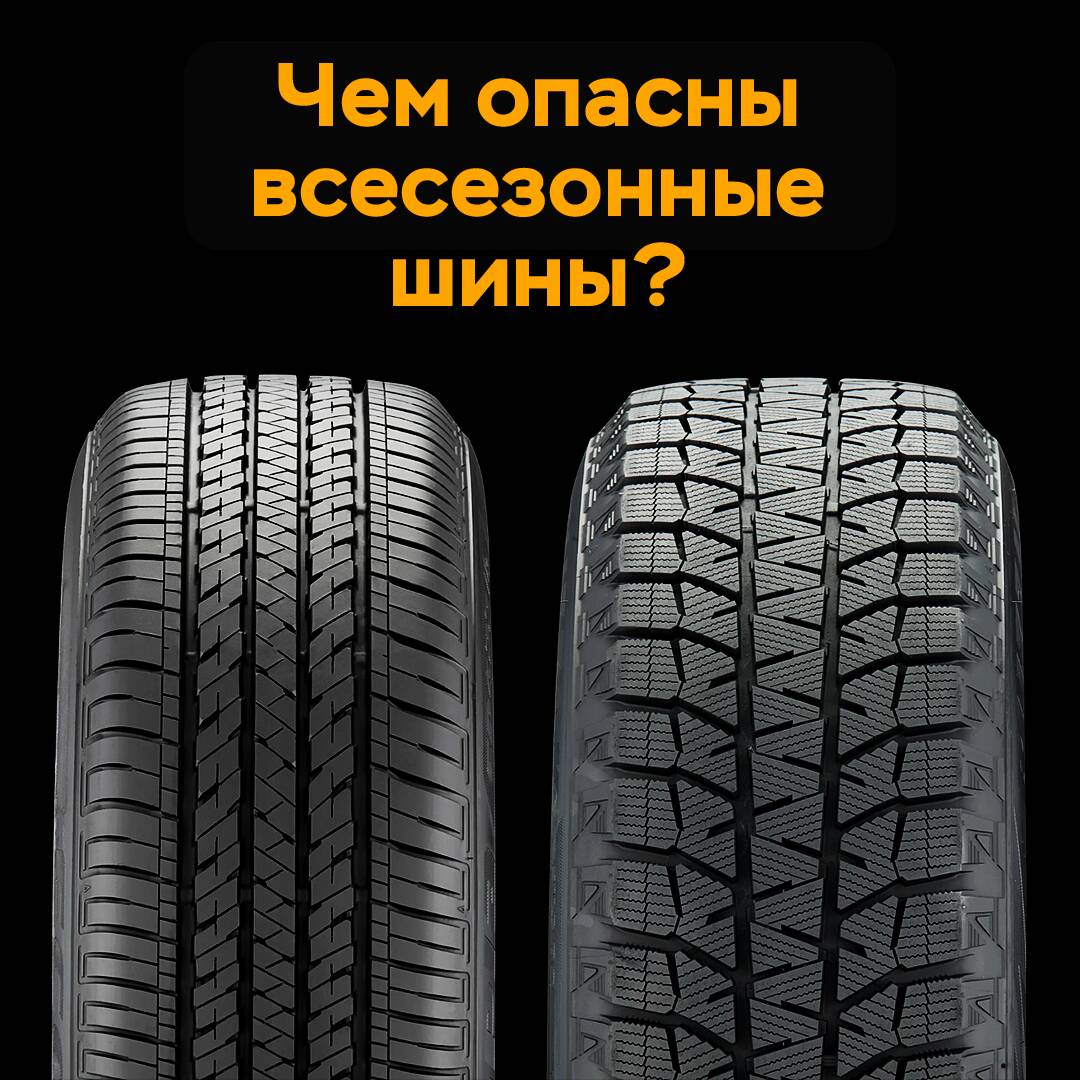
What are all-season tires dangerous for?
For most car owners, buying tires is a daunting task. Few people can truly appreciate the importance of this purchase. It's much more understandable to buy things like a multimedia system or an expensive alarm with auto-start, which you use constantly and enjoy. This can't be said about tires - you put them on and forget about them. That's why you can still find drivers who prefer all-season tires. And this is a big mistake.
We don't want to say that all-season tires are bad for everyone. There is an ideal period during the year for this type of tire, and we have written about it in detail in a separate article. However, it should be clearly understood that using all-season tires during the winter period in harsh winter conditions is dangerous. Many people don't even realize the catastrophic difference in characteristics on winter roads, comforting themselves with the name "all-season". Recently, the UTAC publication conducted an excellent test, demonstrating the characteristics of winter Nordic and all-season tires.
The test was conducted at a comfortable urban speed of 50 km/h. Both studded and non-studded tires were compared. Let's compare the braking on ice for all types of tires. We can take the strongest studded tires, the weakest studded tires, and a non-studded model as examples.
Nokian Hakkapeliitta 10 - 30.8 m
Antares Grip 60 Ice - 51.8 m
Continental VikingContact 7 - 46.1 m
Continental AllSeasonContact - 78.4 m
The braking distance of all-season tires is 48 meters longer than the leader and 27 meters longer than the weakest tire. It's also important to understand that if you find yourself on an intercity highway, where speed limits are higher and the formation of ice is more likely, the braking distance can increase by 2-3 times. A braking distance of 150 meters or more is simply incompatible with safety. In essence, this is a guaranteed accident with serious consequences. Never install all-season tires in harsh winter conditions.